At a Glance
The shape of the event
- Date
- 1522 CE
- Place
- Seville
- Type
- Voyage
The surviving ship of Magellan's expedition returned to Spain after the first circumnavigation of the globe, proving the scale of oceanic connection.
1522 CE; place the event in Seville before comparing causes or consequences.
Circumnavigation changed European geographical knowledge and intensified competition over routes, spices, and oceanic power.
Ferdinand Magellan / Juan Sebastian Elcano are the first names or groups to compare before widening the story.
The voyage demonstrated global maritime possibility while revealing immense human cost and logistical difficulty.
The voyage demonstrated global maritime possibility while revealing immense human cost and logistical difficulty.
Circumnavigation changed European geographical knowledge and intensified competition over routes, spices, and oceanic power.
Continue to Columbus, the Treaty of Tordesillas, Manila, the Columbian Exchange, and Indian Ocean trade.
Background
By the early sixteenth century, a web of pressures drove longer, riskier voyages: European demand for spices and exotic goods, the desire to reach wealthy markets without intermediaries, advancing seamanship and navigational knowledge, and the political imperative to secure maritime advantage. Ports such as Seville were already nodes in expanding commercial networks; financiers, shipowners, and crown officials watched closely for any breakthrough that would shift profits or prestige. Exploration was both individual drama and a response to systemic forces—competition for trade, the limits of land routes, and the lure of untapped markets. At the same time, the material realities of long ocean voyages—food, fresh water, ship maintenance, unpredictable winds and currents—made success a precarious achievement.
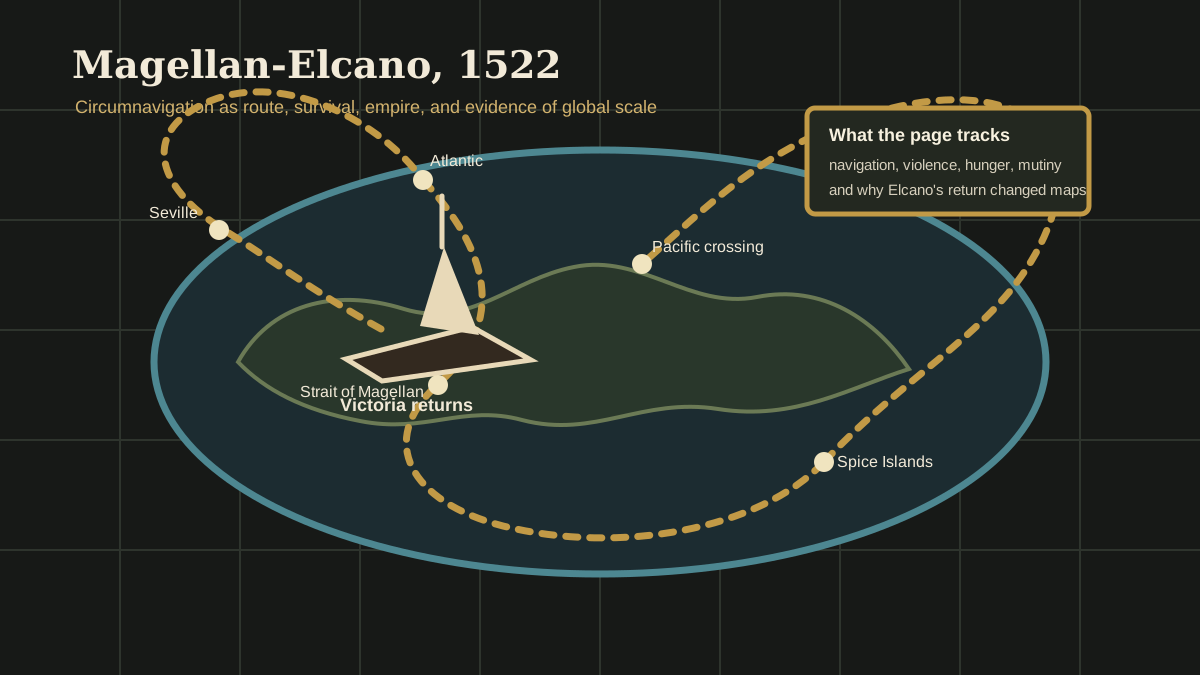
Historians disagree over how much to credit bold captains or the broader economic and institutional context. This account keeps that dispute visible: one voyage can look like the triumph of leadership or the inevitable outcome of deeper commercial and technological pressures. Both perspectives matter for understanding why the return to Seville resonated so strongly. The return of the Victoria in 1522 was a triumph of survival, navigation, and imperial ambition, not a simple adventure story. Ferdinand Magellan had died in the Philippines, many crew members were lost, and Juan Sebastian Elcano commanded the surviving ship back to Spain.
The voyage exposed the scale of the Pacific, the danger of provisioning across unknown waters, and the violence of European intervention in local politics. It also showed how spice trade ambitions could push ships into a global circuit.
The Turning Point
What changed in 1522 was not only a ship’s arrival but the conversion of speculation into demonstrable fact. Before that return, distant seas had been imagined as potential links; the surviving vessel made them undeniable. The expedition is associated with names we still cite—Ferdinand Magellan and Juan Sebastián Elcano—figures who appear in contemporary and later accounts as central actors in the enterprise. The decisive choices that mattered were the repeated judgments made at sea: whether to press westward, how to ration scant supplies, when to search for landfall and when to attempt a homeward course. The fact that one hull completed a global loop forced new thinking about navigational range, provisioning, and command under crisis.
It also exposed the limits of what a small fleet could sustain: the voyage proved possibility but also revealed how fragile long-distance maritime projects were when faced with human exhaustion, scurvy, storms, and logistical failure. Interpretations vary: some emphasize the agency of bold captains who pushed boundaries; others stress the structural momentum of demand for spice and market access that made such risks almost inevitable. The turning point was not only the ship's arrival in Seville, but the proof that one connected oceanic route could circle the earth. That proof mattered for maps, empire, commerce, and imagination.
The voyage confirmed that the globe was navigable in practice, while also revealing that navigation depended on coercive encounters, fragile crews, indigenous knowledge, and uncertain diplomacy. Circumnavigation became a European claim to global reach, but the route passed through worlds that Europeans did not control. The return of the Victoria is the hinge of the story. Magellan had died at Mactan in the Philippines, and Juan Sebastian Elcano commanded the battered survivors who reached Spain in 1522. Only a small remnant of the original expedition came back, but their logbooks, cargo, and testimony made the voyage legible to European courts and merchants.
The achievement therefore belongs to navigation, coercion, encounter, hunger, death, and accounting, not to a clean triumphal line drawn around the globe.
Consequences
In the near term, the returning ship altered how European planners, merchants, and naval patrons judged oceanic opportunity. The voyage offered empirical evidence that global circumnavigation was feasible, which in turn intensified interest in securing sea lanes, claiming profitable island stops, and investing in oceangoing fleets. It also laid bare the immense human and logistical costs of such enterprises—loss, suffering, and the fragility of supply lines—making clear that any gain came with steep sacrifice. Over the longer term, the circumnavigation reshaped cartography and maritime doctrine: maps and pilot guides were revised to reflect new possibilities, and commanders increasingly treated the ocean as a theatre for commercial and imperial competition.
The event fed an acceleration in global exchange—of goods, people, ideas, and pathogens—that remade distant societies and economies. Yet the story resists a single lesson. Some historians treat the voyage as proof of individual daring; others see it as one outcome of broader shifts in technology, finance, and state ambition. Keeping those tensions visible helps explain why the circumnavigation mattered in both immediate and enduring ways. The expedition changed geographic knowledge and intensified competition over oceanic routes, spices, and imperial claims. It helped make the Pacific visible to European mapmakers, though not yet easily governable. The human cost complicates any celebration: mutiny, hunger, disease, combat, and forced encounter shaped the voyage as much as instruments and courage.
The event therefore belongs to the history of globalization, but also to the history of violence and misunderstanding that accompanied early modern expansion. The voyage changed maps without making the world newly empty. The expedition moved through waters, islands, and ports already known to local pilots, rulers, traders, and communities. Its importance lies in the new Spanish-European proof of a westward route to Asian spice markets, the brutal costs of oceanic distance, and the imperial habit of turning encounters into claims.
Interpretation Notes
Calling the voyage Magellan's circumnavigation can hide the fact that Magellan died in the Philippines and Juan Sebastian Elcano brought the Victoria home. The debate is how to balance navigation, violence, local encounters, spice economics, and the small survivor record.
Why Keep Reading
Continue to Columbus, the Treaty of Tordesillas, Manila, the Columbian Exchange, and Indian Ocean trade. Reading those pages together keeps the circumnavigation from becoming a lone adventure story and shows how route knowledge, violence, commerce, and empire remade global connections.
Reading Path
Follow the story without losing the thread
Before This
- Fall of the Aztec Empire1521 CE
- Protestant Reformation Begins1517 CE
- Vasco da Gama Reaches India1498 CE
After This
- Scientific Revolution Begins1543 CE
- Council of Trent1545-1563
- Battle of LepantoOctober 7, 1571
Same Period
Wider Timeline
Mind Map
How to think about Magellan Expedition Circumnavigates the Globe
spice demand
European appetite for spices and luxury goods created economic pressure to find direct maritime routes
Map Layer
Where this event sits geographically
Gold pins mark the approximate locations of published event pages. This is a schematic locator map, not a historical border map.
Coordinates are approximate and are used to help readers orient themselves before opening a full event page.
References
Where to Check the Facts
- Library of Congress: U.S. History Primary Source TimelinePrimary-source timeline reference for Atlantic settlement, colonial expansion, reform, and later U.S. history paths.
- Encyclopaedia BritannicaBackground reference for chronology, names, and historical context.
- WikidataStructured reference for dates, places, alternate names, and entity links.