At a Glance
The shape of the event
- Date
- 1968
- Place
- Prague
- Type
- Reform Movement
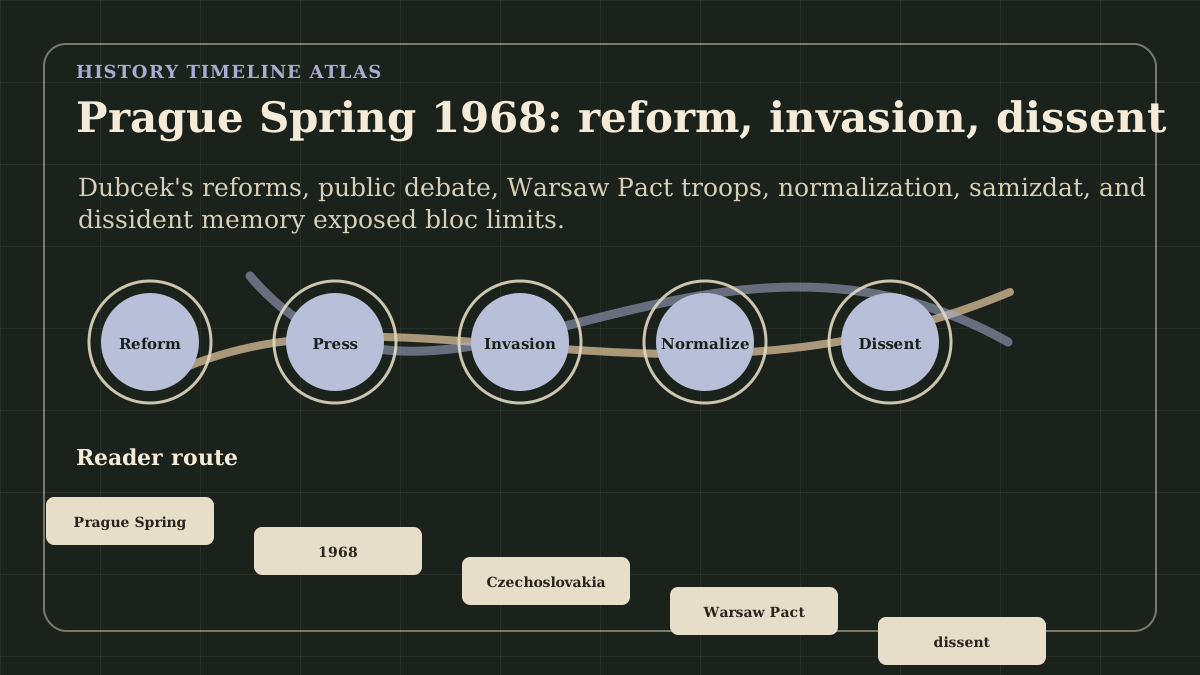
Czechoslovak reformers attempted to liberalize socialism during the Prague Spring before Warsaw Pact forces invaded to stop the movement.
1968; place the event in Prague before comparing causes or consequences.
The crisis exposed the limits of reform inside the Soviet sphere and influenced later dissident movements.
Alexander Dubcek are the first names or groups to compare before widening the story.
The invasion ended the reform period and restored tighter Soviet-bloc control.
The invasion ended the reform period and restored tighter Soviet-bloc control.
The crisis exposed the limits of reform inside the Soviet sphere and influenced later dissident movements.
Prague Spring links directly to the larger narrative of Cold War Europe: the balance between domestic reform and alliance discipline, the ways ideas of liberty circulated inside authoritarian systems, and how memory o...
Background
After World War II Czechoslovakia became one of the Soviet bloc states governed by communist parties aligned to Moscow. By the 1960s economic difficulties, bureaucratic stagnation and cultural restlessness had created pressure for change across the bloc. Intellectuals, students, and some party officials in Czechoslovakia argued that socialism could be made more responsive, creative, and humane without abandoning its underlying principles. That argument found an unusually visible champion in Alexander Dubcek, who rose to party leadership in 1968 and embraced reforms that promised freer speech, loosened press controls, and a relaxation of centralised rule.
Those reforms unfolded inside a Cold War matrix: NATO and the Western powers watched anxiously, while the Soviet Union and allied governments weighed the implications of allowing one of their own states to diverge. Multiple pressures—domestic demand for renewal, institutional inertia within the party, and the geopolitical logic of the Soviet bloc—converged in Prague. Scholars note that no single cause explains what happened next; rather, a mix of local decisions and systemic constraints set the scene for the confrontation that would follow. Prague Spring should be read as a reform movement inside socialism, not simply as a wish to copy the West.
Alexander Dubcek and other Czechoslovak reformers tried to loosen censorship, widen public debate, decentralize parts of economic life, and give socialism a more human face. The movement mattered because it tested whether a Warsaw Pact state could reform without leaving the Soviet bloc. The public sphere gives the event its energy. Newspapers, writers, students, workers, party officials, radio broadcasters, economists, Slovak concerns, Czech reform traditions, and ordinary conversations made politics visible. Reform was not only an elite document; it became something people could read, discuss, and push beyond the limits leaders intended. The Soviet and Warsaw Pact perspective also belongs in the frame.
Moscow feared that reform in Prague could weaken one-party rule, loosen alliance discipline, and encourage other Eastern bloc societies. That fear turned a domestic reform experiment into a bloc-wide security question.
The Turning Point
The crucial change in 1968 was the shift from debate and tentative reform to armed intervention by Warsaw Pact forces. Czechoslovak reformers, led by Alexander Dubcek and colleagues, pursued policies that opened public debate, relaxed censorship and sought to decentralise some aspects of economic and political life. Those choices created visible momentum and a public sense that change was possible inside socialism. Confronted with the prospect of a member state departing from Moscow’s expectations, Soviet leaders and their allies faced a decision: tolerate a degree of variation within the bloc or act to stop it. They chose the latter. Warsaw Pact armies crossed into Czechoslovakia to halt the reform experiment and to reassert a narrower interpretation of socialist governance.
The invasion shifted power from a contested domestic contest to an explicit demonstration of external force. What had been a domestic political opening became a geopolitical crisis; reformers’ hopes collided with alliance discipline. The immediate outcome was a rapid end to the policies that had given Prague its brief freedom, and a clear signal to other capitals about the limits of tolerated change within the Soviet sphere. The turning point was the Warsaw Pact invasion in August 1968. Tanks and troops showed that the limits of sovereignty inside the bloc were enforced by military power. Czechoslovak society resisted with radio broadcasts, signs, strikes, arguments, and refusal to normalize the occupation immediately, but the balance of force was clear.
A second turning point was normalization. Repression did not only arrive as dramatic violence; it came through purges, censorship, career pressure, surveillance, and the slow narrowing of what could be said in public. That quieter aftermath helps readers see why 1968 became a memory of both hope and constraint.
Consequences
In the near term the invasion ended the reform period and restored tighter Soviet-bloc control over Czechoslovakia. Reforms were rolled back; party structures were reasserted and the public face of politics narrowed again. For individuals who had spoken, organised, or hoped for change, the immediate aftermath meant disillusionment, suppression of initiatives, and a renewed emphasis on conformity. In the longer term the crisis did not simply erase its lessons. The Prague Spring exposed how constrained political life was inside the Soviet system and demonstrated the costs of attempting to liberalise from within that system. Those lessons travelled—both as a warning and as inspiration—for later dissident movements across the region.
Activists and intellectuals drew on the memory of 1968 to argue for alternative paths to freedom in subsequent decades. Interpretations of these consequences vary: some historians stress the decisive role of external military choice, others point to internal structural limits that made reform fragile. This page keeps those disputes visible—acknowledging that the invasion was both a product of specific choices and of broader institutional pressures shaping the Soviet bloc. The immediate consequence was the end of the reform period and the reassertion of Soviet bloc discipline. The longer consequence was the growth of dissident memory. Charter 77, samizdat culture, exile writing, and later 1989 politics all carried lessons from the failed reform. Prague Spring also matters for Cold War comparison.
Unlike Hungary 1956, it began as reform from within a communist party. Unlike 1989, it did not bring regime collapse. Its significance lies in the middle: it exposed the contradiction between reform language and imperial discipline.
Interpretation Notes
Prague Spring can look simple when reduced to one date, but the evidence usually points to a wider setting. The useful debate is which part mattered most: leadership, logistics, belief, social pressure, or the institutions that survived afterward.
Why Keep Reading
Prague Spring links directly to the larger narrative of Cold War Europe: the balance between domestic reform and alliance discipline, the ways ideas of liberty circulated inside authoritarian systems, and how memory of suppressed uprisings shaped later opposition. Read next to trace how other states in the Soviet orbit reacted to demands for change, to follow the trajectories of dissident networks that referenced 1968, and to see how Warsaw Pact politics regulated the permissible margins of debate. If you want to understand why a reform movement in one capital mattered for two superpowers, follow the related timelines that connect Prague to wider Cold War decisions and to the later waves of challenge across the region.
Read Prague Spring beside the Hungarian Revolution, Warsaw Pact, Helsinki Final Act, Solidarity, and the fall of the Berlin Wall. That path shows how reform, repression, dissent, and written rights claims accumulated across Eastern Europe.
Reading Path
Follow the story without losing the thread
Before This
- ASEAN FoundedAugust 8, 1967
- Vietnam War Escalation1965
- Partial Nuclear Test Ban TreatyAugust 5, 1963
After This
- Apollo 11 Moon LandingJuly 20, 1969
- ARPANET Connection1969 CE
- SALT I and Detente1972
Same Period
- Cuban Missile CrisisOctober 1962
- Apollo 11 Moon LandingJuly 20, 1969
- Fall of the Berlin WallNovember 9, 1989
Wider Timeline
Mind Map
How to think about Prague Spring
economic stagnation
Domestic economic difficulties and bureaucratic rigidity that fed calls for reform
Map Layer
Where this event sits geographically
Gold pins mark the approximate locations of published event pages. This is a schematic locator map, not a historical border map.
Coordinates are approximate and are used to help readers orient themselves before opening a full event page.
References
Where to Check the Facts
- U.S. National Archives: The Cold WarArchive reference hub for Cold War records, federal documentation, and research guidance.
- Office of the Historian: The Early Cold War, 1945-1952Official diplomatic history reference for early Cold War foreign-policy context.