Central Question
What changes when classical history is read as a long transformation of empires, religions, cities, and frontiers rather than as a simple fall of Rome?
Start With These Dates
- 331 BCEBattle of Gaugamela
Alexander the Great defeated Darius III at Gaugamela, breaking Persian imperial power and opening the way to Macedonian control over the empire.
- 27 BCEFounding of the Roman Empire
Octavian accepted the title Augustus and reorganized Roman power around a new imperial settlement that preserved republican language while concentrating authority.
- c. 30 CEKushan Empire Rises
The Kushan ruling line emerged from Yuezhi groups in Bactria and built a state linking Central Asia, northern India, and long-distance trade routes.
- 313 CEEdict of Milan
The Edict of Milan recognized religious toleration for Christians within the Roman Empire, changing the relationship between imperial power and Christianity.
- 325 CECouncil of Nicaea
Bishops gathered at Nicaea under Constantine to address doctrinal disputes and define shared Christian teaching within an imperial setting.
- 541 CEPlague of Justinian
A devastating plague struck the Byzantine world during Justinian's reign, spreading through connected trade and urban networks.
- c. 610 CEBeginning of Muhammad's Revelations
Islamic tradition places the first revelations to Muhammad near Mecca, beginning a religious movement that would transform Arabia and much of the wider world.
Sources Used Here
- The Metropolitan Museum of Art: Byzantium and Late Antiquity
Reference for late antique art, religion, imperial transition, and Mediterranean continuity.
- Encyclopaedia Britannica: Late Antiquity
Broad reference for the late antique period and its political, religious, and cultural transitions.
Classical and Late Antique Worlds is designed as a route, not a folder. It gathers events that answer related reader questions about power, belief, conflict, exchange, institutions, and memory. The strongest way to read the page is to move from the earliest events toward the later ones, watching how one kind of pressure changes form across different places.
The route currently runs from 331 BCE to c. 610 CE. That span lets readers compare immediate turning points with slower consequences: the founding of institutions, the spread of ideas, the shock of war or disease, and the way later societies reused earlier events as warnings, models, or symbols.
Start with Battle of Gaugamela, Founding of the Roman Empire, Kushan Empire Rises, Edict of Milan, Gupta Empire Rises and then follow the internal links into people, timelines, years, maps, and source lists. The route structure stays visible when each event explains why it belongs with the others and where the next useful page is.
Compare the events by scale. Some are concentrated moments, such as a battle, proclamation, trial, or publication. Others are long processes, such as a reform movement, pandemic, trade route, or diplomatic order. Reading both types together helps prevent the page from becoming a list of dates.
A useful route keeps uncertainty visible. Historical change rarely has one cause or one clean ending, so the reader can separate background pressure, immediate trigger, turning point, result, and later memory. That pattern is what makes the atlas expandable without making the reader start over each time.
This route is also a comparison tool. After reading one event, compare it with a later event on the same page and ask what changed in scale, language, geography, technology, authority, or public memory. The comparison is often more useful than the individual summary because it reveals the pattern the topic page is built to expose. When a claim feels too neat, open the full event page and check whether the evidence supports one cause, several causes, or a contested interpretation before moving on.
Classical and late antique history is often taught as a handoff from Greece and Rome to medieval Europe, but that frame is too narrow. This hub treats the period as a long Afro-Eurasian transformation. Persian imperial habits, Hellenistic kingdoms, Roman law, Gupta and Kushan statecraft, Christian councils, Buddhist routes, Byzantine capitals, Sasanian rivalry, plague, and early Islam all belong to the same problem: how older imperial worlds changed without disappearing all at once.
The route begins before Rome becomes the whole story. Gaugamela shows a Macedonian conquest entering an already sophisticated Persian and Mesopotamian imperial landscape. The Seleucid, Kushan, Gupta, Roman, and Han-related pages then make the reader compare different answers to scale. Some rulers governed through roads and satrapies, some through commanderies, inscriptions, cities, coinage, or court patronage. The point is to see classical history as plural, not as one Mediterranean ladder.
Rome remains central, but it is read as a system under pressure rather than as a monument. The founding of the Roman Empire explains how republican crisis became imperial government. The Edict of Milan, Nicaea, and Constantinople show that the empire's religious and geographic center could move while imperial language survived. The fall of the western imperial office in 476 matters, but it is not the end of Roman power everywhere. It is one visible break inside a longer transformation.
Late antiquity is especially useful because it forces readers to separate collapse from conversion, migration, institutional survival, and memory. Armies crossed frontiers, but bishops, tax systems, cities, courts, legal habits, and diplomatic forms also changed the map. A route that only asks why Rome fell misses the more interesting question: which parts of older worlds were reused, translated, or fought over by later societies?
Religion belongs in the political story. Christianity's imperial turn did not simply replace Roman government with belief; it created new arguments over authority, doctrine, council decisions, bishops, emperors, and public loyalty. Buddhism moved through South and Central Asian networks in a different way, with monasteries, patronage, trade routes, and translation. Early Islam then opens another late antique transformation, beginning in Arabia but quickly changing the political map of western Asia and North Africa.
Geography keeps the route honest. Constantinople mattered because it sat between the Black Sea, Aegean, Balkans, Anatolia, and eastern Mediterranean routes. The Kushan world mattered because Central and South Asia were connected through trade, coinage, and religious movement. Gupta power belonged to South Asian regional politics, not to a Roman timeline. Late antiquity is easiest to understand when readers follow routes, cities, frontiers, and seas instead of memorizing dynasties in isolation.
Disease is part of the transformation too. Justinian's plague shows how microbes could affect tax capacity, military planning, urban life, and imperial ambition. It also reminds readers that late antique change was not only caused by emperors, invaders, or doctrines. Environmental and biological shocks could expose weaknesses that political narratives alone cannot explain.
The evidence changes across the hub. Inscriptions, coins, councils, chronicles, law codes, religious texts, archaeology, art, and later memory all preserve different voices. Elite sources often explain rulers and bishops more clearly than farmers, soldiers, women, migrants, enslaved people, or local communities. A good late antique route therefore asks what the record can show and which experiences require careful reconstruction.
Source families also change by region. Roman law codes and councils preserve imperial and ecclesiastical language; Persian and Armenian traditions preserve frontier memory differently; Sanskrit and Buddhist materials frame South Asian legitimacy through patronage, learning, and ritual; archaeology and coinage connect places that texts keep separate. The route becomes richer when readers notice that evidence is not evenly distributed across Afro-Eurasia.
Ordinary people make the transition more concrete. Soldiers on frontiers, taxpayers, tenant farmers, monks, bishops, merchants, enslaved workers, healers, scribes, caravan travelers, migrants, and families living through plague all experienced late antiquity as pressure on food, safety, belief, and obligation. That scale keeps the hub from becoming a debate among emperors and churchmen alone.
Law and cities are two continuity tests. Roman legal habits, municipal offices, bishoprics, tax registers, markets, walls, roads, and courts did not vanish at the same pace as dynasties. Some cities lost population or wealth; others gained strategic or religious importance. The route asks which institutions still solved problems after older imperial offices weakened, and which problems new rulers had to solve from scratch.
The Sasanian world is an important missing deepening path. Persia was not merely Rome's rival on the edge of the map. Sasanian court culture, Zoroastrian institutions, frontier war, Armenia, Mesopotamia, taxation, and diplomacy shaped the late antique setting in which Byzantium and early Islam emerged. Future pages on the Sasanian route will make the transition less Roman-centered and give readers a stronger western Asian frame.
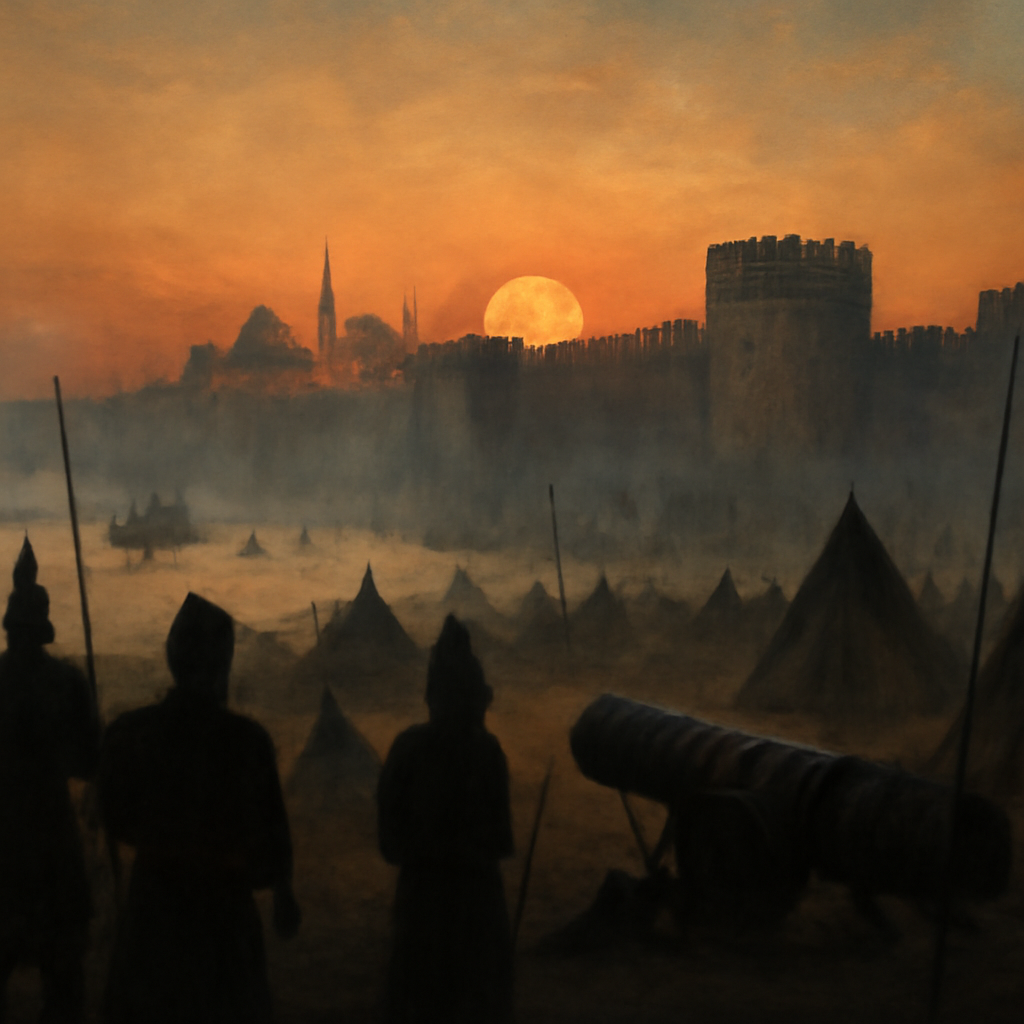
Visual material can clarify the topic when it shows transition rather than a single civilization. A city wall, coin, council scene, manuscript, church, fire temple, trade route, or Constantinople waterway can show institutions moving through time. A visual that only signals one tradition makes the route narrower than the text. The stronger image is one that helps readers see capital, route, belief, and memory crossing an old boundary.
A common misconception is that late antiquity is only decline. The route deliberately complicates that view. Some cities shrank while others gained importance. Some institutions weakened while churches, monasteries, courts, and armies took on new functions. Some communities lost security while others found new patrons or identities. Change was uneven, which is why the hub asks readers to compare regions instead of applying one verdict to all of Afro-Eurasia.
Another useful comparison is between political and cultural endings. A dynasty can lose power while its symbols survive. A language can remain prestigious after military control changes. A religious council can outlast the emperor who called it. Constantinople can preserve Roman claims while becoming the center of a different imperial geography. These afterlives are the reason a late antique hub belongs between ancient and medieval routes.
The page also prepares readers for Islamic history without treating Islam as an abrupt interruption. Arabia was connected to late antique trade, tribal politics, monotheist debates, imperial rivalries, and regional memory. The rise of Islam was new, but it emerged in a world already shaped by Rome, Persia, Christianity, Judaism, trade, and frontier politics.
For classroom reading, the hub gives a clean argument: late antiquity is a period of redistribution. Authority moved from older senates, temples, and imperial courts toward bishops, monasteries, frontier armies, new capitals, and new religious communities. Wealth, literacy, urban life, and military power did not vanish equally. They moved into new containers that later medieval and Islamic worlds would inherit.
The route also makes comparison possible without forcing sameness. Gupta India, Kushan Central Asia, Byzantine Constantinople, post-Roman western kingdoms, and early Islamic Arabia did not follow one script. They faced related questions about legitimacy, patronage, trade, law, and military survival. That shared problem, rather than a single civilization, is what holds the hub together.
This page is also a bridge. It helps readers move from the Ancient Empires cluster into medieval, Islamic, Byzantine, European, South Asian, and Central Asian routes without treating the transition as a blank space. The same event can point backward and forward: Nicaea points to Roman imperial politics and Christian doctrine; Constantinople points to Roman, Byzantine, Ottoman, and global trade histories; Badr points to a new community and a new imperial age.
The western Mediterranean should be read beside Africa and western Asia, not above them. North African cities, Egyptian grain routes, Syriac Christian communities, Armenian frontiers, Arabian trade, and Mesopotamian court cultures all shaped what late antiquity became. The route becomes much more accurate when Rome is one powerful node inside a larger Afro-Eurasian field rather than the only center from which change radiates.
Military history also needs a broader frame. Frontier armies, federate forces, cavalry systems, walls, forts, river crossings, and supply routes show that late antique states were constantly negotiating the price of defense. A battle can matter, but the daily burden of paying, feeding, recruiting, and settling soldiers often explains more about why institutions changed. War was not an interruption of government; it was one of the ways government was reorganized.
Economic life gives the transformation more texture. Coinage, taxation, rents, estates, market towns, grain supply, craft production, caravan traffic, and maritime routes connected elite politics to household survival. When tax systems weakened or shifted, the consequences reached soldiers, peasants, city councils, bishops, landlords, and merchants. This is why the hub treats fiscal history as a public story rather than a specialist footnote.
Language and translation are another deep structure. Greek, Latin, Syriac, Coptic, Armenian, Sanskrit, Prakrit, Middle Persian, and Arabic did not simply record events; they shaped which communities could argue, worship, govern, and remember. Translation carried scripture, law, science, diplomacy, and prestige across boundaries. A late antique route that follows languages can show continuity even when political maps appear broken.
Rural life deserves a stronger place because most people did not experience transformation from the viewpoint of capitals. Villages, estates, irrigation systems, tax collectors, local shrines, market days, military requisitions, and seasonal hunger shaped how large changes were felt. A bishop's letter or imperial law may be the surviving text, but the pressure behind it often came from food, labor, rent, and safety.
Material culture can slow the story down in a useful way. Pottery, lamps, seals, textiles, coins, burial goods, church mosaics, fortifications, and household objects show continuity and change where written narratives are silent. A coin hoard may reveal insecurity; a church floor may reveal patronage; a reused column may reveal both economy and memory. These traces make late antiquity visible below the level of famous rulers.
Women and family history are harder to see but essential. Marriage alliances, inheritance, household management, patronage, religious devotion, monastic life, childbirth, slavery, and widowhood connected private life to public order. Elite women sometimes appear as patrons or dynastic figures, while ordinary women often appear indirectly through law, burial, miracle stories, or economic records. Their uneven visibility is itself part of the evidence problem.
The route also benefits from comparing memory after the fact. Later Byzantine, Islamic, European, Persian, and nationalist histories each remembered late antiquity differently. Some saw it as decline, others as sacred foundation, imperial legitimacy, religious victory, or lost unity. The same event could become warning, inheritance, or origin myth depending on who needed the past to authorize the present.
The strongest next expansion would add Sasanian Persia, Armenia, Syriac Christianity, Aksum, post-Roman kingdoms, monastic networks, and the early Byzantine economy. Those additions would turn the hub from a Rome-centered transition page into a fuller atlas of Afro-Eurasian transformation, where courts, religions, languages, trade routes, and ordinary survival all share the frame.
The reader payoff is a better explanation of historical change. Civilizations rarely end cleanly. They fracture, move, rename themselves, borrow from enemies, sacralize old capitals, and turn defeats into memories. Classical and late antique worlds teach readers to watch transformation rather than hunt for a single final date.
Read the events in order first; the page is built to reveal change over time.
Ask which pressures existed before the visible turning point and which actors had room to choose.
Follow what changed afterward in institutions, borders, law, belief, or everyday life.
Notice which events became symbols and why later generations kept returning to them.
Ask what changed form, what survived, and what later societies reused from older imperial systems.
Read councils, conversions, patronage, doctrine, and pilgrimage as part of public authority, not only private belief.
Follow capitals, routes, and frontier zones from Rome to Constantinople, Central Asia, South Asia, and Arabia.
Compare chronicles, inscriptions, coins, law, art, and archaeology before accepting a simple fall-or-rise story.
Use walls, courts, taxes, bishoprics, markets, and legal habits to test what survived political rupture.
Read plague, taxation, frontier service, migration, food supply, and religious duty at the level of households and local communities.
Choose a Reading Path
Start With the Timeline
Use the related timeline first when you want a chronological route through the topic.
Start with 331 BCE: Battle of GaugamelaOpen a Person Page
Use people pages when the topic is easier to understand through leadership, resistance, reform, or memory.
Start with 27 BCE: Founding of the Roman EmpireUse Year Pages
Use year pages when you need a fast answer to what changed in a specific year.
Start with c. 30 CE: Kushan Empire RisesReturn to the Map
Use the map to keep geography visible while moving between events and regions.
Start with 313 CE: Edict of MilanRome Route
Start with Augustus, Milan, Nicaea, Constantinople, 476, and Justinian's plague to see Roman continuity and rupture.
Start with 325 CE: Council of NicaeaAsian Route
Use Kushan and Gupta pages to keep South and Central Asia inside the late antique world.
Start with 541 CE: Plague of JustinianReligion Route
Move from Nicaea to early Islam when the question is how belief becomes institution, law, conflict, and memory.
Start with c. 610 CE: Beginning of Muhammad's RevelationsTransition Route
Read this hub before medieval and Islamic pages so the change does not look like a sudden restart.
Evidence Route
Compare inscriptions, law codes, councils, coins, archaeology, and religious texts when the question is continuity.
City Route
Follow Rome, Constantinople, frontier towns, monasteries, and trade cities to see how public order moved into new containers.
How the Story Builds
Begin with Battle of Gaugamela. The opening event usually shows the pressure that made the route necessary: a crisis of authority, an expanding exchange system, a new technology, a contested idea, or a conflict that older institutions could no longer contain.
Council of Nicaea works as a checkpoint because it lets readers ask what had become irreversible, which actors still had choices, and how the route changed scale between the opening event and the later consequences.
The later edge of the route includes Fall of the Western Roman Empire, 476 AD: What Happened Next, Plague of Justinian, and Beginning of Muhammad's Revelations. These pages help readers see what survived beyond the first shock: institutions, borders, laws, memories, technologies, movements, or arguments that kept shaping later history.
The route is easier to remember through people and places. Watch figures such as Alexander the Great, Darius III, Augustus, Kujula Kadphises, Yuezhi groups, and Constantine the Great move through settings such as Gaugamela, Rome, Bactria, Milan, and Magadha; that is where large structures become visible as choices, risks, costs, and memories.
Persian, Hellenistic, Roman, Kushan, Gupta, and Han-related worlds give the route multiple models of classical order.
Milan and Nicaea show doctrine, patronage, and council decisions becoming part of imperial politics.
Constantinople, Central Asia, South Asia, and Arabia shift attention away from one western Mediterranean center.
476 and Justinian's plague reveal political, military, fiscal, and biological pressures working together.
Early Islam, Byzantium, post-Roman kingdoms, and Asian religious networks reused older institutions while creating new routes.
Coins, laws, chronicles, councils, buildings, and later memory show which old forms survived as symbols, habits, or institutions.
- Which event in Classical and Late Antique Worlds feels like the true point of no return, and why might another reader choose a different event?
- What changes if the route is read from the perspective of ordinary people rather than rulers, armies, inventors, reformers, or institutions?
- Which consequence was immediate, and which consequence only became clear decades later?
- Where does the map change the interpretation by showing distance, borders, routes, ports, capitals, or frontiers?
- Why is late antiquity more useful than a simple ancient-to-medieval handoff?
- Which Roman institutions survived the loss of western imperial officeholding?
- How do South and Central Asian examples change a Mediterranean-only story?
- When does religious change become political change?
- What kind of evidence best shows continuity rather than collapse?
- How would the route change if Sasanian Persia and Armenian frontier evidence stood closer to the center?
- Which experiences are least visible in elite sources: farmers, soldiers, women, enslaved people, migrants, or plague survivors?
Interactive Timeline
Follow Classical and Late Antique Worlds by sequence
Battle of Gaugamela
Alexander the Great defeated Darius III at Gaugamela, breaking Persian imperial power and opening the way to Macedonian control over the empire.
Read the full event pageMap Layer
Classical and Late Antique Worlds geography
Gold pins mark the approximate locations of published event pages. This is a schematic locator map, not a historical border map.
Coordinates are approximate and are used to help readers orient themselves before opening a full event page.
Route Events
Events in This Topic
Battle of Gaugamela
Alexander the Great defeated Darius III at Gaugamela, breaking Persian imperial power and opening the way to Macedonian control over the empire.
Founding of the Roman Empire
Octavian accepted the title Augustus and reorganized Roman power around a new imperial settlement that preserved republican language while concentrating authority.
Kushan Empire Rises
The Kushan ruling line emerged from Yuezhi groups in Bactria and built a state linking Central Asia, northern India, and long-distance trade paths.
Edict of Milan
The Edict of Milan recognized religious toleration for Christians within the Roman Empire, changing the relationship between imperial power and Christianity.
Gupta Empire Rises
The Gupta dynasty rose in northern India, building a durable imperial order from the Ganges heartland.
Council of Nicaea
Bishops gathered at Nicaea under Constantine to address doctrinal disputes and define shared Christian teaching within an imperial setting.
Constantinople Founded
Constantine inaugurated Constantinople as a new imperial capital on the site of Byzantium, shifting Roman political gravity toward the eastern Mediterranean.
Fall of the Western Roman Empire, 476 AD: What Happened Next
In 476 AD, Odoacer deposed Romulus Augustulus in Ravenna. That is why 476 is used for the fall of the Western Roman Empire: the western Roman imperial office ended in Italy, while eastern Roman rule continued from Constantinople. Read the event with a west-east map distinction, then compare it with 330, Justinian, Charlemagne, and 1453.
Plague of Justinian
A devastating plague struck the Byzantine world during Justinian's reign, spreading through connected trade and urban networks.
Beginning of Muhammad's Revelations
Islamic tradition places the first revelations to Muhammad near Mecca, beginning a religious movement that would transform Arabia and much of the wider world.
References
Where to Check the Facts
- The Metropolitan Museum of Art: Byzantium and Late AntiquityReference for late antique art, religion, imperial transition, and Mediterranean continuity.
- Encyclopaedia Britannica: Late AntiquityBroad reference for the late antique period and its political, religious, and cultural transitions.