At a Glance
The shape of the event
- Date
- 1688 CE
- Place
- London
- Type
- Political Revolution
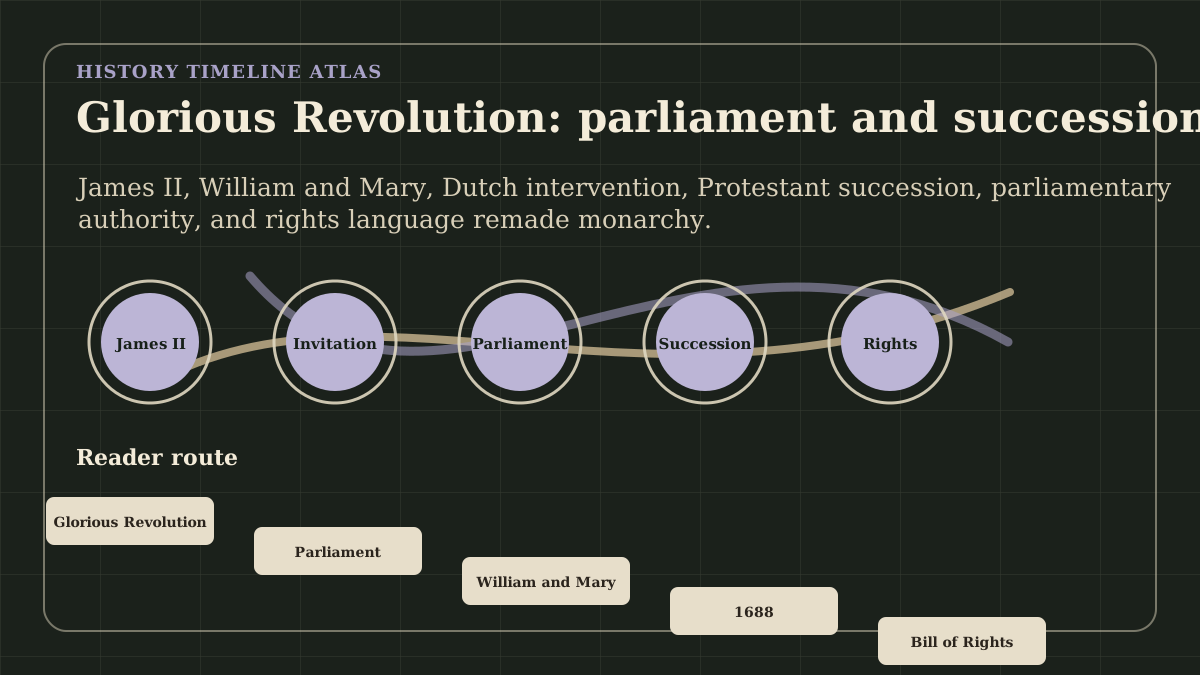
James II was replaced by William and Mary after elite opposition invited Dutch intervention, recasting the relationship between crown and Parliament.
1688 CE; place the event in London before comparing causes or consequences.
The revolution became central to British constitutional memory and the growth of parliamentary monarchy.
James II / William III / Mary II are the first names or groups to compare before widening the story.
The settlement affirmed parliamentary authority and Protestant succession.
The settlement affirmed parliamentary authority and Protestant succession.
The revolution became central to British constitutional memory and the growth of parliamentary monarchy.
Follow the subsequent timeline to see how the 1688 settlement was translated into law and practice: read about the parliamentary acts that formalised succession and limits on the crown; track how political parties and...
Background
By the late 1680s England carried several simmering tensions: a monarchy accustomed to strong prerogative; a Parliament increasingly assertive about laws, taxes and religion; and a Protestant public anxious about Catholic succession. James II’s reign crystallised those pressures. His policies and appointments alarmed political elites who feared a return to unchecked royal authority and a permanent Catholic dynasty. These anxieties were not uniform or simple: some opponents hoped to curb the king’s power while others sought more radical change. At the same time, continental politics made England a focus of wider strategic interest. Into this layered situation walked an invitation from elements of the English elite to a Dutch prince.
That invitation converted private elite dissent into an open constitutional crisis centered on who could claim legitimate rule, how religion would shape succession, and how far Parliament could assert its authority over the monarch. Historians debate whether the Revolution was driven by the choices of a few men or by longer structural shifts in politics and religion; this account keeps both kinds of explanation visible. The Glorious Revolution is more interesting when it is not reduced to a bloodless English transfer of power. It joined religion, dynastic succession, fear of absolutism, Dutch military intervention, parliamentary calculation, Scottish and Irish consequences, and a wider European war against Louis XIV's France.
James II's Catholicism mattered, but religion alone does not explain the crisis. Political trust collapsed because opponents believed the king was using standing army, officeholding, law, and royal prerogative to remake the kingdom's future. The birth of a male heir in 1688 made those fears dynastic rather than temporary. The event also needs a three-kingdom map. England, Scotland, and Ireland did not experience the settlement in the same way. What looked like constitutional balance in Westminster could look like war, dispossession, or confessional conflict elsewhere.
The Turning Point
The decisive shift of 1688 was not a single battlefield victory but a sequence of choices that emptied James II of effective support and placed William and Mary into power. Key political figures—members of the elite who distrusted James’s direction—invited Dutch intervention, turning elite resistance into an instrument of regime change. William’s arrival and the ensuing political maneuvers forced rival institutions to declare positions: Parliament, anxious merchants, and influential churchmen weighed allegiances against the risks of disorder or civil rupture. James II’s position weakened as political loyalty fractured; those who had formerly accepted royal prerogative now calculated that a new arrangement offered safer guarantees for Protestant succession and limits on arbitrary rule.
William and Mary accepted a settlement that framed their claim in terms that satisfied powerful parliamentary interests. The change was therefore both personal—the replacement of one monarch by another—and constitutional: it refocused authority through negotiated settlement rather than unilateral royal command. The contested character of these decisions leaves room for differing interpretations about how much was contingent on individual choices and how much flowed from deeper social and institutional pressures. The turning point was the invitation to William of Orange and James II's flight. Elite opponents converted constitutional anxiety into an international intervention, while William tied English politics to Dutch and European security against France. The settlement then turned crisis into language.
The Declaration of Right and Bill of Rights made claims about consent, law, taxation, arms, parliamentary freedom, and succession. The revolution's power came partly from replacing a disputed king and partly from giving later politicians a usable constitutional memory.
Consequences
In the near term the settlement that followed the Revolution established that crown and Parliament would operate under new constraints: the succession would be Protestant, and parliamentary authority—especially over law and finance—received clearer affirmation. These immediate outcomes altered who could exercise power in London and set political incentives that favored parliamentary negotiation over purely royal initiative. In the longer view, the Revolution became a touchstone in British constitutional memory. Later politicians and jurists invoked 1688 as justification for limiting monarchs and for a constitutional monarchy in which Parliament played the central role in governance. That influence shaped party politics, legal doctrine, and public expectations about religious settlement and the legitimacy of government.
Yet the Revolution’s legacy is not a single tidy lineage: historians continue to dispute whether it chiefly reflected elite bargaining, the pressures of religious conflict, or broader economic and social transformations. The event’s significance therefore lies as much in what it changed on the ground—succession, parliamentary authority—as in how future generations used it to explain and justify their own constitutional settlements. The consequence was a stronger parliamentary monarchy, not modern democracy. Power remained limited by property, gender, confession, empire, and social hierarchy. Still, the settlement altered how monarchs, ministers, and Parliament argued about legitimate rule. Its afterlife stretched into political thought, colonial argument, party conflict, and later histories of rights.
The label glorious can hide violence in Ireland and Scotland, so a careful reading holds constitutional memory and coercive consequences together.
Interpretation Notes
Glorious Revolution can look simple when reduced to one date, but the evidence usually points to a wider setting. The useful debate is which part mattered most: leadership, logistics, belief, social pressure, or the institutions that survived afterward.
Why Keep Reading
Follow the subsequent timeline to see how the 1688 settlement was translated into law and practice: read about the parliamentary acts that formalised succession and limits on the crown; track how political parties and public opinion evolved around those settlements; and compare this revolution to contemporaneous events on the continent to judge how English constitutional outcomes were distinctive. Each next step shows the slow, sometimes disputed process by which a single year became a constitutional precedent. Read the Glorious Revolution after the English Civil War and Restoration, then continue to the Bill of Rights, American Revolution, French Revolution, and parliamentary reform. The path follows how arguments about sovereignty moved from monarchy to legislatures and wider rights claims.
Reading Path
Follow the story without losing the thread
Before This
- Newton Publishes Principia1687 CE
- Peace of Westphalia1648 CE
- English Civil War Begins1642 CE
After This
No direct path yet.
Same Period
Wider Timeline
No curated timeline yet.
Mind Map
How to think about Glorious Revolution
elite invitation
English political elites invited Dutch intervention, turning private opposition into open regime change
Map Layer
Where this event sits geographically
Gold pins mark the approximate locations of published event pages. This is a schematic locator map, not a historical border map.
Coordinates are approximate and are used to help readers orient themselves before opening a full event page.
References
Where to Check the Facts
- Encyclopaedia Britannica: Glorious RevolutionSpecific reference for the 1688-1689 revolution, James II, William and Mary, Parliament, and the settlement.
- The National Archives: The Bill of RightsArchive education reference for the 1689 Bill of Rights and constitutional settlement after the Glorious Revolution.
- The National Archives: Magna CartaArchive education reference for Magna Carta, monarchy, rights language, and medieval political bargaining.