At a Glance
The shape of the event
- Date
- 691-692 CE
- Place
- Jerusalem
- Type
- Monumental construction
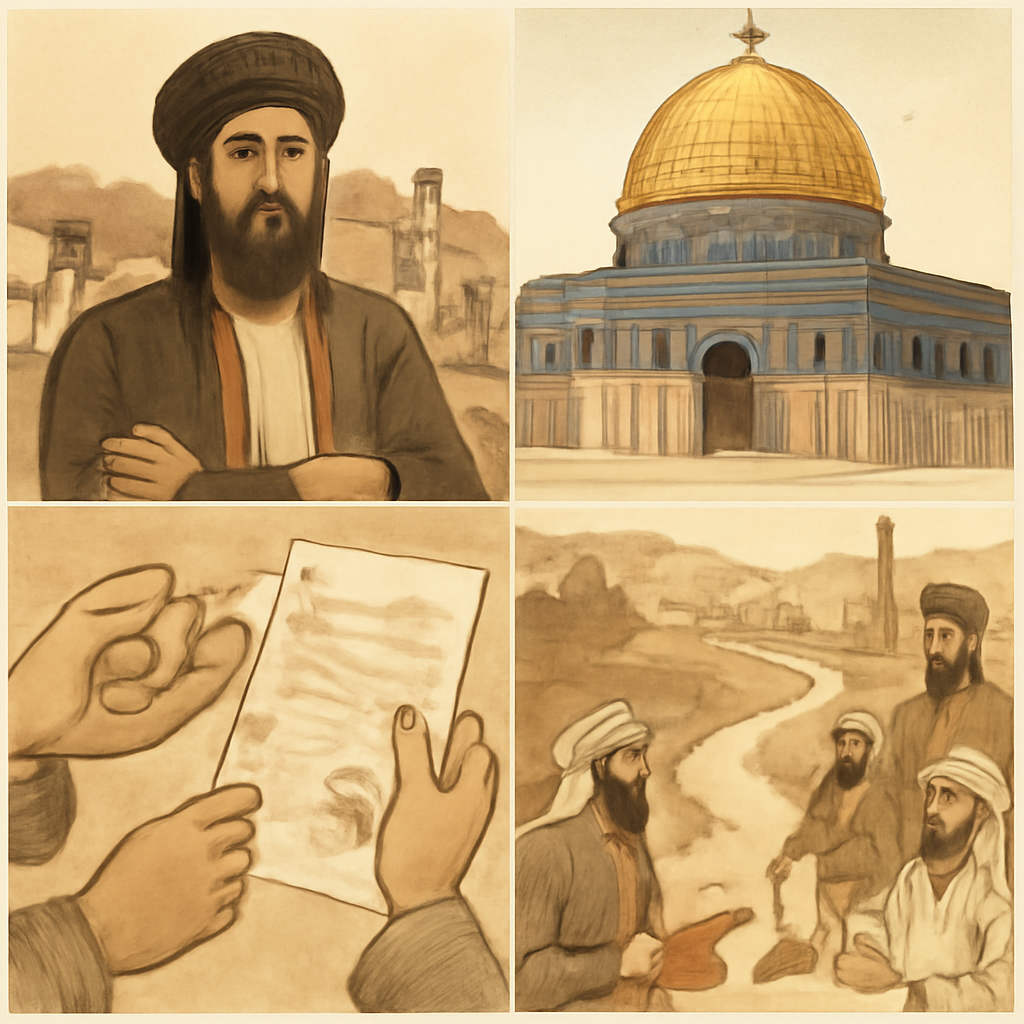
The Umayyad caliph Abd al-Malik completed the Dome of the Rock in Jerusalem, giving early Islamic rule a monumental architectural statement in a city of layered sacred history.
691-692 CE; place the event in Jerusalem before comparing causes or consequences.
It made Umayyad authority visible through stone, inscription, and sacred space, and it remains a key example of how religion, empire, and urban memory can meet in architecture.
Abd al-Malik are the first names or groups to compare before widening the story.
The monument became one of the earliest surviving major works of Islamic architecture.
The monument became one of the earliest surviving major works of Islamic architecture.
It made Umayyad authority visible through stone, inscription, and sacred space, and it remains a key example of how religion, empire, and urban memory can meet in architecture.
Follow the Dome of the Rock’s story forward and backward to see how one building links eras.
Background
Jerusalem in the late seventh century was a city of accumulated memories: Jewish, Christian and earlier Roman and Byzantine sacred landscapes overlapped in a compact urban core. The Umayyad Caliphate, newly established as a dynastic Islamic polity, faced the perennial problem of translating military and administrative control into enduring symbols of rule. Rulers across late antiquity and the early medieval Mediterranean used monumental architecture to project authority, codify religious identity and reorder urban topography. At the same time, a distinct visual language of Islamic art was emerging, drawing on local craftsmen, building traditions and available imagery.
Abd al-Malik’s completion of the Dome of the Rock took place against these pressures: a desire to mark Islamic rule in a city of layered sanctity, the need to speak to both local populations and distant audiences, and the practical realities of assembling labor, materials and skilled hands on a site already charged with earlier meanings. None of these pressures alone explains the project; together they shaped the choice to finish a monument that would be impossible to ignore. The Dome of the Rock deserves to be read as a monument inside a contested and sacred city, not as a decorative architectural milestone.
Jerusalem already carried Jewish and Christian sacred geographies, Byzantine memories, pilgrimage routes, and local communities before Abd al-Malik's building made Umayyad authority visible there. The structure also belongs to state formation. Inscriptions, mosaics, patronage, location, coinage reform, Arabic administration, and post-civil-war consolidation all help explain why a shrine could act as a public argument about legitimacy.
The Turning Point
The decisive change came when a political claim was fixed in stone and mosaic atop one of Jerusalem’s most symbolic points. Abd al-Malik—ruler of the Umayyad Caliphate—brought the project to completion in 691–692 CE, turning a program of patronage into a tangible presence on the city’s sacred plateau. That completion required concrete decisions: the selection and reuse of a prominent mount long associated with earlier sacred traditions; the allocation of resources to an ambitious octagonal structure crowned by a conspicuous dome; and the employment of skilled artisans who could translate emerging Islamic visual vocabulary into a monument that would be read by diverse viewers.
Those choices made the Dome of the Rock readable in several registers at once: as a devotional site, as an imperial statement, and as an architectural argument about what early Islamic rule could look and sound like. In short, the turning point was not the idea of building but the act of finishing—a deliberate conversion of political and religious intention into an enduring urban landmark. The turning point was the use of monumental space to make early Islamic rule legible. The building did not merely occupy a site; it organized memory, sightlines, script, sacred association, and caliphal authority into one public form.
Consequences
In the immediate aftermath, the Dome of the Rock established a new focal point for Islamic presence in Jerusalem. As an early surviving major work of Islamic architecture, it made Umayyad authority legible through stone, inscription and sacred space, providing a built complement to governance and ritual. The monument also altered the experience of Jerusalem for residents and pilgrims: it introduced a distinct Islamic landmark into a city where sacred geographies had long been contested and conjoined. Over the longue durée, the building has carried layered meanings.
Art historians prize it as one of the earliest major monuments in the developing corpus of Islamic architecture; historians of religion and politics read it as an argument about legitimacy, piety and public memory. That multiplicity of readings is itself consequential: the Dome’s meaning has been reinterpreted in different eras, becoming a point of contestation as Jerusalem’s political and religious landscapes shifted. Cautiously phrased, its completion did not settle questions about the city’s identity so much as provide a durable stage on which later debates—about art, sovereignty and sacred topography—would be played out. The afterlife runs through pilgrimage, restoration, interreligious memory, changing dynasties, modern politics, conservation, and arguments over how sacred places carry multiple histories at once.
The event matters because the building kept producing meaning long after construction ended.
Interpretation Notes
The monument's meaning is debated because it belongs simultaneously to art history, religious history, political legitimacy, and the later contested memory of Jerusalem.
Why Keep Reading
Follow the Dome of the Rock’s story forward and backward to see how one building links eras. Trace earlier uses of the mount to understand what was being reworked or superseded; then watch how later rulers, pilgrims and chroniclers reread Abd al-Malik’s statement across centuries of dynastic change, crusade and Ottoman rule. Each stage reveals a different angle: techniques of construction and decoration, the politics of urban memory, and the ways religious claims are made legible in stone. If you want to see how architecture can both memorialize and provoke, the Dome’s long career supplies a focused line of inquiry that leads into the broader histories of Islamic art, Jerusalem’s contested sacred geography, and the politics of visual authority.
Read this event with 637 Jerusalem, Abd al-Malik, the Umayyads, Karbala, the Crusades, and Ottoman Jerusalem. That route keeps sacred geography, architecture, and power connected.
Reading Path
Follow the story without losing the thread
Before This
- Battle of Karbala680 CE
- Umayyad Caliphate Founded661 CE
- Rashidun Conquest of Jerusalem637 CE
After This
Same Period
- Rashidun Conquest of Jerusalem637 CE
- Umayyad Caliphate Founded661 CE
- Battle of Karbala680 CE
Wider Timeline
Mind Map
How to think about Dome of the Rock Completed
Temple Mount choice
The selection of a platform long associated with earlier sacred traditions tied the new monument to existing memory and visibility
Map Layer
Where this event sits geographically
Gold pins mark the approximate locations of published event pages. This is a schematic locator map, not a historical border map.
Coordinates are approximate and are used to help readers orient themselves before opening a full event page.
References
Where to Check the Facts
- Encyclopaedia Britannica: Dome of the RockReference for the monument's patronage, date, architectural significance, and sacred location.
- The Metropolitan Museum of Art: Dome of the RockMuseum reference for early Islamic architecture, visual form, and Jerusalem setting.