Fast Answer
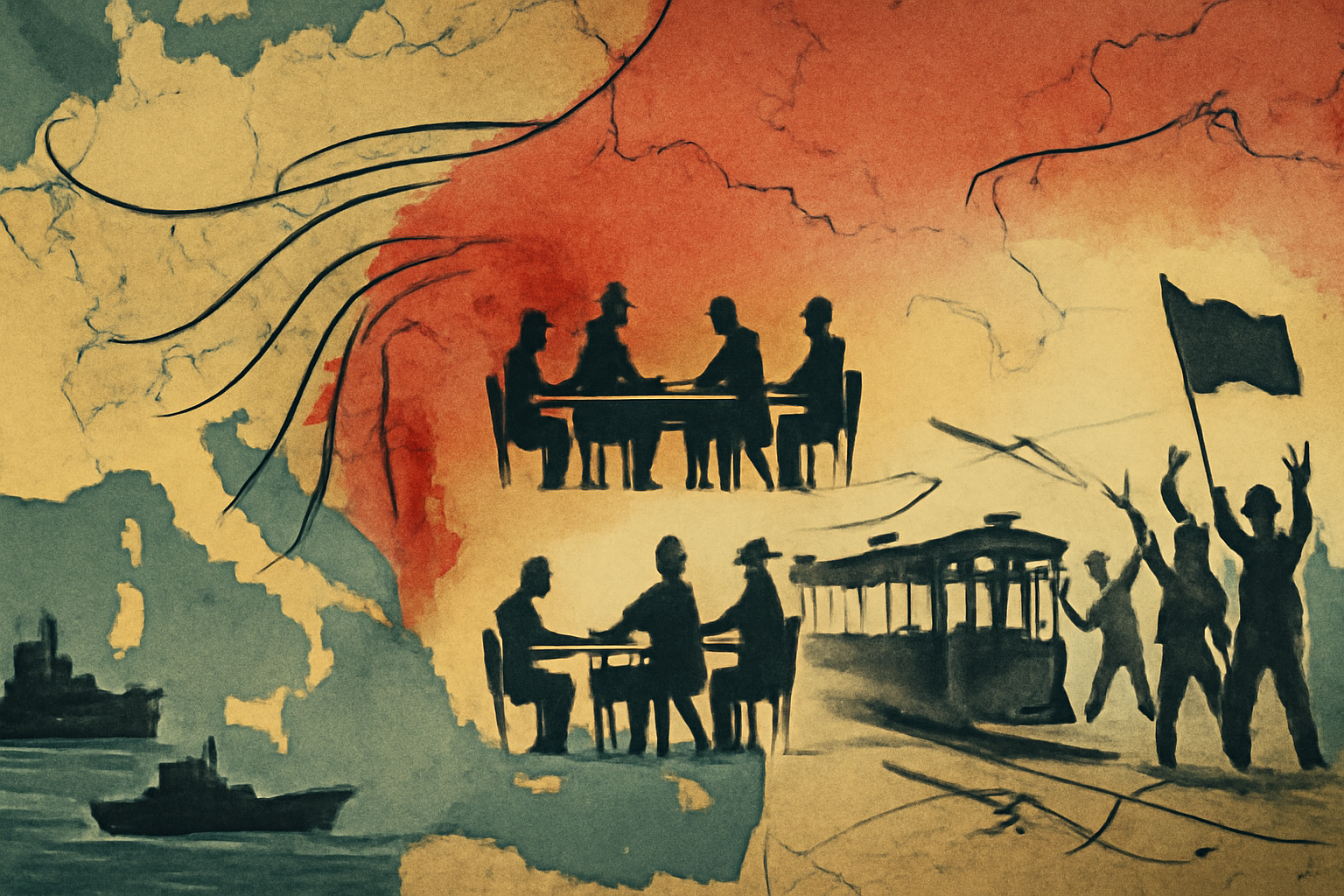
Suez Crisis and Cuban Missile Crisis both faced crisis management in a world where old empires, new states, and superpowers collided, but Suez exposed the weakness of British and French imperial power after Nasser nationalized the canal, while the Cuban Missile Crisis brought U.S.-Soviet nuclear confrontation to the edge of war. The fastest answer starts with that contrast, then adds geography: Suez turns on Egypt, the canal, Mediterranean shipping, Britain, France, Israel, and U.S.-Soviet pressure; Cuba turns on the Caribbean, U.S. security, Soviet missiles, Berlin memory, and global nuclear fear. The deeper answer keeps Egyptians, Cubans, soldiers, canal workers, diplomats, families under nuclear fear, and populations far from the negotiating room all lived inside the risks created by leaders visible so the comparison does not become only a story of rulers, armies, or abstract systems.
Suez Crisis and Cuban Missile Crisis become useful to compare when they are treated as answers to crisis management in a world where old empires, new states, and superpowers collided. The comparison is not a scoreboard; it separates shared pressures from different institutions, geographies, vocabularies of legitimacy, and afterlives.
Reading Paths
Choose a reading path
Suez Crisis vs Cuban Missile Crisis becomes clearer when the broad answer stays tied to sequence, place, and concrete next pages.
Follow the comparison through dated examples before returning to the grid.
Suez Crisis
The Suez Crisis followed Egypt's nationalization of the canal and a British, French, and Israeli attack that exposed the limits of old imperial power.
Bandung Conference
Asian and African leaders met at Bandung to discuss anti-colonial solidarity, racial equality, economic cooperation, sovereignty, and alternatives to Cold War bloc politics.
Truman Doctrine
President Harry Truman asked Congress to support Greece and Turkey, framing American policy around containing communist expansion.
Warsaw Pact Founded
The Soviet Union and allied eastern European governments formed the Warsaw Pact as a military alliance in response to Cold War security pressures.
Cuban Revolution Triumphs
Cuban revolutionaries overthrew Fulgencio Batista, creating a revolutionary government that soon became central to Cold War politics.
Comparison Grid
Suez Crisis
Suez Crisis faced crisis management in a world where old empires, new states, and superpowers collided through its own institutions and inherited expectations.
Cuban Missile Crisis
Cuban Missile Crisis faced the same broad problem through a different political, social, and geographic setting.
The shared question makes the comparison possible; the local setting prevents it from becoming flat.Suez Crisis
Suez Crisis becomes clearer when the map is read through routes, capitals, borders, and zones of contact.
Cuban Missile Crisis
Cuban Missile Crisis changes the map frame by emphasizing different corridors, centers, or frontiers.
Suez turns on Egypt, the canal, Mediterranean shipping, Britain, France, Israel, and U.S.-Soviet pressure; Cuba turns on the Caribbean, U.S. security, Soviet missiles, Berlin memory, and global nuclear fearSuez Crisis
Suez Crisis shaped people who rarely appear as the main title of the event.
Cuban Missile Crisis
Cuban Missile Crisis also depended on ordinary labor, coercion, negotiation, and memory.
Egyptians, Cubans, soldiers, canal workers, diplomats, families under nuclear fear, and populations far from the negotiating room all lived inside the risks created by leadersSuez Crisis
Suez Crisis left institutions and symbols that later people reused.
Cuban Missile Crisis
Cuban Missile Crisis produced its own afterlife through law, memory, identity, or opposition.
Suez became a marker of imperial decline and nonaligned assertion; Cuba became a symbol of nuclear brinkmanship, back-channel diplomacy, and the terror of miscalculationWhy the Comparison Matters
Suez Crisis and Cuban Missile Crisis are often named together because both look large on a map or central in a textbook sequence. That is only the entrance. The better comparison asks what problem each case tried to solve, which tools were available, and which costs were pushed onto people with less power. crisis management in a world where old empires, new states, and superpowers collided gives the two cases a shared frame without pretending they were the same.
Suez exposed the weakness of British and French imperial power after Nasser nationalized the canal, while the Cuban Missile Crisis brought U.S.-Soviet nuclear confrontation to the edge of war. That difference changes the whole interpretation. A date, battle, law, treaty, or reform may look similar at first glance, but it worked through different institutions and expectations. The comparison becomes richer when readers track offices, ports, courts, religious authorities, armies, labor systems, taxes, and local communities rather than only matching one famous leader against another.
The comparison also protects the atlas from a narrow regional habit. It lets a familiar search query open into a wider world-historical method: keep one question constant, then let the evidence remain local. The result is more useful than a list of similarities and differences because it explains why the similarities appeared and why the differences mattered.
Causes, Pressures, and Turning Points
both crises grew from regional decisions, superpower rivalry, public credibility, military planning, and the pressure to appear strong without losing control. Causes here are layered. Some pressures were slow: fiscal strain, social hierarchy, trade routes, land hunger, legal tradition, religious authority, or inherited political memory. Others became visible as triggers: a battle, a treaty, a revolt, a reform, a crisis of succession, or a diplomatic failure.
For Suez Crisis, the turning points reveal which institutions could absorb pressure and which could not. For Cuban Missile Crisis, the same question produces a different pattern because the political field, source record, and map were different. The strongest comparison keeps background pressure, immediate trigger, decision, and consequence in separate layers.
This separation matters for search intent as well as historical accuracy. A reader asking for causes usually needs more than a single origin story. The comparison shows how different causes can lead to apparently similar outcomes, and how similar pressures can produce different consequences when institutions, geography, and public memory diverge.
Geography and Institutions
Suez turns on Egypt, the canal, Mediterranean shipping, Britain, France, Israel, and U.S.-Soviet pressure; Cuba turns on the Caribbean, U.S. security, Soviet missiles, Berlin memory, and global nuclear fear. Geography is not scenery in this comparison. It decides which routes mattered, where armies or officials could move, which ports or capitals collected information, and which borderlands became pressure zones. A map changes the answer because it makes distance, environment, and connection visible.
Institutions turn that geography into durable behavior. Courts, charters, councils, fleets, land systems, tribute, parliaments, assemblies, religious offices, companies, schools, and armies all created habits that outlasted individual decisions. Suez Crisis and Cuban Missile Crisis differed most when those institutions translated ambition into ordinary practice.
The comparison therefore moves between scale and texture. Scale explains why the cases mattered across regions; texture explains how people experienced them locally. A capital city, a plantation, a frontier settlement, a treaty port, a courtroom, a village, and a battlefield each reveal a different part of the same historical structure.
People, Labor, and Affected Groups
Egyptians, Cubans, soldiers, canal workers, diplomats, families under nuclear fear, and populations far from the negotiating room all lived inside the risks created by leaders. This is the layer that prevents the comparison from becoming too clean. Power operated through workers, soldiers, enslaved people, migrants, merchants, officials, women in households and courts, religious communities, students, colonized subjects, and local elites who had to live with decisions made elsewhere.
The human scale also changes causation. People did not only suffer systems; they adapted, resisted, interpreted, collaborated, fled, petitioned, organized, and remembered. Their actions often forced institutions to change. A comparison that includes affected groups can explain both top-down command and bottom-up pressure.
That wider lens is especially important when later memory turns complex histories into simplified symbols. Some groups become visible in monuments and schoolbooks; others survive in court records, petitions, oral traditions, material culture, or the silences of archives. The comparison invites readers to ask who is easy to see and who requires more careful reconstruction.
Consequences and Memory
Suez became a marker of imperial decline and nonaligned assertion; Cuba became a symbol of nuclear brinkmanship, back-channel diplomacy, and the terror of miscalculation. Consequences did not stop when the main event sequence ended. Institutions, borders, categories of citizenship, racial systems, religious identities, economic habits, and political vocabulary often survived in altered forms. Memory then selected certain lessons and pushed others aside.
The afterlife of Suez Crisis may appear in law, identity, statecraft, monuments, political language, or public arguments. The afterlife of Cuban Missile Crisis may appear through different channels. The point is not to flatten both into the same legacy, but to ask which institutions and memories continued to organize later choices.
A useful comparison ends with unresolved questions. Which consequences were immediate, which were medium-term, and which became durable? Which groups gained language for new claims? Which injuries remained unaddressed? Which later movements reused the memory for purposes the original actors could not have predicted?
How to Read the Evidence Trail
The linked events give the comparison a route. Start with the earliest event to see the background pressure, then follow the turning points in chronological order. Each event page adds a map, actors, causes, consequences, sources, and reading questions that keep the comparison grounded in evidence rather than analogy alone.
The timeline links keep chronology visible. They show whether the comparison concerns a short crisis, a long institutional transformation, or a memory that changed meaning across generations. The topic links widen the frame so the reader can move from a single comparison into empire, rights, trade, religion, science, decolonization, or global exchange.
The strongest reading method is recursive. Read the fast answer, inspect the comparison grid, follow one event, return to the map, and then ask whether the original contrast still holds. Good comparisons survive that test because they become more precise as evidence accumulates.
The final habit is humility about sources. Court chronicles, official treaties, newspapers, museum collections, oral memory, legal documents, diplomatic records, inscriptions, and later histories do not preserve the same voices. A comparison is strongest when it admits what the evidence shows clearly and where the record remains uneven.
A second pass through the route can use one factor at a time. Read only the geography first, then read only institutions, then read affected groups, then read memory. The comparison becomes easier to hold because each pass asks one focused question instead of demanding that the whole argument arrive at once.
The comparison also points outward. Related topic hubs explain the broader vocabulary, timeline pages keep the sequence visible, and event pages slow down the causal chain. That structure lets the reader move from a quick answer into deeper study without creating duplicate pages for every similar search phrase.
When the cases seem too far apart, return to the shared problem. When they seem too similar, return to the map. That two-step habit keeps the comparison flexible: the shared question creates coherence, and the local evidence restores difference.
The first contrast is the meaning of sovereignty. In Egypt, Gamal Abdel Nasser's nationalization of the Suez Canal turned a company, a waterway, and an older imperial arrangement into a public claim that Egypt could control strategic infrastructure on Egyptian soil. In Cuba, Fidel Castro's revolution and the later Soviet missile deployment turned a Caribbean island into a test of security, ideology, and superpower credibility. Both crises involved small or middle powers, but those powers were not passive scenery.
Suez is easier to understand when the canal is treated as infrastructure rather than only as a diplomatic symbol. The canal connected Mediterranean and Red Sea shipping, oil routes, British and French strategic memory, Egyptian labor, and postwar decolonization politics. When Britain, France, and Israel acted militarily, they were not simply responding to a navigation dispute. They were trying to preserve a hierarchy that postwar anticolonial politics was already making harder to defend.
The Cuban Missile Crisis is easier to understand when nuclear weapons are treated as political instruments as well as military hardware. Soviet missiles in Cuba altered warning time, bargaining leverage, and public fear. U.S. leaders had to consider invasion, air strike, blockade, back-channel negotiation, alliance credibility, and the risk that one local clash could become global nuclear war. That is why quarantine, communication, and restraint matter as much as missile counts.
The United States appears differently in the two crises. During Suez, U.S. pressure helped force Britain and France back, partly because Washington did not want old-style imperial action to damage its Cold War position in the decolonizing world. During Cuba, the United States was itself the frontline superpower managing military risk near its coast. The comparison shows how the same state could act as anti-imperial restrainer in one crisis and nuclear brinkmanship actor in another.
The Soviet Union also played different roles. In Suez, Soviet threats and diplomatic pressure mattered, but Moscow was not controlling the canal crisis from start to finish. In Cuba, Soviet decision-making was central: missiles, secrecy, alliance with Castro, and the eventual bargain with Washington shaped the outcome. The comparison helps readers avoid treating the Cold War as one uniform script. Regional events could pull superpowers in different directions.
Human stakes make the comparison less abstract. Egyptian civilians, soldiers, and canal workers experienced bombing, invasion, and the politics of national dignity. Cubans experienced revolutionary vulnerability, U.S. hostility, Soviet protection, and the terrifying possibility that their island could become a nuclear battlefield. Families far from Egypt or Cuba also lived inside the fear produced by radio bulletins, newspapers, civil-defense drills, and rumors.
Diplomacy also worked through public performance. Leaders had to bargain privately while showing domestic audiences that they had not surrendered. Britain and France faced the embarrassment of retreat from a plan they had helped create. Nasser turned survival into political prestige. Kennedy and Khrushchev each needed an exit that could be described as firmness rather than defeat. Crisis management therefore depended on language, timing, and face-saving as well as ships and missiles.
The memory of each crisis has a different afterlife. Suez is often used as shorthand for the end of British and French imperial freedom of action, the rise of Nasserism, and the importance of nonaligned politics. Cuba is often used as shorthand for nuclear brinkmanship, hotlines, back-channel diplomacy, and the idea that leaders can survive crisis by giving opponents a way out. Both memories are useful, but each can become too neat if local actors disappear.
A strong reading route starts with Bandung and Suez to see decolonization and imperial retreat, then moves to the Cuban Revolution and the missile crisis to see revolutionary sovereignty collide with superpower security. End with detente and SALT I to ask whether fear produced learning. The comparison becomes a study of crisis management, but also of who gets to create a crisis and who has to live under it.
The page also helps readers separate three kinds of Cold War power. Imperial power appears in Suez through canal control, military intervention, and the collapse of older European assumptions. Superpower power appears in Cuba through nuclear arsenals, naval quarantine, intelligence, and direct U.S.-Soviet bargaining. Regional power appears in Egypt and Cuba through leaders who used global rivalry to defend local revolutionary projects. All three kinds of power were present, but they were not equal.
A final check is to name one institution, one place, one affected group, and one memory for each side. If any slot stays empty, the comparison still has a blind spot worth following through the linked pages.
Reader Lenses
crisis management in a world where old empires, new states, and superpowers collided
Suez exposed the weakness of British and French imperial power after Nasser nationalized the canal, while the Cuban Missile Crisis brought U.S.-Soviet nuclear confrontation to the edge of war
Suez turns on Egypt, the canal, Mediterranean shipping, Britain, France, Israel, and U.S.-Soviet pressure; Cuba turns on the Caribbean, U.S. security, Soviet missiles, Berlin memory, and global nuclear fear
Egyptians, Cubans, soldiers, canal workers, diplomats, families under nuclear fear, and populations far from the negotiating room all lived inside the risks created by leaders
Suez became a marker of imperial decline and nonaligned assertion; Cuba became a symbol of nuclear brinkmanship, back-channel diplomacy, and the terror of miscalculation
Map Layer
Suez Crisis vs Cuban Missile Crisis geography
Gold pins mark the approximate locations of published event pages. This is a schematic locator map, not a historical border map.
Coordinates are approximate and are used to help readers orient themselves before opening a full event page.
Linked Events
Read the Evidence Trail
Suez Crisis
The Suez Crisis followed Egypt's nationalization of the canal and a British, French, and Israeli attack that exposed the limits of old imperial power.
Bandung Conference
Asian and African leaders met at Bandung to discuss anti-colonial solidarity, racial equality, economic cooperation, sovereignty, and alternatives to Cold War bloc politics.
Truman Doctrine
President Harry Truman asked Congress to support Greece and Turkey, framing American policy around containing communist expansion.
Warsaw Pact Founded
The Soviet Union and allied eastern European governments formed the Warsaw Pact as a military alliance in response to Cold War security pressures.
Cuban Revolution Triumphs
Cuban revolutionaries overthrew Fulgencio Batista, creating a revolutionary government that soon became central to Cold War politics.
Cuban Missile Crisis
The United States and Soviet Union confronted each other over Soviet nuclear missiles in Cuba, bringing the Cold War close to nuclear war.
SALT I and Detente
The United States and Soviet Union signed arms-control agreements during detente, accepting limits on some strategic weapons while rivalry continued.
References
Where to Check the Facts
- Encyclopaedia Britannica: Cold WarReference for Cold War chronology, blocs, and crises.
- Imperial War Museums: What Was the Cold War?Museum reference for Cold War public-history framing.
- Encyclopaedia Britannica: Cuban missile crisisReference for the 1962 nuclear crisis.