At a Glance
The shape of the event
- Date
- May 1955
- Place
- Warsaw
- Type
- Alliance Founding
The Soviet Union and allied eastern European governments formed the Warsaw Pact as a military alliance in response to Cold War security pressures.
May 1955; place the event in Warsaw before comparing causes or consequences.
The pact institutionalized Europe's military division and became a tool for Soviet influence over allied states.
Soviet Union / Eastern Bloc governments are the first names or groups to compare before widening the story.
Eastern bloc states were placed inside a formal security framework led by Moscow.
Eastern bloc states were placed inside a formal security framework led by Moscow.
The pact institutionalized Europe's military division and became a tool for Soviet influence over allied states.
Follow the next pages to see how the Pact operated in practice and how its presence altered crisis behaviour across Europe.
Background
The early 1950s were a time of intensified rivalry across Europe. The Second World War had rearranged borders and political systems; new governments in Eastern Europe owed political allegiance to Moscow even as they tried to rebuild. In the West, NATO's military integration and the rearmament of Germany were perceived in Moscow as a direct challenge to Soviet security. Eastern bloc governments faced pressures both from Warsaw and from NATO's consolidation. Domestic considerations mattered too: regimes in Eastern Europe needed the trappings of collective defense to justify internal controls and to reassure Moscow of their loyalty. At the same time, Soviet leaders sought formal mechanisms to standardize command, co-ordinate forces and make their security sphere legible to allies and rivals.
Historians debate how much of the Pact reflects coercion from above, voluntary alignment by client states, or structural dynamics of Cold War bipolarity. This page keeps those differences visible: it lays out pressures, decisions and constraints without asserting a single, definitive cause. The Warsaw Pact is most useful when it is read as both a military alliance and a sovereignty problem. It was created after West Germany entered NATO, but it also formalized Soviet command over Eastern bloc security. Member states had armies, governments, and national histories, yet alliance politics made clear that Moscow expected strategic obedience. The page should not make the pact a mirror image of NATO without explanation.
NATO and the Warsaw Pact both used alliance language, exercises, planning, and deterrence, but the political structures behind them differed. In the Eastern bloc, party rule, Soviet military presence, and limits on domestic political choice shaped what alliance membership meant. Eastern Europe gives the pact its human and political texture. Poland, East Germany, Czechoslovakia, Hungary, Romania, Bulgaria, and Albania did not experience bloc discipline in identical ways. National leaders maneuvered inside constraints, publics lived with militarized borders and propaganda, and moments of crisis revealed where sovereignty ended.
The Turning Point
The founding of the Warsaw Pact in Warsaw, May 1955, altered the mechanics of alliance politics in Europe. Up to that point, Soviet influence over Eastern Europe had been exercised through party networks, bilateral agreements and military occupations. The Pact converted that influence into an institutional framework with formal articles, integrated military councils and regular planning sessions. Soviet representatives used those structures to set doctrine, coordinate troop deployments and oversee training standards across allied armies. Eastern European governments—Poland, East Germany, Czechoslovakia, Hungary, Romania, Bulgaria and Albania—entered the arrangement with varying degrees of enthusiasm and agency.
For some leaders, the Pact offered security guarantees and clearer roles in the face of a rearming West; for others, it was a way to lock in Soviet protection while limiting their own freedom of manoeuvre. The choice to create a collective defence treaty thus transformed a loose Soviet bloc into a military alliance with centralized leadership. That institutionalisation made military planning more predictable for Moscow and more binding for allies, narrowing the range of independent action available to individual states. The turning point was the conversion of Eastern bloc military dependence into a formal treaty structure. The Warsaw Pact made Soviet-led defense planning more visible and gave Moscow a language for coordinated response to NATO.
It also made the division of Europe look institutional rather than temporary. The pact's deeper meaning appeared during crises. Hungary in 1956 and Czechoslovakia in 1968 showed that alliance solidarity could become intervention against a member society's reform effort. That history makes the pact more than a Cold War acronym; it was a mechanism for managing limits inside the bloc.
Consequences
In the near term the Warsaw Pact provided a formal structure for joint exercises, shared command procedures and rapid consultation among Soviet and Eastern European militaries. It placed allied states inside a security framework that was visibly led by Moscow and that could be invoked to justify Soviet intervention or coordinated response. Over the longer run, the Pact became a durable instrument of Soviet influence: it normalised Soviet presence in allied defence planning and created legal and organisational pretexts for steering domestic and foreign policies inside the bloc. That institutionalisation helped sustain the military division of Europe through cold spells and crises alike, from border standoffs to political purges.
Yet the Pact also contained tensions: competing national interests, differing threat perceptions and occasional resistance to Moscow’s directives. Interpretations of its legacy vary—some see it primarily as coercive architecture, others as an alliance that Eastern governments sometimes used to secure resources or prestige. What is clearer is that the Warsaw Pact made Europe’s division administrative as well as geopolitical, embedding a command-and-control logic that shaped decisions until the alliance itself dissolved decades later. The immediate consequence was a sharper military map of divided Europe. The longer consequence was a set of institutions, exercises, commands, and assumptions that shaped planning on both sides of the Iron Curtain. Arms racing, border security, propaganda, and crisis diplomacy all moved through that alliance structure.
The pact's collapse after 1989 revealed how much of its strength had depended on Soviet power and one-party rule. Once Eastern European governments changed course and the Soviet Union weakened, the alliance lost its political foundation. Its history therefore helps readers connect Cold War military organization to the revolutions of 1989 and the post-Cold War order.
Interpretation Notes
Warsaw Pact Founded can look simple when reduced to one date, but the evidence usually points to a wider setting. The useful debate is which part mattered most: leadership, logistics, belief, social pressure, or the institutions that survived afterward.
Why Keep Reading
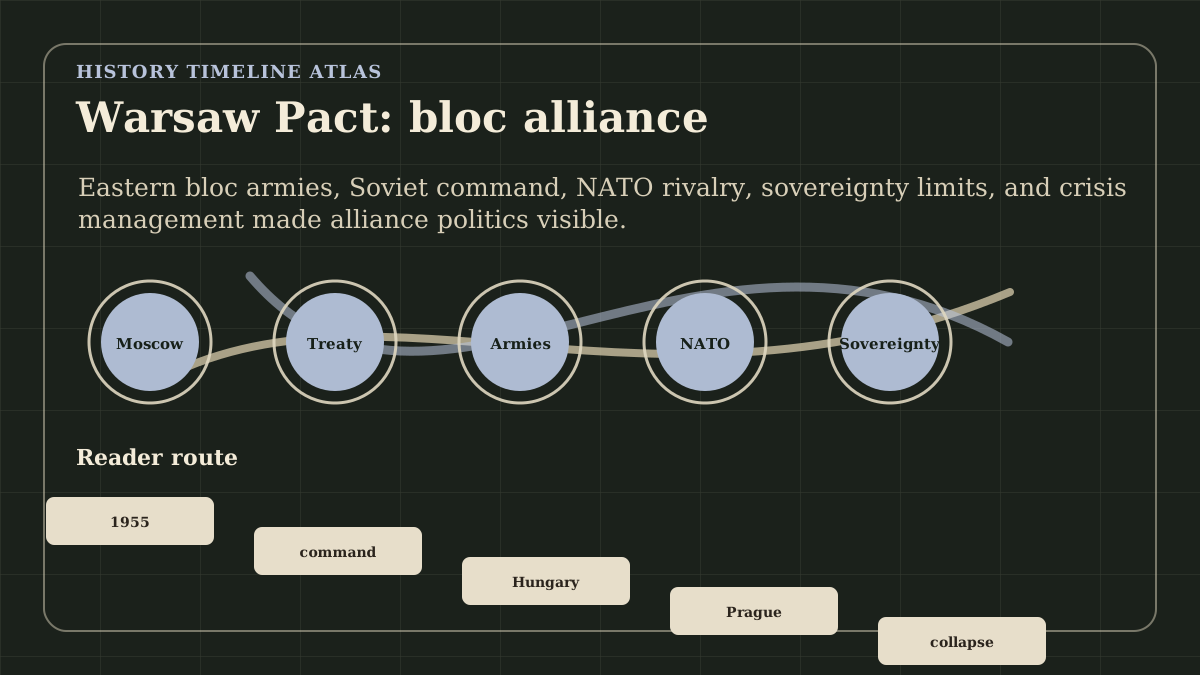
Follow the next pages to see how the Pact operated in practice and how its presence altered crisis behaviour across Europe. Read on to compare its structures with NATO’s, to trace moments when the alliance constrained or justified intervention, and to explore episodes when member states pushed back against Moscow’s lead. Those subsequent entries show how a treaty signed in Warsaw translated into exercises, commands and contingency plans—and why that mattered for governments, soldiers and civilians caught between competing security orders. Read the Warsaw Pact beside NATO, the Hungarian Revolution, Prague Spring, Berlin Wall, and the Cold War timeline. That route shows how alliances can promise security while also defining the limits of sovereignty.
Reading Path
Follow the story without losing the thread
Before This
- Battle of Dien Bien Phu1954 CE
- Guatemalan Coup1954
- Korean ArmisticeJuly 27, 1953
After This
- Suez Crisis1956 CE
- Hungarian RevolutionOctober-November 1956
- Sputnik 1 LaunchedOctober 4, 1957
Same Period
- Cuban Missile CrisisOctober 1962
- Apollo 11 Moon LandingJuly 20, 1969
- Fall of the Berlin WallNovember 9, 1989
Wider Timeline
Mind Map
How to think about Warsaw Pact Founded
Soviet security fears
Perception of NATO expansion and German rearmament drove Moscow to formalize a military bloc.
Map Layer
Where this event sits geographically
Gold pins mark the approximate locations of published event pages. This is a schematic locator map, not a historical border map.
Coordinates are approximate and are used to help readers orient themselves before opening a full event page.
References
Where to Check the Facts
- U.S. National Archives: The Cold WarArchive reference hub for Cold War records, federal documentation, and research guidance.
- Office of the Historian: The Early Cold War, 1945-1952Official diplomatic history reference for early Cold War foreign-policy context.