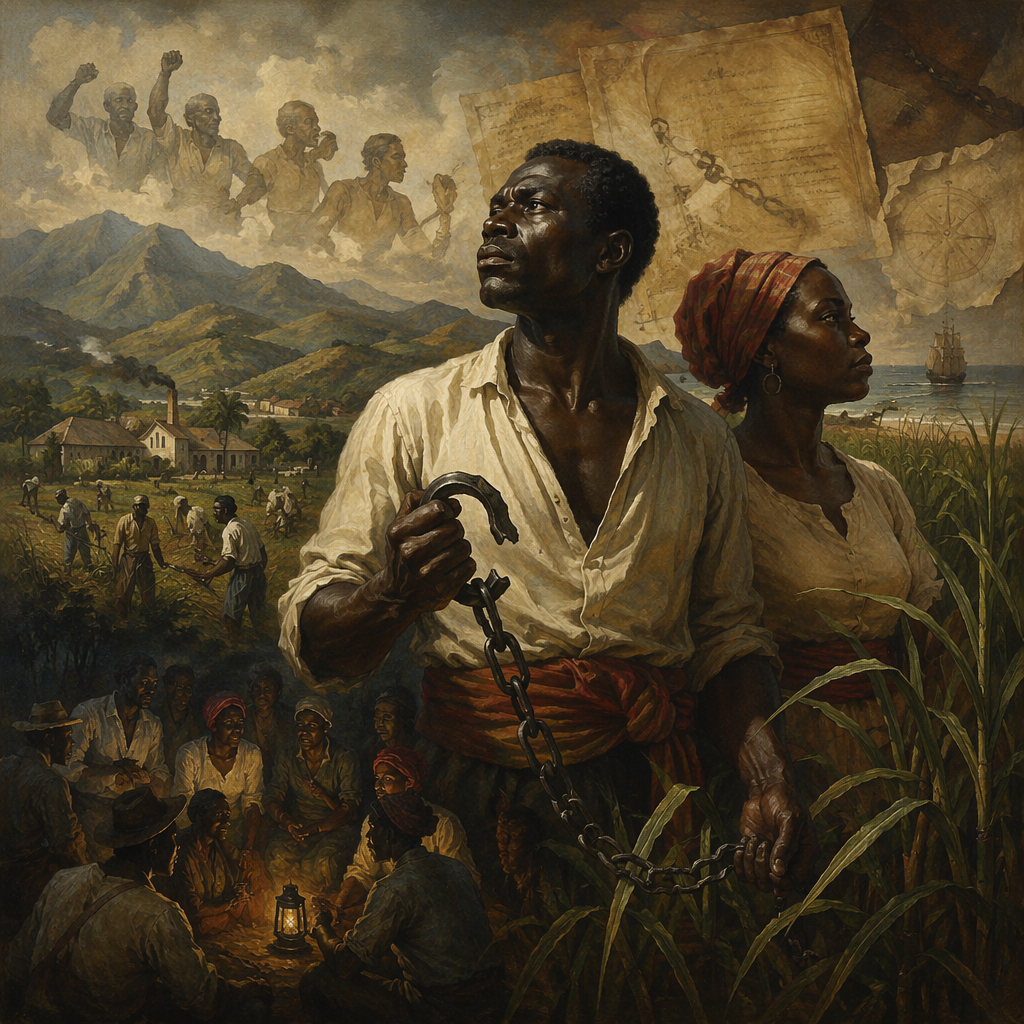
Fast Answer
The American Revolution created an independent republic while leaving slavery intact. The Haitian Revolution overthrew slavery and French colonial rule, creating the first state founded by formerly enslaved people. Reading them together makes the limits and possibilities of Atlantic revolutionary language clearer.
The American and Haitian Revolutions both challenged imperial authority, but they had radically different relationships to slavery, race, citizenship, and the meaning of freedom.
Reading Paths
Choose a reading path
Haitian Revolution vs American Revolution becomes clearer when the broad answer stays tied to sequence, place, and concrete next pages.
Follow the comparison through dated examples before returning to the grid.
Declaration of Independence
The Continental Congress adopted a declaration that presented the American colonies as independent states and justified separation from Britain.
Haitian Revolution Begins
Enslaved people in Saint-Domingue rose against plantation slavery, turning the French colony into the center of the Atlantic world's most radical revolution.
Haitian Revolution Begins
The Haitian Revolution began as enslaved people and free people of color challenged plantation slavery, French colonial power, and racial hierarchy in Saint-Domingue.
Britain Abolishes the Slave Trade
Parliament abolished British participation in the transatlantic slave trade after decades of Black resistance, abolitionist campaigning, and political pressure.
Thirteenth Amendment Ratified
The Thirteenth Amendment abolished slavery in the United States except as punishment for crime.
Comparison Grid
American Revolution
Independence from Britain
Haitian Revolution
Emancipation and independence from France
Both used freedom language, but the social meaning differed.American Revolution
Continued and expanded in many regions
Haitian Revolution
Overthrown through revolutionary conflict
The Haitian Revolution made slavery the central issue.American Revolution
Became a model for republican independence
Haitian Revolution
Inspired and frightened slaveholding societies
Reception depended on race, property, and empire.Fast Frame
Haitian Revolution vs American Revolution is not a simple sequence of events. It is a way to compare power, geography, labor, memory, and evidence across cases that are often separated into national stories.
One revolution limited freedom while another made emancipation central to state formation. The useful question is not which case matters most, but what becomes visible when the cases are placed on the same route.
A reader arriving from search usually wants a quick answer, but quick answers become misleading when they hide structure. This page keeps the short answer near the top while giving enough route logic for causes, turning points, and afterlives to stay connected.
What Changes When the Route Is Connected
Connected reading keeps the atlas from turning history into isolated summaries. A conquest page needs an Indigenous state before it; an abolition page needs a forced-migration system behind it; a revolution page needs a post-independence state after it.
This structure also helps Google and readers understand that the canonical page is answering one broad intent. The page gathers related terms into a single route instead of splitting near-duplicate pages across the site.
The connected route also makes comparison fairer. Instead of asking one event to carry an entire civilization or region, the page lets several pages share the explanation: a hub for context, a timeline for order, event pages for detail, people pages for agency, and year pages for entry points.
Geography and Scale
Geography is not scenery in this route. Lakes, mountains, ports, islands, plantations, roads, deserts, courts, and capitals decide what kinds of power are practical. A state that can move labor through mountains faces a different problem from a state that depends on ships, forts, or treaty language.
Scale also changes the argument. A village, city, kingdom, empire, plantation zone, treaty system, and international conference do not work the same way. The page keeps moving between scales because historical causation often sits in the gap between local experience and large institutions.
That map-aware structure is useful for readers because dates become easier to remember when each one has a place, a route, and a material problem attached to it.
How to Read Evidence
The evidence changes across the route. Archaeology, inscriptions, oral memory, treaty language, court records, voyage databases, speeches, constitutions, photographs, and climate diplomacy do not produce the same kind of historical voice.
A strong answer keeps those source differences visible. The goal is not to flatten every case into the same pattern, but to let comparison reveal where the pattern breaks.
Official records often preserve the language of states, courts, and empires. Archaeology can show settlement, diet, labor, trade, and ritual without requiring written archives. Oral memory and public commemoration preserve meanings that formal documents often miss.
Actors and Affected Groups
The route keeps famous leaders in view without letting them take over the whole explanation. Rulers, rebels, diplomats, priests, captains, enslavers, merchants, and ministers mattered, but so did farmers, builders, enslaved families, island communities, students, workers, translators, migrants, and survivors.
This matters because many broad history pages become thin when they turn every change into a decision by one recognizable person. The route asks who had power, who carried costs, who interpreted events afterward, and who had to live inside institutions created by others.
A reader can therefore move from a named person to the larger structure around that person. Pachacuti makes Inca expansion easier to enter, but roads and labor systems explain how expansion worked. Liliuokalani makes Hawaiian sovereignty vivid, but land, law, diplomacy, and foreign residents explain why the overthrow mattered.
Causes, Triggers, and Afterlives
The page separates background causes from visible triggers. A battle, treaty, uprising, or law may be the moment people remember, but it usually depended on older pressures: land conflict, labor demand, fiscal strain, racial hierarchy, military technology, ecological risk, or imperial rivalry.
Afterlives matter as much as origins. Conquest created memory and resistance. Abolition created new labor struggles. Independence created state-building problems. Treaty disputes created modern legal and political debates. Climate diplomacy turned older colonial and environmental histories into present-day survival questions.
This cause-trigger-afterlife structure makes the route useful for essays and search answers. It gives the reader a way to answer why something happened, what happened next, and why the event still appears in public memory.
Common Misreadings
One common error is to read the route as inevitable. Conquest was not inevitable, abolition was not inevitable, independence was not inevitable, and reform was not inevitable. People made choices under constraints, and those choices interacted with disease, geography, military power, markets, and institutions.
Another error is to treat the region as empty before outside powers arrived. Indigenous America, the Pacific, and East Asia all had political systems, knowledge routes, and conflicts of their own. Atlantic slavery and Latin American independence also cannot be explained only from European capitals.
The page guards against those errors by giving readers several linked doors into the same subject. If one page feels too narrow, the timeline and hub widen the view; if the hub feels broad, the event and person pages make the argument concrete.
Reader Path
Begin with the hub, then open the timeline to see the order. Move into event pages for causes and consequences, people pages for agency, and year pages when a single date becomes an entry point.
The route is designed for students and curious readers who need a usable structure before they need specialist detail. Each next read answers a concrete question rather than sending the reader to a generic related list.
The best next click depends on the reader's question. A causes question belongs with an explainer or event page; a sequence question belongs with the timeline; a people question belongs with a biography; a broad study question belongs with the hub.
Why This Belongs in a World History Atlas
World history becomes thinner when the Americas, Pacific, slavery, and East Asia appear only when European powers arrive. These routes make older local systems, Indigenous sovereignty, coerced labor, state-building, and modern memory part of the main map.
The page also protects against a common reader-quality failure: a site can have many URLs but still feel shallow if each URL answers only one narrow fact. A comparison or explainer page can hold the larger question together.
The atlas becomes more useful when broad routes and detailed pages reinforce each other. The route gives structure; the individual pages give texture; the sources give readers a way to check the claim.
What the First Screen Must Answer
The first screen has to answer the search query without exhausting the subject. A useful answer names the core contrast, the time span, the geographic setting, and the reason the comparison matters. It also creates a reason to keep reading: there is a hidden structure beneath the familiar label, and the page will make that structure visible.
That opening promise matters for general readers. Many arrive with a school assignment, a half-remembered date, or a phrase from a video or book. They need confidence quickly, but they also need a route that does not collapse into trivia. The page therefore moves from fast answer to evidence, geography, actors, causes, consequences, and reading path.
The page avoids a common generic web-copy failure by refusing to summarize everything at the same temperature. Some details are anchors, some are turning points, some are examples, and some are caveats. Varying their weight makes the page feel guided rather than mechanically exhaustive.
How the Route Handles Uncertainty
Historical evidence is uneven. Some events have official texts, court records, parliamentary debates, or treaty documents. Others depend more heavily on archaeology, oral tradition, material culture, later chronicles, or contested memory. The page keeps that unevenness visible because confidence is part of historical explanation.
Uncertainty does not make the subject vague. It changes the kind of claim a careful page can make. A date may be approximate, a motive may be debated, a number may be an estimate, and a political meaning may differ across communities. Good structure lets the reader see the difference between a firm fact, an interpretation, and a public memory.
This is also a quality control rule for future content generation. A draft is not rich merely because it is long. It needs source-aware language, named places, concrete institutions, and clear limits on what the page knows. When a page cannot support a claim, the workflow goes back to sources or narrows the claim.
How This Page Connects to Deeper Study
The best use of the page is not a single read-through. A reader can use the comparison as a launch point: open the timeline for sequence, open event pages for causation, open people pages for agency, open year pages for chronology, and return to the hub when the larger route becomes blurry.
That pattern is deliberate. The structure stays visible: one main question, supporting examples, and descriptive anchors that name how each next page extends the problem. Internal links are not decoration; they are how the atlas lets a reader move from a broad claim into evidence.
The deeper-study path also keeps the route from becoming shallow. Each connected page has a job: one gives sequence, another gives causation, another gives a person or date, and another opens a broader regional frame. When the jobs are clear, the route feels guided rather than scattered.
Questions That Keep the Page Alive
A strong comparison ends with better questions than it began with. Who had power before the famous event? Which institutions made that power durable? Which groups paid the cost? What changed immediately, what changed slowly, and what remained unresolved? These questions turn a topic from a closed summary into a route for further reading.
The same questions keep the route consistent. Causes and consequences belong with events; chronological and regional structure belongs with hubs; turning points belong with timelines; constraints around individual agency belong with people pages. Without those questions, a large atlas can still feel thin.
A useful page makes a reader want the next click. The next click is not random related content. It is a continuation of the problem the page raised: a date that needs context, a person whose choices need constraints, a place whose geography shaped outcomes, or a later debate that keeps the past active.
Two Meanings of Freedom
The word freedom does different work in the two revolutions. In the American Revolution, many Patriots used liberty to argue against parliamentary taxation, imperial authority, standing armies, and threats to colonial self-government. In Saint-Domingue, freedom became inseparable from ending slavery, destroying racial hierarchy, and claiming political life for people whom the plantation order had treated as property.
That contrast does not make the American Revolution unimportant. It shows the limits of its settlement. Independence produced republican language, constitutions, and wider arguments about rights, yet slavery survived and expanded in much of the new United States. The Haitian Revolution forced the Atlantic world to confront a more radical question: could enslaved people make themselves sovereign?
The comparison becomes strongest when readers hold promise and exclusion together. American revolutionary documents gave later abolitionists and rights movements language to reuse, but the Haitian Revolution enacted emancipation through war and state formation. One revolution left slavery as an unresolved contradiction; the other made abolition the foundation of independence.
Plantation War, Republic, and Atlantic Fear
Saint-Domingue was not a marginal colony. It was one of the Atlantic world's richest plantation colonies, built on brutal sugar and coffee slavery, racial law, free people of color, French imperial politics, and global commodity demand. Revolution there threatened wealth, racial order, and the assumptions that slaveholding societies used to defend themselves.
The American Revolution unfolded across colonies with assemblies, militias, ports, frontier conflicts, loyalists, enslaved people seeking freedom, Native nations defending land, and foreign alliances. The Haitian Revolution unfolded through slave uprising, civil war, French revolutionary politics, Spanish and British intervention, Toussaint Louverture's leadership, Napoleon's expedition, and the declaration of Haitian independence.
Atlantic reaction reveals the difference. The United States could be recognized as a new republic despite conflict with Britain. Haiti faced diplomatic isolation, economic pressure, indemnity demands, and fear from slaveholding states. Recognition was not only about sovereignty; it was about whether a Black republic born from slave revolt would be allowed into the international order.
What to Follow After the Comparison
The American Revolution route runs into constitutional politics, slavery's expansion, abolition, civil war, and the Thirteenth Amendment. The line from 1776 to emancipation is not straight. It runs through compromise, resistance, enslaved people's choices, political conflict, and violence.
The Haitian route moves through the 1791 uprising, emancipation decrees, Louverture, the war against Napoleon, independence in 1804, isolation, indemnity, and later debates over memory and debt. The revolution did not end the economic and diplomatic pressures around Haiti. It changed the terms under which those pressures operated.
The page works as a doorway into Atlantic history because it asks who could use revolutionary language. Planters, merchants, enslaved people, free people of color, soldiers, sailors, diplomats, writers, and later reformers all heard the word freedom differently. That difference is the reason the two revolutions still need to be read together.
Reader Checkpoints
A quick comparison has to answer three questions before it feels complete. Did the revolution challenge imperial rule, slavery, or both? Who gained legal standing after victory, and who remained excluded? How did other Atlantic societies react when the meaning of freedom threatened property, race, and labor systems?
Those questions keep the comparison from becoming a moral slogan. They let the American Revolution remain historically important while making clear why the Haitian Revolution was more radical in its attack on slavery and racial hierarchy.
The most useful final sentence holds contradiction and consequence together: 1776 widened republican language while leaving bondage central to the new republic, and 1791-1804 turned enslaved people's revolt into sovereignty while facing punishment from a slaveholding Atlantic world.
That final sentence also explains why the two revolutions kept speaking to later movements. Abolitionists, Black republicans, enslaved rebels, slaveholders, diplomats, and civil-rights organizers all read the memory of revolution through their own struggles over law, labor, race, and citizenship. The comparison stays alive because freedom was not settled by either victory or memory.
Reader Lenses
Freedom meant independence for many American revolutionaries, but emancipation and sovereignty in Haiti.
Slavery survived in the United States but was destroyed by revolutionary struggle in Haiti.
Both revolutions weakened Atlantic empires in different ways.
The comparison turns abstract rights language into a concrete question about who counted as free.
Map Layer
Haitian Revolution vs American Revolution geography
Gold pins mark the approximate locations of published event pages. This is a schematic locator map, not a historical border map.
Coordinates are approximate and are used to help readers orient themselves before opening a full event page.
Linked Events
Read the Evidence Trail
Declaration of Independence
The Continental Congress adopted a declaration that presented the American colonies as independent states and justified separation from Britain.
Haitian Revolution Begins
Enslaved people in Saint-Domingue rose against plantation slavery, turning the French colony into the center of the Atlantic world's most radical revolution.
Haitian Revolution Begins
The Haitian Revolution began as enslaved people and free people of color challenged plantation slavery, French colonial power, and racial hierarchy in Saint-Domingue.
Britain Abolishes the Slave Trade
Parliament abolished British participation in the transatlantic slave trade after decades of Black resistance, abolitionist campaigning, and political pressure.
Thirteenth Amendment Ratified
The Thirteenth Amendment abolished slavery in the United States except as punishment for crime.
References
Where to Check the Facts
- Encyclopaedia Britannica: Transatlantic slave tradeReference for the forced migration system, Atlantic paths, and slavery's global consequences.
- Gilder Lehrman Institute: Olaudah Equiano, 1789Primary-source teaching reference for Equiano's abolitionist narrative and remembered Middle Passage experience.
- Official database: Slave VoyagesReference database for transatlantic slave trade paths, voyages, forced migration, and estimates.
- The National Archives: British transatlantic slave trade recordsOfficial research guide reference for British slave-trade records and digitised legislation including the Abolition of the Slave Trade Act 1807 and Slavery Abolition Act 1833.
- Official archive: Emancipation ProclamationReference for the United States Emancipation Proclamation and its legal setting.
- Legifrance: French abolition decree, 1848Official legal reference for the 1848 abolition of slavery in French colonies and possessions.
- Gilder Lehrman Institute: Frederick Douglass, 1852Primary-source teaching reference for Douglass's abolitionist Fourth of July address.
- Yale Archives: Cuban slavery collectionArchival reference for Cuban slavery and the 1886 abolition date.
- Encyclopaedia Britannica: William WilberforceBiographical reference for Wilberforce, parliamentary abolitionism, the 1807 slave-trade abolition, and the 1833 slavery abolition act.
- Encyclopaedia Britannica: Slavery Abolition ActReference for British abolition of slavery in much of the empire.