Fast Answer
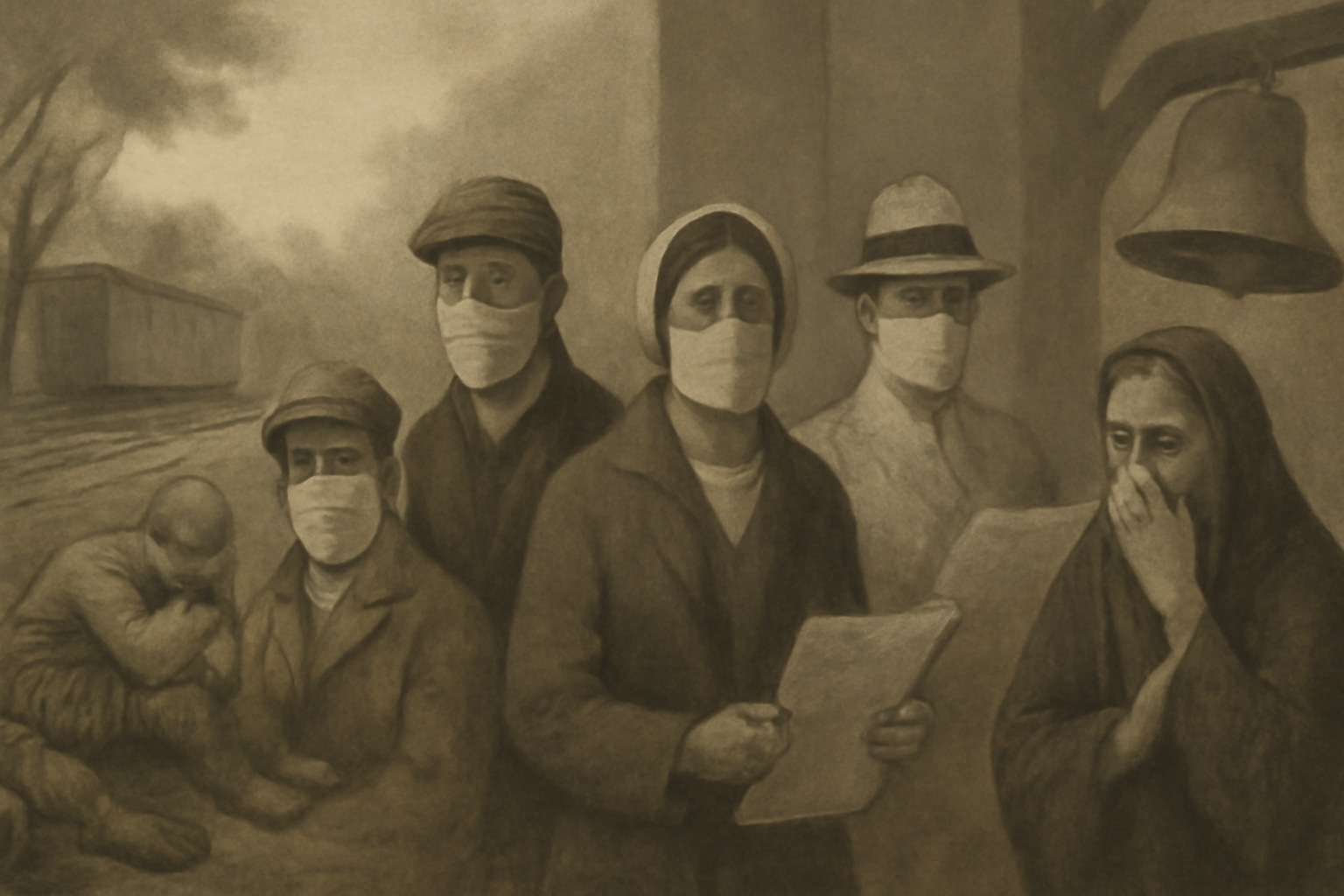
Black Death and Spanish Flu both faced pandemic disease moving through connected societies and exposing social, economic, and political vulnerability, but the Black Death moved through medieval trade and ecological conditions with limited medical understanding, while the 1918 influenza pandemic spread through a wartime world of troop movement, censorship, public health systems, and global transport. The fastest answer starts with that contrast, then adds geography: the Black Death route connects Eurasian trade, the Black Sea, Mediterranean ports, and European towns; Spanish Flu connects World War I troop routes, cities, camps, colonies, ports, and public-health networks. The deeper answer keeps families, workers, soldiers, nurses, port residents, poor communities, migrants, religious institutions, and local officials faced death, labor disruption, grief, and blame visible so the comparison does not become only a story of rulers, armies, or abstract systems.
Black Death and Spanish Flu become useful to compare when they are treated as answers to pandemic disease moving through connected societies and exposing social, economic, and political vulnerability. The comparison is not a scoreboard; it separates shared pressures from different institutions, geographies, vocabularies of legitimacy, and afterlives.
Reading Paths
Choose a reading path
Black Death vs Spanish Flu becomes clearer when the broad answer stays tied to sequence, place, and concrete next pages.
Follow the comparison through dated examples before returning to the grid.
Plague of Justinian
A devastating plague struck the Byzantine world during Justinian's reign, spreading through connected trade and urban networks.
Black Death Reaches Europe
Plague entered Mediterranean Europe through trade paths and port cities, beginning a catastrophe that killed a large share of the population.
Spanish Flu Pandemic
An influenza pandemic spread across a world already disrupted by war, killing millions and exposing the limits of public health systems.
Smallpox Vaccine
Edward Jenner tested vaccination against smallpox, helping establish a new method for preventing one of history's deadliest diseases.
Columbian Exchange Begins
After sustained transatlantic contact, plants, animals, pathogens, people, and forced labor systems moved across the Atlantic with world-changing consequences.
Comparison Grid
Black Death
Black Death faced pandemic disease moving through connected societies and exposing social, economic, and political vulnerability through its own institutions and inherited expectations.
Spanish Flu
Spanish Flu faced the same broad problem through a different political, social, and geographic setting.
The shared question makes the comparison possible; the local setting prevents it from becoming flat.Black Death
Black Death becomes clearer when the map is read through routes, capitals, borders, and zones of contact.
Spanish Flu
Spanish Flu changes the map frame by emphasizing different corridors, centers, or frontiers.
the Black Death route connects Eurasian trade, the Black Sea, Mediterranean ports, and European towns; Spanish Flu connects World War I troop routes, cities, camps, colonies, ports, and public-health networksBlack Death
Black Death shaped people who rarely appear as the main title of the event.
Spanish Flu
Spanish Flu also depended on ordinary labor, coercion, negotiation, and memory.
families, workers, soldiers, nurses, port residents, poor communities, migrants, religious institutions, and local officials faced death, labor disruption, grief, and blameBlack Death
Black Death left institutions and symbols that later people reused.
Spanish Flu
Spanish Flu produced its own afterlife through law, memory, identity, or opposition.
the Black Death became a symbol of medieval catastrophe and social transformation; Spanish Flu was long overshadowed by World War I before becoming central to modern pandemic memoryWhy the Comparison Matters
Black Death and Spanish Flu are often named together because both look large on a map or central in a textbook sequence. That is only the entrance. The better comparison asks what problem each case tried to solve, which tools were available, and which costs were pushed onto people with less power. pandemic disease moving through connected societies and exposing social, economic, and political vulnerability gives the two cases a shared frame without pretending they were the same.
the Black Death moved through medieval trade and ecological conditions with limited medical understanding, while the 1918 influenza pandemic spread through a wartime world of troop movement, censorship, public health systems, and global transport. That difference changes the whole interpretation. A date, battle, law, treaty, or reform may look similar at first glance, but it worked through different institutions and expectations. The comparison becomes richer when readers track offices, ports, courts, religious authorities, armies, labor systems, taxes, and local communities rather than only matching one famous leader against another.
The comparison also protects the atlas from a narrow regional habit. It lets a familiar search query open into a wider world-historical method: keep one question constant, then let the evidence remain local. The result is more useful than a list of similarities and differences because it explains why the similarities appeared and why the differences mattered.
Causes, Pressures, and Turning Points
both pandemics depended on movement, crowding, information limits, social inequality, and institutions that struggled to respond quickly enough. Causes here are layered. Some pressures were slow: fiscal strain, social hierarchy, trade routes, land hunger, legal tradition, religious authority, or inherited political memory. Others became visible as triggers: a battle, a treaty, a revolt, a reform, a crisis of succession, or a diplomatic failure.
For Black Death, the turning points reveal which institutions could absorb pressure and which could not. For Spanish Flu, the same question produces a different pattern because the political field, source record, and map were different. The strongest comparison keeps background pressure, immediate trigger, decision, and consequence in separate layers.
This separation matters for search intent as well as historical accuracy. A reader asking for causes usually needs more than a single origin story. The comparison shows how different causes can lead to apparently similar outcomes, and how similar pressures can produce different consequences when institutions, geography, and public memory diverge.
Geography and Institutions
the Black Death route connects Eurasian trade, the Black Sea, Mediterranean ports, and European towns; Spanish Flu connects World War I troop routes, cities, camps, colonies, ports, and public-health networks. Geography is not scenery in this comparison. It decides which routes mattered, where armies or officials could move, which ports or capitals collected information, and which borderlands became pressure zones. A map changes the answer because it makes distance, environment, and connection visible.
Institutions turn that geography into durable behavior. Courts, charters, councils, fleets, land systems, tribute, parliaments, assemblies, religious offices, companies, schools, and armies all created habits that outlasted individual decisions. Black Death and Spanish Flu differed most when those institutions translated ambition into ordinary practice.
The comparison therefore moves between scale and texture. Scale explains why the cases mattered across regions; texture explains how people experienced them locally. A capital city, a plantation, a frontier settlement, a treaty port, a courtroom, a village, and a battlefield each reveal a different part of the same historical structure.
People, Labor, and Affected Groups
families, workers, soldiers, nurses, port residents, poor communities, migrants, religious institutions, and local officials faced death, labor disruption, grief, and blame. This is the layer that prevents the comparison from becoming too clean. Power operated through workers, soldiers, enslaved people, migrants, merchants, officials, women in households and courts, religious communities, students, colonized subjects, and local elites who had to live with decisions made elsewhere.
The human scale also changes causation. People did not only suffer systems; they adapted, resisted, interpreted, collaborated, fled, petitioned, organized, and remembered. Their actions often forced institutions to change. A comparison that includes affected groups can explain both top-down command and bottom-up pressure.
That wider lens is especially important when later memory turns complex histories into simplified symbols. Some groups become visible in monuments and schoolbooks; others survive in court records, petitions, oral traditions, material culture, or the silences of archives. The comparison invites readers to ask who is easy to see and who requires more careful reconstruction.
Consequences and Memory
the Black Death became a symbol of medieval catastrophe and social transformation; Spanish Flu was long overshadowed by World War I before becoming central to modern pandemic memory. Consequences did not stop when the main event sequence ended. Institutions, borders, categories of citizenship, racial systems, religious identities, economic habits, and political vocabulary often survived in altered forms. Memory then selected certain lessons and pushed others aside.
The afterlife of Black Death may appear in law, identity, statecraft, monuments, political language, or public arguments. The afterlife of Spanish Flu may appear through different channels. The point is not to flatten both into the same legacy, but to ask which institutions and memories continued to organize later choices.
A useful comparison ends with unresolved questions. Which consequences were immediate, which were medium-term, and which became durable? Which groups gained language for new claims? Which injuries remained unaddressed? Which later movements reused the memory for purposes the original actors could not have predicted?
How to Read the Evidence Trail
The linked events give the comparison a route. Start with the earliest event to see the background pressure, then follow the turning points in chronological order. Each event page adds a map, actors, causes, consequences, sources, and reading questions that keep the comparison grounded in evidence rather than analogy alone.
The timeline links keep chronology visible. They show whether the comparison concerns a short crisis, a long institutional transformation, or a memory that changed meaning across generations. The topic links widen the frame so the reader can move from a single comparison into empire, rights, trade, religion, science, decolonization, or global exchange.
The strongest reading method is recursive. Read the fast answer, inspect the comparison grid, follow one event, return to the map, and then ask whether the original contrast still holds. Good comparisons survive that test because they become more precise as evidence accumulates.
The final habit is humility about sources. Court chronicles, official treaties, newspapers, museum collections, oral memory, legal documents, diplomatic records, inscriptions, and later histories do not preserve the same voices. A comparison is strongest when it admits what the evidence shows clearly and where the record remains uneven.
A second pass through the route can use one factor at a time. Read only the geography first, then read only institutions, then read affected groups, then read memory. The comparison becomes easier to hold because each pass asks one focused question instead of demanding that the whole argument arrive at once.
The comparison also points outward. Related topic hubs explain the broader vocabulary, timeline pages keep the sequence visible, and event pages slow down the causal chain. That structure lets the reader move from a quick answer into deeper study without creating duplicate pages for every similar search phrase.
When the cases seem too far apart, return to the shared problem. When they seem too similar, return to the map. That two-step habit keeps the comparison flexible: the shared question creates coherence, and the local evidence restores difference.
The first useful contrast is the information environment. During the Black Death, people interpreted catastrophe through religion, rumor, humoral medicine, local observation, community fear, and limited theories of contagion. During the 1918 influenza pandemic, germ theory and public-health institutions existed, but wartime censorship, troop movement, crowded camps, and political pressure limited how quickly societies could respond. More modern knowledge did not automatically mean more honest information.
Routes mattered in both cases. Plague moved through Eurasian commercial corridors, Black Sea connections, Mediterranean ports, towns, and rural hinterlands. Influenza moved through troop ships, barracks, ports, factories, cities, colonial labor routes, and demobilizing armies. A pandemic map is therefore not just a disease map. It is a map of trade, war, labor, empire, and the speed at which people and goods moved.
The Black Death changed labor history because mortality disrupted the balance between landholders and workers in many regions. Labor shortages, wage pressure, peasant bargaining, legal attempts to control wages, and social unrest became part of the aftershock. The effects varied by place, but the pandemic made visible how much medieval economies depended on ordinary labor that elites often treated as fixed.
The 1918 influenza pandemic exposed a different labor and state problem. War industries, military camps, hospitals, public gatherings, schools, transport systems, and colonial workforces all had to keep functioning while illness spread. Nurses, doctors, orderlies, families, undertakers, public-health officials, and local volunteers became part of the pandemic infrastructure. The crisis was biological, but response depended on institutions and trust.
Blame followed both pandemics. Medieval communities sometimes turned fear against Jews, foreigners, beggars, outsiders, or suspected poisoners, producing violence that cannot be separated from the history of the disease. In 1918, naming, rumor, censorship, racial and colonial inequality, and wartime propaganda shaped who was believed and who was ignored. Pandemic history therefore includes scapegoating as well as mortality.
Social inequality shaped exposure and recovery. Poorer households, crowded neighborhoods, port workers, servants, soldiers, migrants, prisoners, and colonized communities often had fewer choices about movement, work, food, isolation, or care. Elites could sometimes leave cities, command labor, or record their grief more visibly. The comparison asks not only how many died, but whose vulnerability was treated as normal before disease arrived.
The comparison also changes how readers understand medicine. The Black Death shows a world with limited effective treatment and uneven explanations, but not a world without care, ritual, observation, or community response. Spanish Flu shows a world with laboratories, hospitals, public-health boards, newspapers, and quarantine tools, but not enough knowledge, transparency, or capacity to prevent mass death. The difference is not ignorance versus science; it is two different medical worlds under pressure.
Government capacity also differed. Medieval authorities could use quarantine, city controls, flight rules, burial orders, prayer, and policing, but they did not have modern epidemiology or national health systems. In 1918, governments had more administrative tools yet were constrained by war priorities, censorship, limited antivirals or vaccines, and uneven public compliance. Capacity is therefore not a straight line from past weakness to modern mastery.
Memory is uneven. The Black Death became a major symbol of medieval crisis because its demographic shock, cultural memory, and later historical writing made it stand out. The 1918 influenza pandemic killed on a vast scale but was long overshadowed by World War I in many public narratives. That silence is itself historical evidence: societies can remember war more loudly than disease even when disease touches more households.
A careful route begins with the Plague of Justinian to show that pandemic disease had earlier imperial consequences, then moves to the Black Death for medieval Eurasian transformation, then to 1918 for war, public health, and global transport. Ending with COVID-19 does not flatten the past into a lesson for the present. It helps readers ask what changes and what repeats: movement, inequality, trust, institutions, grief, and contested memory.
The comparison is strongest when it stays practical. Ask how disease traveled, who had authority to respond, what information people trusted, what labor could not stop, who got blamed, and what changed after the death wave passed. Those questions make the two pandemics comparable without pretending that a medieval plague world and an industrial wartime world were the same.
A final check is to name one institution, one place, one affected group, and one memory for each side. If any slot stays empty, the comparison still has a blind spot worth following through the linked pages.
Reader Lenses
pandemic disease moving through connected societies and exposing social, economic, and political vulnerability
the Black Death moved through medieval trade and ecological conditions with limited medical understanding, while the 1918 influenza pandemic spread through a wartime world of troop movement, censorship, public health systems, and global transport
the Black Death route connects Eurasian trade, the Black Sea, Mediterranean ports, and European towns; Spanish Flu connects World War I troop routes, cities, camps, colonies, ports, and public-health networks
families, workers, soldiers, nurses, port residents, poor communities, migrants, religious institutions, and local officials faced death, labor disruption, grief, and blame
the Black Death became a symbol of medieval catastrophe and social transformation; Spanish Flu was long overshadowed by World War I before becoming central to modern pandemic memory
Map Layer
Black Death vs Spanish Flu geography
Gold pins mark the approximate locations of published event pages. This is a schematic locator map, not a historical border map.
Coordinates are approximate and are used to help readers orient themselves before opening a full event page.
Linked Events
Read the Evidence Trail
Plague of Justinian
A devastating plague struck the Byzantine world during Justinian's reign, spreading through connected trade and urban networks.
Black Death Reaches Europe
Plague entered Mediterranean Europe through trade paths and port cities, beginning a catastrophe that killed a large share of the population.
Spanish Flu Pandemic
An influenza pandemic spread across a world already disrupted by war, killing millions and exposing the limits of public health systems.
Smallpox Vaccine
Edward Jenner tested vaccination against smallpox, helping establish a new method for preventing one of history's deadliest diseases.
Columbian Exchange Begins
After sustained transatlantic contact, plants, animals, pathogens, people, and forced labor systems moved across the Atlantic with world-changing consequences.
COVID-19 Pandemic Declared
The World Health Organization characterized COVID-19 as a pandemic after the virus spread across continents and strained public-health systems.
References
Where to Check the Facts
- Encyclopaedia Britannica: Black DeathReference for plague chronology and consequences.
- Encyclopaedia Britannica: Influenza pandemic of 1918-19Reference for the 1918 pandemic.
- World Health Organization: COVID-19Institutional reference for COVID-19 public-health context.