Fast Answer
Umayyad Caliphate and Abbasid Caliphate both faced turning early Islamic community and conquest into durable imperial government, but the Umayyads ruled from Damascus through Arab military expansion and dynastic monarchy, while the Abbasids recentered power around Baghdad, broader imperial coalitions, administration, translation, and urban culture. The fastest answer starts with that contrast, then adds geography: Damascus points toward Syria, the Mediterranean, and rapid western and eastern expansion; Baghdad points toward Iraq, Iran, Central Asia, Indian Ocean routes, and a denser bureaucratic-capital world. The deeper answer keeps Arab soldiers, converts, mawali, scholars, merchants, tax communities, urban workers, court families, and provincial elites all shaped what caliphal rule meant visible so the comparison does not become only a story of rulers, armies, or abstract systems.
Umayyad Caliphate and Abbasid Caliphate become useful to compare when they are treated as answers to turning early Islamic community and conquest into durable imperial government. The comparison is not a scoreboard; it separates shared pressures from different institutions, geographies, vocabularies of legitimacy, and afterlives.
Reading Paths
Choose a reading path
Abbasid Caliphate vs Umayyad Caliphate becomes clearer when the broad answer stays tied to sequence, place, and concrete next pages.
Follow the comparison through dated examples before returning to the grid.
Umayyad Caliphate Founded
The Umayyad dynasty established a caliphal regime centered on Damascus, turning early Islamic rule toward a more durable dynastic and imperial form.
Battle of Karbala
Husayn ibn Ali and a small group of supporters were killed by Umayyad forces at Karbala, creating one of the most powerful memories of sacrifice, legitimacy, and mourning in Islamic history.
Dome of the Rock Completed
The Umayyad caliph Abd al-Malik completed the Dome of the Rock in Jerusalem, giving early Islamic rule a monumental architectural statement in a city of layered sacred history.
Abbasid Revolution
The Abbasid movement overthrew the Umayyad dynasty and reoriented caliphal power toward Iraq and the eastern Islamic world.
Baghdad Founded in 762: Al-Mansur, Round City, and Abbasid Aftermath
In 762, Abbasid caliph al-Mansur founded Baghdad as the Round City near the Tigris. What happened was a capital-building project; the main side was the Abbasid court; why it matters is that the city became a political and scholarly center with a long aftermath.
Comparison Grid
Umayyad Caliphate
Umayyad Caliphate faced turning early Islamic community and conquest into durable imperial government through its own institutions and inherited expectations.
Abbasid Caliphate
Abbasid Caliphate faced the same broad problem through a different political, social, and geographic setting.
The shared question makes the comparison possible; the local setting prevents it from becoming flat.Umayyad Caliphate
Umayyad Caliphate becomes clearer when the map is read through routes, capitals, borders, and zones of contact.
Abbasid Caliphate
Abbasid Caliphate changes the map frame by emphasizing different corridors, centers, or frontiers.
Damascus points toward Syria, the Mediterranean, and rapid western and eastern expansion; Baghdad points toward Iraq, Iran, Central Asia, Indian Ocean routes, and a denser bureaucratic-capital worldUmayyad Caliphate
Umayyad Caliphate shaped people who rarely appear as the main title of the event.
Abbasid Caliphate
Abbasid Caliphate also depended on ordinary labor, coercion, negotiation, and memory.
Arab soldiers, converts, mawali, scholars, merchants, tax communities, urban workers, court families, and provincial elites all shaped what caliphal rule meantUmayyad Caliphate
Umayyad Caliphate left institutions and symbols that later people reused.
Abbasid Caliphate
Abbasid Caliphate produced its own afterlife through law, memory, identity, or opposition.
Umayyad memory often centers conquest, Karbala, and dynastic controversy; Abbasid memory often centers Baghdad, translation, administration, and the cultural imagination of a golden ageWhy the Comparison Matters
Umayyad Caliphate and Abbasid Caliphate are often named together because both look large on a map or central in a textbook sequence. That is only the entrance. The better comparison asks what problem each case tried to solve, which tools were available, and which costs were pushed onto people with less power. turning early Islamic community and conquest into durable imperial government gives the two cases a shared frame without pretending they were the same.
the Umayyads ruled from Damascus through Arab military expansion and dynastic monarchy, while the Abbasids recentered power around Baghdad, broader imperial coalitions, administration, translation, and urban culture. That difference changes the whole interpretation. A date, battle, law, treaty, or reform may look similar at first glance, but it worked through different institutions and expectations. The comparison becomes richer when readers track offices, ports, courts, religious authorities, armies, labor systems, taxes, and local communities rather than only matching one famous leader against another.
The comparison also protects the atlas from a narrow regional habit. It lets a familiar search query open into a wider world-historical method: keep one question constant, then let the evidence remain local. The result is more useful than a list of similarities and differences because it explains why the similarities appeared and why the differences mattered.
Causes, Pressures, and Turning Points
the Abbasid Revolution drew strength from discontent with Umayyad privilege, regional coalitions, religious legitimacy claims, and the political possibilities opened by an expanding Islamic empire. Causes here are layered. Some pressures were slow: fiscal strain, social hierarchy, trade routes, land hunger, legal tradition, religious authority, or inherited political memory. Others became visible as triggers: a battle, a treaty, a revolt, a reform, a crisis of succession, or a diplomatic failure.
For Umayyad Caliphate, the turning points reveal which institutions could absorb pressure and which could not. For Abbasid Caliphate, the same question produces a different pattern because the political field, source record, and map were different. The strongest comparison keeps background pressure, immediate trigger, decision, and consequence in separate layers.
This separation matters for search intent as well as historical accuracy. A reader asking for causes usually needs more than a single origin story. The comparison shows how different causes can lead to apparently similar outcomes, and how similar pressures can produce different consequences when institutions, geography, and public memory diverge.
Geography and Institutions
Damascus points toward Syria, the Mediterranean, and rapid western and eastern expansion; Baghdad points toward Iraq, Iran, Central Asia, Indian Ocean routes, and a denser bureaucratic-capital world. Geography is not scenery in this comparison. It decides which routes mattered, where armies or officials could move, which ports or capitals collected information, and which borderlands became pressure zones. A map changes the answer because it makes distance, environment, and connection visible.
Institutions turn that geography into durable behavior. Courts, charters, councils, fleets, land systems, tribute, parliaments, assemblies, religious offices, companies, schools, and armies all created habits that outlasted individual decisions. Umayyad Caliphate and Abbasid Caliphate differed most when those institutions translated ambition into ordinary practice.
The comparison therefore moves between scale and texture. Scale explains why the cases mattered across regions; texture explains how people experienced them locally. A capital city, a plantation, a frontier settlement, a treaty port, a courtroom, a village, and a battlefield each reveal a different part of the same historical structure.
People, Labor, and Affected Groups
Arab soldiers, converts, mawali, scholars, merchants, tax communities, urban workers, court families, and provincial elites all shaped what caliphal rule meant. This is the layer that prevents the comparison from becoming too clean. Power operated through workers, soldiers, enslaved people, migrants, merchants, officials, women in households and courts, religious communities, students, colonized subjects, and local elites who had to live with decisions made elsewhere.
The human scale also changes causation. People did not only suffer systems; they adapted, resisted, interpreted, collaborated, fled, petitioned, organized, and remembered. Their actions often forced institutions to change. A comparison that includes affected groups can explain both top-down command and bottom-up pressure.
That wider lens is especially important when later memory turns complex histories into simplified symbols. Some groups become visible in monuments and schoolbooks; others survive in court records, petitions, oral traditions, material culture, or the silences of archives. The comparison invites readers to ask who is easy to see and who requires more careful reconstruction.
Consequences and Memory
Umayyad memory often centers conquest, Karbala, and dynastic controversy; Abbasid memory often centers Baghdad, translation, administration, and the cultural imagination of a golden age. Consequences did not stop when the main event sequence ended. Institutions, borders, categories of citizenship, racial systems, religious identities, economic habits, and political vocabulary often survived in altered forms. Memory then selected certain lessons and pushed others aside.
The afterlife of Umayyad Caliphate may appear in law, identity, statecraft, monuments, political language, or public arguments. The afterlife of Abbasid Caliphate may appear through different channels. The point is not to flatten both into the same legacy, but to ask which institutions and memories continued to organize later choices.
A useful comparison ends with unresolved questions. Which consequences were immediate, which were medium-term, and which became durable? Which groups gained language for new claims? Which injuries remained unaddressed? Which later movements reused the memory for purposes the original actors could not have predicted?
How to Read the Evidence Trail
The linked events give the comparison a route. Start with the earliest event to see the background pressure, then follow the turning points in chronological order. Each event page adds a map, actors, causes, consequences, sources, and reading questions that keep the comparison grounded in evidence rather than analogy alone.
The timeline links keep chronology visible. They show whether the comparison concerns a short crisis, a long institutional transformation, or a memory that changed meaning across generations. The topic links widen the frame so the reader can move from a single comparison into empire, rights, trade, religion, science, decolonization, or global exchange.
The strongest reading method is recursive. Read the fast answer, inspect the comparison grid, follow one event, return to the map, and then ask whether the original contrast still holds. Good comparisons survive that test because they become more precise as evidence accumulates.
The final habit is humility about sources. Court chronicles, official treaties, newspapers, museum collections, oral memory, legal documents, diplomatic records, inscriptions, and later histories do not preserve the same voices. A comparison is strongest when it admits what the evidence shows clearly and where the record remains uneven.
A second pass through the route can use one factor at a time. Read only the geography first, then read only institutions, then read affected groups, then read memory. The comparison becomes easier to hold because each pass asks one focused question instead of demanding that the whole argument arrive at once.
The comparison also points outward. Related topic hubs explain the broader vocabulary, timeline pages keep the sequence visible, and event pages slow down the causal chain. That structure lets the reader move from a quick answer into deeper study without creating duplicate pages for every similar search phrase.
When the cases seem too far apart, return to the shared problem. When they seem too similar, return to the map. That two-step habit keeps the comparison flexible: the shared question creates coherence, and the local evidence restores difference.
The capital contrast gives the comparison a concrete shape. Damascus was not only a seat of rulers; it placed Umayyad power close to Syria's armies, Byzantine frontiers, Mediterranean routes, and older late antique urban traditions. Baghdad was not only a new city; it was a planned Abbasid center near Iraq's river systems, Persianate administrative worlds, and routes that tied court politics to merchants, scholars, translators, soldiers, and provincial agents.
Legitimacy changed as the empire widened. Umayyad rule carried memories of conquest, Arab military settlement, and dynastic monarchy, but it also faced disputes over succession, religious authority, non-Arab converts, taxation, and the memory of Karbala. Abbasid rule drew power from opposition to Umayyad privilege and claims around the Prophet's family, yet Abbasid government soon faced its own challenge: converting revolutionary legitimacy into ordinary administration.
The comparison becomes more useful when converts and tax communities remain visible. The category often called mawali points readers toward non-Arab Muslims whose place in the early empire was politically charged. Fiscal arrangements, military stipends, land revenue, garrison towns, and provincial bargaining shaped how religious belonging became a problem of governance. A caliphate was never only a court theology; it was also a system for collecting, paying, judging, and appointing.
Religious memory requires care. Karbala, the Dome of the Rock, Abbasid revolutionary language, scholarly networks, hadith transmission, legal schools, and court patronage belong to overlapping but different stories. The page avoids turning Sunni-Shi'a history into a fixed map from the start. Confessional boundaries hardened through institutions, memory, law, patronage, and conflict across time rather than appearing fully formed in one dramatic moment.
Expansion also meant translation between worlds. Umayyad armies moved across North Africa, Iberia, Central Asia, and the eastern frontiers, while local elites, cities, and tax systems shaped what conquest could become. Abbasid Baghdad became famous for scholarship and translation, but the knowledge route depended on patrons, scribes, paper, court competition, physicians, astronomers, mathematicians, administrators, and languages already circulating across the region.
The social scale keeps the comparison human. A soldier in a Syrian army register, a convert negotiating status, a merchant arriving in Baghdad, a scholar copying texts, a tax collector in Egypt, a family living through factional conflict, and a provincial governor balancing loyalty and ambition all experienced caliphal power differently. Their varied positions explain why the caliphate could feel both universal and locally contested.
The strongest reading path moves from Umayyad foundation to Karbala, then to the Dome of the Rock, Abbasid Revolution, Baghdad, and the House of Wisdom. That sequence turns a dynasty comparison into a story of legitimacy, city-making, religious memory, administration, and knowledge. It also prevents a common shortcut: calling one period merely political and the other merely cultural.
The evidence trail is uneven. Chronicles, later histories, architecture, coins, inscriptions, legal traditions, and literary memory preserve different kinds of voices. Court narratives can make caliphs look central, while buildings, tax categories, scholarly lineages, and provincial histories reveal how rule was experienced beyond the palace. The comparison becomes sharper when evidence type remains part of the answer.
The afterlife of the two dynasties also differs. Umayyad memory continued through controversy, conquest narratives, Cordoba, and debates over early Islamic authority. Abbasid memory continued through Baghdad, translation, urban culture, law, and the idea of a golden age. Those memories are powerful, but neither memory is neutral. Later readers selected what they wanted each dynasty to mean.
A sharper comparison also asks what each dynasty made possible for later Islamic polities. Umayyad rule demonstrated how conquest, Arabic administration, coinage, monumental building, and dynastic monarchy could organize a huge imperial zone. Abbasid rule demonstrated how a capital, bureaucracy, court culture, scholarly patronage, and regional delegation could hold authority even when direct military control became uneven.
The route becomes especially useful for students when it separates three questions that often blur together: who ruled, where authority sat, and how people remembered legitimacy. The answer changes if the reader starts with Damascus, Baghdad, Karbala, the Dome of the Rock, a tax district, or a translation circle. Each starting point reveals a different caliphate.
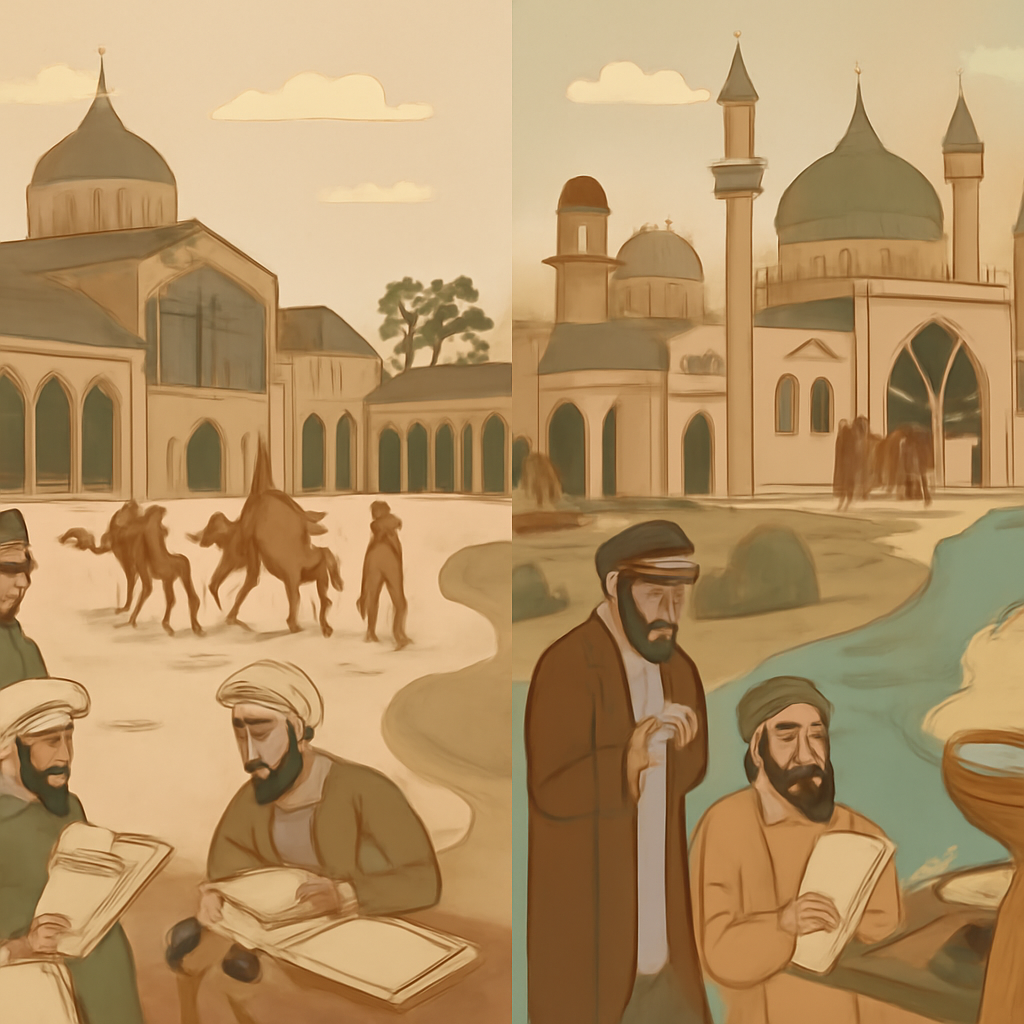
That is why the visual focuses on capitals, routes, scholars, and administrators rather than on a single ruler. The comparison is not a portrait contest. It is a study of how rule moved through cities, records, religious authority, money, memory, and long-distance movement.
For a final pass, compare one administrative tool on each side. Coinage, language, judges, postal routes, stipends, and court appointments reveal how spiritual authority and imperial management met in daily practice.
A final check is to name one institution, one place, one affected group, and one memory for each side. If any slot stays empty, the comparison still has a blind spot worth following through the linked pages.
Reader Lenses
turning early Islamic community and conquest into durable imperial government
the Umayyads ruled from Damascus through Arab military expansion and dynastic monarchy, while the Abbasids recentered power around Baghdad, broader imperial coalitions, administration, translation, and urban culture
Damascus points toward Syria, the Mediterranean, and rapid western and eastern expansion; Baghdad points toward Iraq, Iran, Central Asia, Indian Ocean routes, and a denser bureaucratic-capital world
Arab soldiers, converts, mawali, scholars, merchants, tax communities, urban workers, court families, and provincial elites all shaped what caliphal rule meant
Umayyad memory often centers conquest, Karbala, and dynastic controversy; Abbasid memory often centers Baghdad, translation, administration, and the cultural imagination of a golden age
Map Layer
Abbasid Caliphate vs Umayyad Caliphate geography
Gold pins mark the approximate locations of published event pages. This is a schematic locator map, not a historical border map.
Coordinates are approximate and are used to help readers orient themselves before opening a full event page.
Linked Events
Read the Evidence Trail
Umayyad Caliphate Founded
The Umayyad dynasty established a caliphal regime centered on Damascus, turning early Islamic rule toward a more durable dynastic and imperial form.
Battle of Karbala
Husayn ibn Ali and a small group of supporters were killed by Umayyad forces at Karbala, creating one of the most powerful memories of sacrifice, legitimacy, and mourning in Islamic history.
Dome of the Rock Completed
The Umayyad caliph Abd al-Malik completed the Dome of the Rock in Jerusalem, giving early Islamic rule a monumental architectural statement in a city of layered sacred history.
Abbasid Revolution
The Abbasid movement overthrew the Umayyad dynasty and reoriented caliphal power toward Iraq and the eastern Islamic world.
Baghdad Founded in 762: Al-Mansur, Round City, and Abbasid Aftermath
In 762, Abbasid caliph al-Mansur founded Baghdad as the Round City near the Tigris. What happened was a capital-building project; the main side was the Abbasid court; why it matters is that the city became a political and scholarly center with a long aftermath.
House of Wisdom Flourishes
The Abbasid court's Bayt al-Hikmah, or House of Wisdom, became a symbol of translation, scholarship, and mathematical and scientific work in Baghdad.
References
Where to Check the Facts
- Encyclopaedia Britannica: Umayyad dynastyReference for Umayyad rule and expansion.
- Encyclopaedia Britannica: Abbasid caliphateReference for Abbasid revolution, Baghdad, and caliphal politics.
- The Metropolitan Museum of Art: The Art of the Abbasid PeriodMuseum reference for Abbasid material culture and urban-cultural setting.