Historical Role
Gandhi's life is easiest to enter through concrete places: Porbandar and London before his public career, South Africa where he tested satyagraha under racial law, Sabarmati Ashram where discipline became daily practice, and the 1930 walk to Dandi where salt turned empire into something ordinary people could touch. His name often stands for nonviolence, but the history is wider and harder than that shorthand.
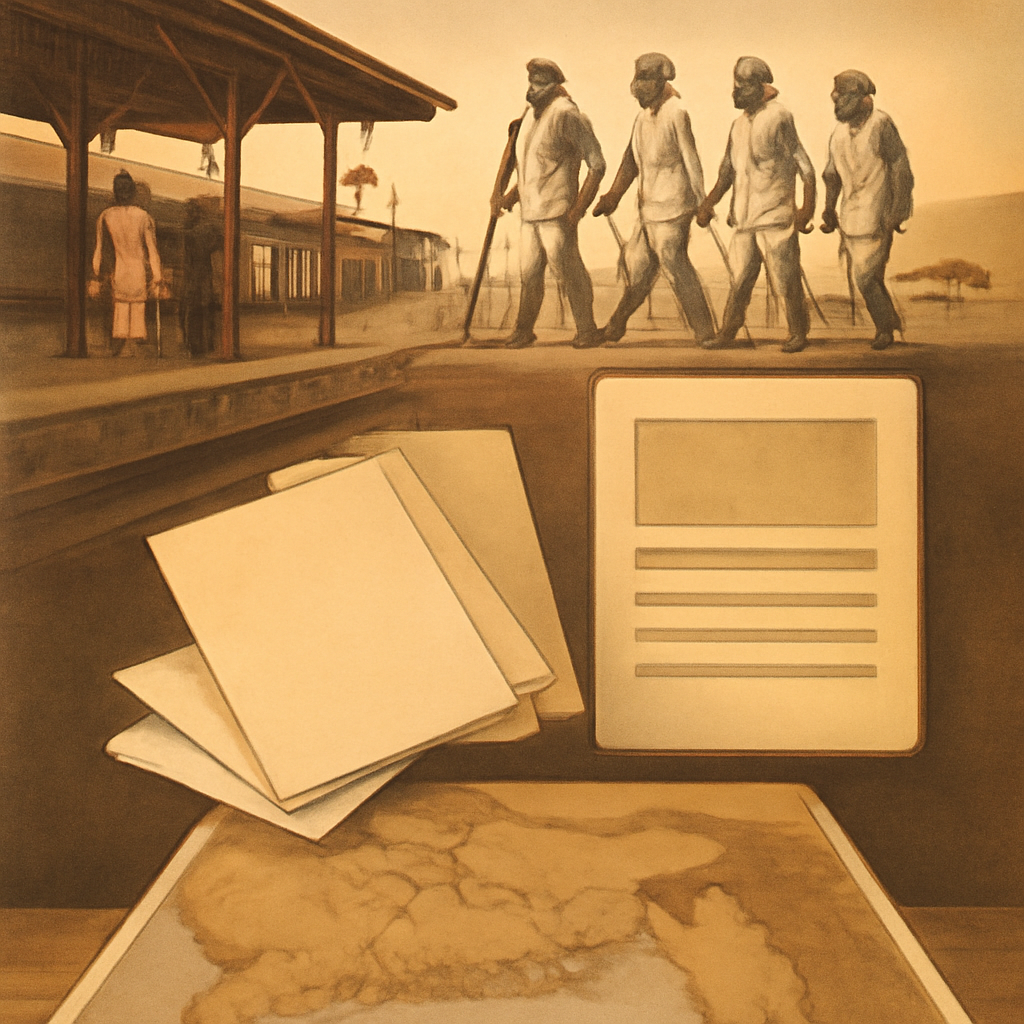
The Salt March gives the biography a scene rather than a slogan. Gandhi left Sabarmati in March 1930 with a small disciplined group, walked village by village toward the Arabian Sea, and reached Dandi in April to break the British salt monopoly in public. The action was theatrical, legal, economic, and bodily at once: feet on roads, salt in hands, police watching, newspapers following, and villagers seeing imperial revenue turned into a household object.
His South Asian setting matters. Gandhi did not invent Indian nationalism alone. He entered a field shaped by the Indian National Congress, provincial politics, British law, vernacular newspapers, Muslim, Hindu, Sikh, Dalit, labor, peasant, and business constituencies, and older reform movements. His influence came from making mass participation feel possible across distance: spinning, fasting, marches, petitions, boycotts, ashram discipline, and symbolic acts made politics visible beyond legislative halls.
Nonviolence in Gandhi's career was not passive withdrawal. It was a method for creating confrontation while controlling its form. Satyagraha tried to expose coercion by refusing cooperation with it, accepting punishment, and forcing officials, observers, and participants to ask who held moral authority. That method required training, communication, and limits. When violence broke out, Gandhi often paused campaigns because he believed political means shaped political ends.
The British Empire is the other actor in the biography. Colonial officials had law, police, prisons, railways, intelligence, censorship, and negotiations at their disposal. Gandhi's campaigns mattered because they attacked the legitimacy of that machinery, not simply because they embarrassed individual officials. Salt was powerful because it was ordinary. A tax on a necessity let people connect empire to daily life, and the march turned that connection into a sequence reporters could follow.
Gandhi's place in Indian independence is also contested. He is remembered for anti-colonial mobilization and moral courage, but he also sits inside disputes over caste, gender, religion, industrialization, class, and the politics of Partition. B. R. Ambedkar and Dalit critics challenged the limits of Gandhi's social vision. Muslim League politics and Hindu nationalist politics reveal that national unity was never automatic. A strong reading keeps those tensions near the center.
The biography becomes richer when it separates three kinds of power: personal authority, organizational capacity, and historical circumstance. Gandhi's personal discipline gave his politics a recognizable style. Congress organization and local activists made campaigns move. Imperial weakness after world war, global criticism of empire, Indian social change, and mass participation created circumstances that no single person controlled. The result was influence, not omnipotence.
Gandhi's global afterlife also needs care. Martin Luther King Jr., Nelson Mandela, anti-apartheid activists, and many civil-rights movements drew from Gandhian language, but they adapted it to different legal systems, racial orders, churches, prisons, media environments, and state violence. Influence does not mean copying. It means later movements found tools that could be translated into their own conflicts.
Read Gandhi beside 1947 and Partition, not only beside the Salt March. Independence came with statehood, but also with mass displacement and violence. That fact complicates any simple victory story. It asks whether anti-colonial success can be understood without asking how communities imagine belonging, who gets protected by the new nation, and how moral politics responds when public violence exceeds its own vocabulary.
The most useful route through Gandhi starts small and then widens. Salt, cloth, prayer meetings, jail terms, and letters look local or personal, but each one sits inside a system of imperial revenue, industrial imports, religious identity, political negotiation, and public memory. Gandhi matters because he made those systems legible to millions of participants and to observers outside India.
A final question follows the reader into the Rights and Decolonization routes: can moral pressure defeat an empire without also solving the conflicts inside the society that replaces it? Gandhi's life does not answer that cleanly. It gives readers a way to study both the power and the limits of principled mass politics.
Mahatma Gandhi helps connect individual action with wider historical change in India. The biography works best when it keeps the surrounding world visible: authority, conflict, belief, reform, or discovery moved through decisions made under pressure.
The related events show how roles such as Anti-colonial leader, Civil disobedience strategist can be read through dates, places, institutions, and consequences rather than through reputation alone. The biography explains why this person matters, while the linked events explain what changed around them.
A richer reading starts with the limits around the person. Some figures acted through offices, armies, courts, laboratories, churches, parties, ships, trade networks, or protest movements; others became important because later communities turned their lives into symbols. The page therefore asks what this person could actually change, what was already moving before them, and which consequences later readers attached to the name.
Read the biography against absence as well. Many lives around Mahatma Gandhi are less visible in the record: opponents, collaborators, family members, workers, soldiers, students, subjects, victims, translators, scribes, or local communities. Keeping those surrounding people in view makes the page less like a name card and more like an entry point into historical systems.
Mahatma Gandhi also works as a navigation point. Open the linked event pages to see where the biography becomes chronology, then use the topic routes to test whether the same pattern appears beyond one life. That extra step matters because historical importance is rarely contained inside a single decision; it usually spreads through institutions, witnesses, opponents, imitators, and later arguments over memory.
Sources and Method
Source trail: Gandhi's writings and campaign record are checked against the Gandhi Heritage Portal, the British Library biography, Britannica's Salt March account, and Cambridge scholarship on the Poona Pact. The page uses those sources to keep scenes, dates, and disputes tied to named records rather than to a general reputation for saintliness.
Attribution note: claims about caste and representation are linked to Ambedkar-Gandhi conflict and the Poona Pact, not treated as a vague criticism. Claims about the Salt March are tied to the 1930 Dandi campaign. Claims about public memory are separated from what Gandhi, Congress organizers, provincial activists, revolutionaries, Dalit critics, Muslim political leaders, and imperial officials were trying to do at the time.
Evidence Notes
How Sensitive Claims Are Sourced
- 1
Salt March as scene and strategy
The Dandi march is presented as a specific 1930 campaign against the British salt monopoly, not as a generic symbol of nonviolence. It links daily life, tax law, media attention, village participation, and disciplined civil disobedience.
- 2
Caste, Ambedkar, and representation
The page treats the Poona Pact and Dalit representation as a real interpretive conflict, not a footnote. Gandhi's moral language, Ambedkar's political critique, and colonial constitutional bargaining are kept in view together.
Why This Person Matters
Mahatma Gandhi matters because the connected events make a larger historical pattern easier to follow. The page links biography to consequences so readers can move from a life story into the wider atlas, compare the person with contemporaries, and understand why later memory kept returning to this figure.
What becomes clearer when this person's life is read through connected events instead of isolated biography, and where do the consequences outgrow the person?
How to Read This Life
Mahatma Gandhi is easiest to understand when the biography is read beside Salt March, Indian Independence and Partition. Those events show the historical setting in motion: dates, places, institutions, conflict, and consequences give the life a structure that a short biography alone cannot provide.
The surrounding route crosses Twentieth Century and locations such as Dandi, South Asia. That matters because influence rarely stays inside one person. It moves through offices, armies, movements, laws, texts, speeches, institutions, and later memory.
A useful reading path starts with the role labels, then opens the event pages to see what changed, and finally compares this person with other actors facing similar pressures.
For readers who arrive on a biography first, this page is meant to become a doorway rather than a stop. Read one paragraph for the answer, then use the turning points, topic routes, and event links to test whether the person's reputation matches the wider evidence.
Start with the Salt March, then move to India and Pakistan Partition. That order prevents a comforting myth. It shows how disciplined protest could delegitimize empire, while independence still opened unresolved questions about religious community, borders, minority safety, and the violence of state formation.
Use the Rights / Independence route to compare Gandhi with King, Mandela, Du Bois, and anti-colonial organizers. The comparison works when readers ask what each movement could borrow from nonviolence and what each setting forced activists to change.
Read Mahatma Gandhi through the roles of Anti-colonial leader, Civil disobedience strategist rather than as reputation alone.
Place the biography inside India and the wider events linked below.
Ask which choices were personal and which were constrained by institutions or crisis.
Follow how later memory simplified, contested, or reused this person's role.
Track nonviolence as organized confrontation, not as quiet moral preference.
Ask how salt, cloth, jail, law, railways, and newspapers turned imperial authority into daily experience.
Read caste, religious division, gender, class, and Partition as constraints on any simple heroic account.
Legacy, Limits, and Memory
A useful biography keeps scale in view. Mahatma Gandhi mattered because individual choices met a wider structure: institutions, enemies, allies, audiences, technologies, beliefs, and inherited conflicts. The related event pages help separate personal agency from conditions that no single person controlled.
Memory is part of the biography too. Later readers often simplify a figure into a hero, villain, founder, reformer, conqueror, prophet, scientist, or symbol. Those labels can be helpful, but they become misleading when they hide conflict, compromise, exclusion, uncertainty, or the experiences of people outside the main biography.
For the next step, compare this life with a topic route rather than stopping at the name. If the same pattern appears across several figures, the reader has found a historical structure; if this person breaks the pattern, the contrast is usually where the most interesting question begins.
Gandhi's memory is often moralized before it is analyzed. The better historical move is to ask how method, media, organization, religious language, caste politics, and imperial law interacted. Admiration and criticism both become sharper when the machinery around the person is visible.
The biography also warns against leader-only history. The Salt March is famous because Gandhi walked, but it mattered because thousands organized, reported, sheltered, followed, debated, and accepted risk. Mass politics is built by visible leaders and by less visible networks.
Historians and critics do not weigh Gandhi's importance in only one way. Congress organization, provincial leadership, revolutionary nationalism, labor and peasant politics, global war, British fiscal strain, Ambedkarite critique, feminist critique, Muslim League politics, and local activists all complicate a single-person account. The page keeps Gandhi central without making him the whole explanation for Indian independence.
Turning Points to Read Next
Salt March
Mahatma Gandhi led a march to the sea to protest Britain's salt monopoly, turning a common commodity into a symbol of colonial resistance.
Indian Independence and Partition
British India became independent as India and Pakistan, while partition produced mass migration, communal violence, and unresolved border questions.
Related Timeline
- March-April 1930Salt March
Mahatma Gandhi led a march to the sea to protest Britain's salt monopoly, turning a common commodity into a symbol of colonial resistance.
- August 1947Indian Independence and Partition
British India became independent as India and Pakistan, while partition produced mass migration, communal violence, and unresolved border questions.
References
Where to Check the Facts
- Official Mahatma Gandhi eArchive and Reference LibraryOfficial eArchive reference for Gandhi writings, photographs, audio, video, and documentary materials.
- Encyclopaedia Britannica: Mahatma GandhiBiography reference for Gandhi's life and politics.
- British Library: Mahatma GandhiInstitutional reference for Gandhi's political role and public memory.
- Encyclopaedia Britannica: Salt MarchSpecific reference for the 1930 Salt March, Dandi, civil disobedience, and British salt monopoly.
- Cambridge Core: The Poona Pact and Dalit RepresentationAcademic reference for Gandhi, Ambedkar, the Poona Pact, and debates over Dalit representation.