Fast Answer
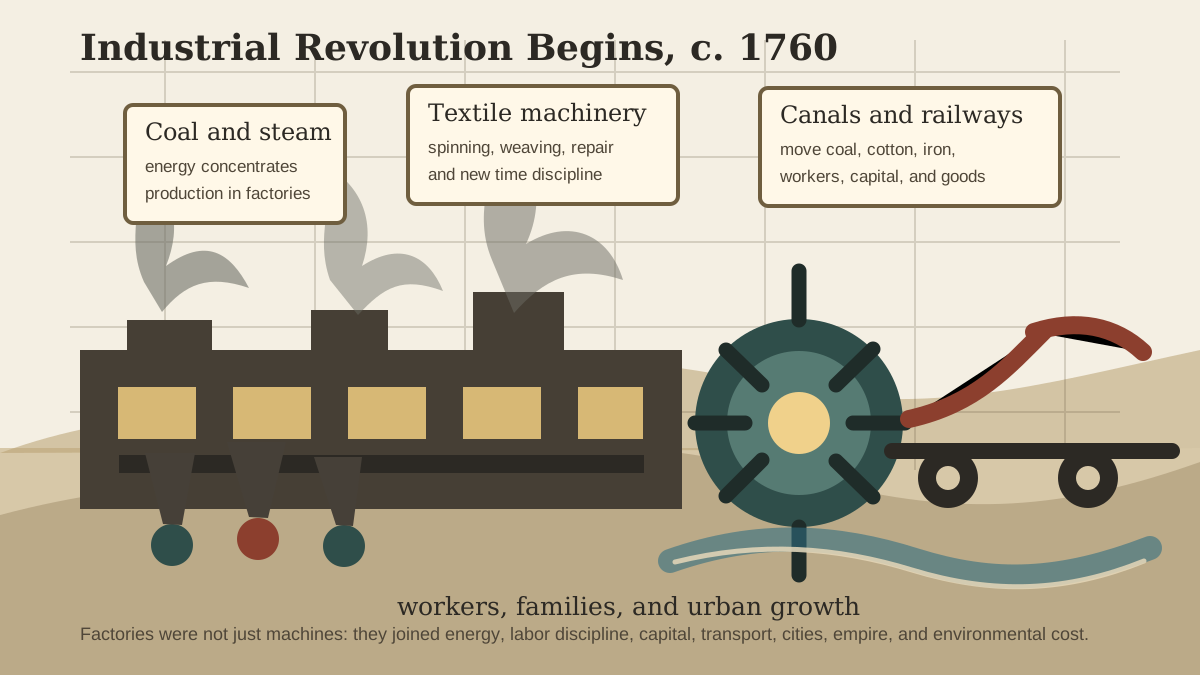
The Industrial Revolution began when energy access, capital, labor discipline, textile demand, technical experimentation, patents, transport, agriculture, and imperial markets combined into a system of mechanized production. Key sequence: early modern science and commerce created conditions, eighteenth-century Britain concentrated coal, capital, and textile demand, and nineteenth-century railways, steam power, factories, and global markets widened the transformation. The map matters because coalfields, textile towns, ports, canals, railways, plantations, and imperial supply chains explain why industrialization was spatially uneven. The human stakes are concrete: factory workers, miners, women and children in textile labor, enslaved cotton producers, inventors, investors, consumers, and colonized producers all belonged to the industrial system.
Why Did the Industrial Revolution Begin cannot be answered by a definition alone. The answer has to name the people, places, institutions, corridors, and conflicts that made the process visible.
Reading Paths
Choose a reading path
Why Did the Industrial Revolution Begin? becomes clearer when the broad answer stays tied to sequence, place, and concrete next pages.
Start with a concrete event, then return to the fast answer with evidence in view.
Scientific Revolution Begins
Publications by Copernicus and Vesalius helped mark a new phase in European inquiry about astronomy, anatomy, evidence, and method.
Newton Publishes Principia
Isaac Newton published the Principia, presenting laws of motion and universal gravitation in a mathematical framework.
Industrial Revolution Begins
Mechanized production, coal energy, factory organization, and new transport systems began transforming work and wealth in Britain before spreading globally.
Opening of the Suez Canal
The Suez Canal opened a direct water path between the Mediterranean and Red Sea, shortening sea travel between Europe and Asia.
First Transcontinental Railroad Completed
The first transcontinental railroad in the United States linked eastern and western rail networks after years of construction.
How to Think About It
The Industrial Revolution began when energy access, capital, labor discipline, textile demand, technical experimentation, patents, transport, agriculture, and imperial markets combined into a system of mechanized production
early modern science and commerce created conditions, eighteenth-century Britain concentrated coal, capital, and textile demand, and nineteenth-century railways, steam power, factories, and global markets widened the transformation
coalfields, textile towns, ports, canals, railways, plantations, and imperial supply chains explain why industrialization was spatially uneven
factory workers, miners, women and children in textile labor, enslaved cotton producers, inventors, investors, consumers, and colonized producers all belonged to the industrial system
Debate centers on whether energy, wages, institutions, empire, science, capital, or ecological pressure mattered most in the first breakthrough
Fast Explanation
The Industrial Revolution began when energy access, capital, labor discipline, textile demand, technical experimentation, patents, transport, agriculture, and imperial markets combined into a system of mechanized production. The answer becomes persuasive only when it is tied to named places, institutions, and choices rather than repeated as a slogan.
early modern science and commerce created conditions, eighteenth-century Britain concentrated coal, capital, and textile demand, and nineteenth-century railways, steam power, factories, and global markets widened the transformation. That order matters because it shows when pressure built, when people still had choices, and when later outcomes narrowed those choices.
Dates, places, institutions, names, and affected groups carry the explanation. factory workers, miners, women and children in textile labor, enslaved cotton producers, inventors, investors, consumers, and colonized producers all belonged to the industrial system.
A reader can test the answer by following one named case first, then asking whether the same pattern appears elsewhere. The best examples usually show a pressure becoming visible in law, labor, violence, diplomacy, technology, or public memory.
The useful question is never only what happened. Ask who had leverage, who had to react, what place made action possible, what institution preserved the change, and what later memory simplified. That habit turns a broad answer into a historical argument instead of a glossary entry.
Causes and Conditions
The causes sit in layers. Long-term conditions created pressure: resources, labor systems, beliefs, state capacity, borders, technology, public language, and inherited inequality. Immediate triggers then made the pressure visible through a crisis, law, protest, battle, treaty, discovery, or institutional failure.
The common misconception is that a few inventions alone caused industrialization. That misconception survives because it is simple, but it hides the sequence. A better answer separates background conditions from triggers and then follows the decisions that made one outcome more likely than another.
The strongest causal explanation also includes people who did not control formal institutions. Workers, enslaved people, colonized communities, soldiers, women, migrants, students, religious communities, scientists, officials, and local leaders often changed the path by resisting, adapting, organizing, translating, or refusing.
The same cause can also work differently across regions. A port, empire, plantation, school, borderland, laboratory, or city council could translate the larger pressure into a local choice with its own risks and limits.
Geography and Movement
coalfields, textile towns, ports, canals, railways, plantations, and imperial supply chains explain why industrialization was spatially uneven. The map determines what could move, how fast, and at what cost. Ports, rivers, mountain passes, railroads, plantations, capitals, treaty ports, islands, borderlands, and disease corridors all change the shape of the explanation.
Geography also changes whose experience becomes visible. A capital may preserve speeches and laws, while a port reveals labor, disease, migration, customs records, and commercial pressure. A battlefield shows command decisions; a village or settlement may show taxes, land loss, hunger, religious change, or family separation.
Once the places are visible, the reader can ask why the story unfolded there and not somewhere else. The geography is part of the cause, not scenery behind the cause.
Affected Groups and Unequal Power
factory workers, miners, women and children in textile labor, enslaved cotton producers, inventors, investors, consumers, and colonized producers all belonged to the industrial system. The people most affected were not always the people most visible in official sources. A careful explanation keeps both formal decision-makers and less powerful communities in the same frame.
Unequal power changes the evidence. Officials leave records that explain policy; communities under pressure may appear through petitions, court cases, archaeology, oral memory, music, protest, missionary records, business records, or hostile descriptions written by others. Reading those sources requires attention to voice and silence.
This human layer also makes the topic more readable. Readers keep going when the stakes are concrete: land, food, family, wages, law, schooling, worship, voting, safety, sovereignty, mobility, or memory. The explanation becomes richer when those stakes are named directly.
Debate and Misconception
Debate centers on whether energy, wages, institutions, empire, science, capital, or ecological pressure mattered most in the first breakthrough. Debate does not weaken the explanation. It shows where historians, communities, and public memory disagree about cause, responsibility, significance, or moral language.
The common mistake is to make the topic too clean. Some histories are remembered as progress, but they also include coercion. Others are remembered as catastrophe, but they also include survival, adaptation, and new political claims. A useful explainer keeps those tensions on the surface.
Another mistake is to treat later categories as if actors at the time already shared them. Words such as empire, nation, rights, race, science, globalization, reform, sovereignty, and civilization changed meaning. The page works when it explains vocabulary as part of the history.
Consequences and Why It Still Matters
Industrialization matters because it changed work, cities, family life, warfare, empire, inequality, climate, and the speed of global economic connection. The consequences belong in more than one time frame. Immediate effects changed institutions and decisions; medium-term effects changed alliances, economies, education, borders, movements, or laws; long-term effects shaped memory and later political language.
Each connected event adds a case where the topic becomes visible. Order matters, because wars, reforms, revolutions, treaties, migrations, technologies, and social movements stop looking isolated when their sequence is clear.
The strongest follow-up is to test the fast answer against one concrete case, then return to the larger question with sharper evidence.
How to Use This Reading Path
The reading path works best in three passes. First, read the fast answer to get the basic claim. Second, follow the event links in chronological order. Third, return to the question and ask which event changed the claim most. That rhythm turns a broad topic into a sequence of evidence rather than a loose definition.
The linked timelines add another layer. They reveal whether the topic was a short crisis, a long transformation, or a recurring pattern that changed meaning in different periods. A single event can explain a trigger, but a timeline explains why the trigger had consequences beyond the moment.
The topic hubs widen the frame without scattering the reader. A question about why did the industrial revolution begin? may lead into trade, empire, rights, religion, science, disease, nationalism, or decolonization. The hub links show those neighboring paths while keeping the original search intent anchored to one canonical answer.
Source awareness belongs inside the reading path. Official documents often preserve decisions; museum and archive collections preserve material evidence; encyclopedias stabilize chronology; community memory preserves experiences that formal records may flatten. Reading across source types makes the explanation less brittle.
A strong answer begins in Britain without treating Britain as magically inventive. Coal near navigable water, high urban demand, commercial credit, patent culture, textile markets, skilled artisans, and state protection for property and trade all mattered because they reinforced one another. The useful point is the combination: coal without capital stays underground, invention without markets remains local, and markets without transport cannot easily reorganize production.
Textiles make the breakthrough easier to picture. Cotton moved through fields, ports, warehouses, spinning rooms, weaving sheds, shops, and overseas markets. Enslaved labor in the Atlantic world and coerced colonial production helped supply raw material and purchasing power, while British inventors and investors reorganized spinning and weaving inside factories. The Industrial Revolution was therefore not only a domestic factory story; it was a global commodity story.
Energy changed the ceiling of production. Water frames and water power mattered early, but coal and steam loosened the dependence on river sites and seasonal flows. That shift helped factories, mines, ironworks, railways, and urban growth reinforce each other. The question is not simply who invented a machine, but why a society had enough fuel, demand, skill, finance, and labor discipline for machines to spread.
Labor discipline deserves direct attention because mechanization changed time. Factory bells, wage books, overseers, child labor, gendered pay, mine work, injury, housing, and urban crowding made industrialization visible in ordinary lives. Workers did not merely enter a new economy; they entered new rhythms of supervision and dependence. Later unions, reform laws, public health campaigns, and political movements grew from those pressures.
Agriculture and transport supplied less dramatic but essential foundations. Enclosure, crop changes, market farming, canals, roads, ports, and railways changed how food, raw materials, and finished goods moved. A factory town could grow only if food arrived, workers moved, coal reached machines, and goods found buyers. Industrialization was a system of movement before it was a collection of inventions.
The long consequence is that industrialization reorganized power beyond factories. States could arm faster, cities could grow larger, companies could scale production, empires could extract and ship more efficiently, and carbon energy could transform the climate over time. That is why the page connects scientific change, steam, railways, canals, telegraphy, empire, labor conflict, and environmental afterlife instead of isolating one heroic inventor.
The timing also matters. Industrialization did not arrive everywhere at once, and the early British pattern was not a universal recipe. Belgium, France, Germany, the United States, Japan, India, China, Russia, and Latin American economies encountered industry through different mixtures of state policy, foreign capital, railways, tariffs, military pressure, labor systems, and colonial dependency. A good answer explains origin without pretending later paths were copies.
Readers should also separate invention from adoption. A machine can be patented before it becomes profitable, and a technique can exist before enough workshops, mechanics, investors, suppliers, and buyers can support it. The industrial breakthrough happened when many small improvements could be repeated, repaired, financed, taught, and scaled. That is why workshops and skilled labor belong beside famous machines.
The environmental layer is not an afterthought. Coal, iron, cotton, steam, canals, railways, and later oil changed landscapes as well as wages. Mining scars, smoke, water pollution, urban crowding, plantation expansion, and fossil carbon show that industrial growth redistributed environmental costs. The page becomes more useful when it asks who received cheaper goods and who absorbed dangerous work or damaged land.
For a reader building an essay, the safest structure is a chain rather than a list: energy and resources made mechanization possible; labor and markets made it profitable; finance and institutions made it scalable; transport made it connected; empire and global exchange widened supply and demand; social conflict and environmental change revealed the costs. That chain answers the cause question without reducing history to invention.
Manchester is useful as a mental anchor, but the explanation works better when it does not become a single-city story. Lancashire mills, Midlands metalworking, Scottish engineering, Welsh coal, Liverpool shipping, Caribbean and American cotton, Indian textile competition, and colonial markets all belonged to the same widening system. The map of industrialization crosses the factory wall.
The reader can finish by asking a counterfactual question: which missing condition would have slowed the breakthrough most? Without coal, steam power loses scale. Without cotton demand, textile mechanization loses urgency. Without credit and patents, invention spreads unevenly. Without transport, cheap output cannot travel. The strength of the explanation is that no single condition works alone.
That is why the cause question remains useful after the first answer. It trains readers to connect technology with labor, ecology, finance, empire, and state power. The Industrial Revolution began as a regional breakthrough, but it matters because its system of energy-intensive growth became a world historical problem.
Counterexamples are useful too. When one linked event does not fit the quick answer, it may reveal a regional difference, a missing institution, a weaker source trail, or a later memory that changed the topic's meaning.
The most useful note-taking method is to separate four columns: pressure, trigger, institution, and consequence. Pressure explains why change became possible. Trigger explains why it became visible. Institution explains how change became durable. Consequence explains why later people remembered it.
The final reading question is not whether the topic was important in general. It is which concrete people, places, and institutions made it important. Once those are visible, the explanation can support essays, classroom study, search snippets, and deeper browsing without losing historical texture.
A second path is comparative. Place two linked events beside each other and ask what changed: the actors, the geography, the technology, the legal language, the scale of violence, or the memory afterward. Comparison keeps the explainer from becoming a one-directional summary.
A third path is source-led. Start with the strongest institutional source, then ask which voices it privileges. Move to a museum, archive, or event page to recover material evidence and local experience. The answer becomes stronger when it treats evidence as part of the story instead of a footnote.
A fourth path is vocabulary-led. Terms such as empire, rights, reform, globalization, nation, revolution, science, and religion carry different meanings in different periods. Track how the term changes from the earliest linked event to the latest one, and the broad question becomes a historical sequence.
The reading path also supports a practical study habit: after reading, summarize the answer in one sentence, then add one example that proves it and one example that complicates it. If both examples fit, the explanation has enough depth to be useful beyond a search snippet.
The last pass is human. Name who gained, who paid, who moved, who was forced, who argued, who recorded the event, and who later remembered it differently. Broad explanations become memorable when they end with people rather than abstractions.
That human pass also reveals limits. Some sources make officials easy to quote while leaving workers, families, captives, migrants, or local witnesses harder to hear. The reading path keeps those limits visible so the answer remains curious rather than overconfident, and it gives the next click a real historical purpose grounded in evidence, geography, lived stakes, public memory, institutions, consequences, contingency, conflict over power, and changing historical vocabulary. It also helps readers notice when an apparently simple answer is really a dispute over records, authority, survival, and interpretation.
Map Layer
Why Did the Industrial Revolution Begin? map examples
Gold pins mark the approximate locations of published event pages. This is a schematic locator map, not a historical border map.
Coordinates are approximate and are used to help readers orient themselves before opening a full event page.
Examples
Events That Make the Pattern Visible
Scientific Revolution Begins
Publications by Copernicus and Vesalius helped mark a new phase in European inquiry about astronomy, anatomy, evidence, and method.
Newton Publishes Principia
Isaac Newton published the Principia, presenting laws of motion and universal gravitation in a mathematical framework.
Industrial Revolution Begins
Mechanized production, coal energy, factory organization, and new transport systems began transforming work and wealth in Britain before spreading globally.
Opening of the Suez Canal
The Suez Canal opened a direct water path between the Mediterranean and Red Sea, shortening sea travel between Europe and Asia.
First Transcontinental Railroad Completed
The first transcontinental railroad in the United States linked eastern and western rail networks after years of construction.
Telephone Patented
Alexander Graham Bell received a patent for the telephone, helping launch a new era of voice communication over distance.
References
Where to Check the Facts
- Encyclopaedia Britannica: Scientific RevolutionReference for early modern scientific change.
- Encyclopaedia Britannica: Industrial RevolutionReference for mechanization, industry, and social change.
- Science Museum: The Industrial RevolutionMuseum reference for industrial technology and social transformation.
- Science and Industry Museum: Objects and StoriesMuseum reference for industrial collections, Manchester, invention, and social transformation.