At a Glance
The shape of the event
- Date
- c. 65,000 BCE
- Place
- Northern Australia
- Type
- Migration and Settlement
The settlement of Australia by First Peoples shows that human migration crossed sea gaps, adapted to varied environments, and created some of the world's longest continuous cultural histories.
c. 65,000 BCE; place the event in Northern Australia before comparing causes or consequences.
The event makes Oceania central to deep history and prevents world-history maps from beginning only with agriculture, writing, or Eurasian states.
First Peoples of Australia are the first names or groups to compare before widening the story.
Communities established enduring relationships with Australian landscapes, waters, seasonal knowledge, story, and place.
Communities established enduring relationships with Australian landscapes, waters, seasonal knowledge, story, and place.
The event makes Oceania central to deep history and prevents world-history maps from beginning only with agriculture, writing, or Eurasian states.
Follow this thread to understand how early settlement set the terms for later cultural developments across Australia and Oceania: how seasonal knowledge became law and song, how stories mapped resources and routes, an...
Background
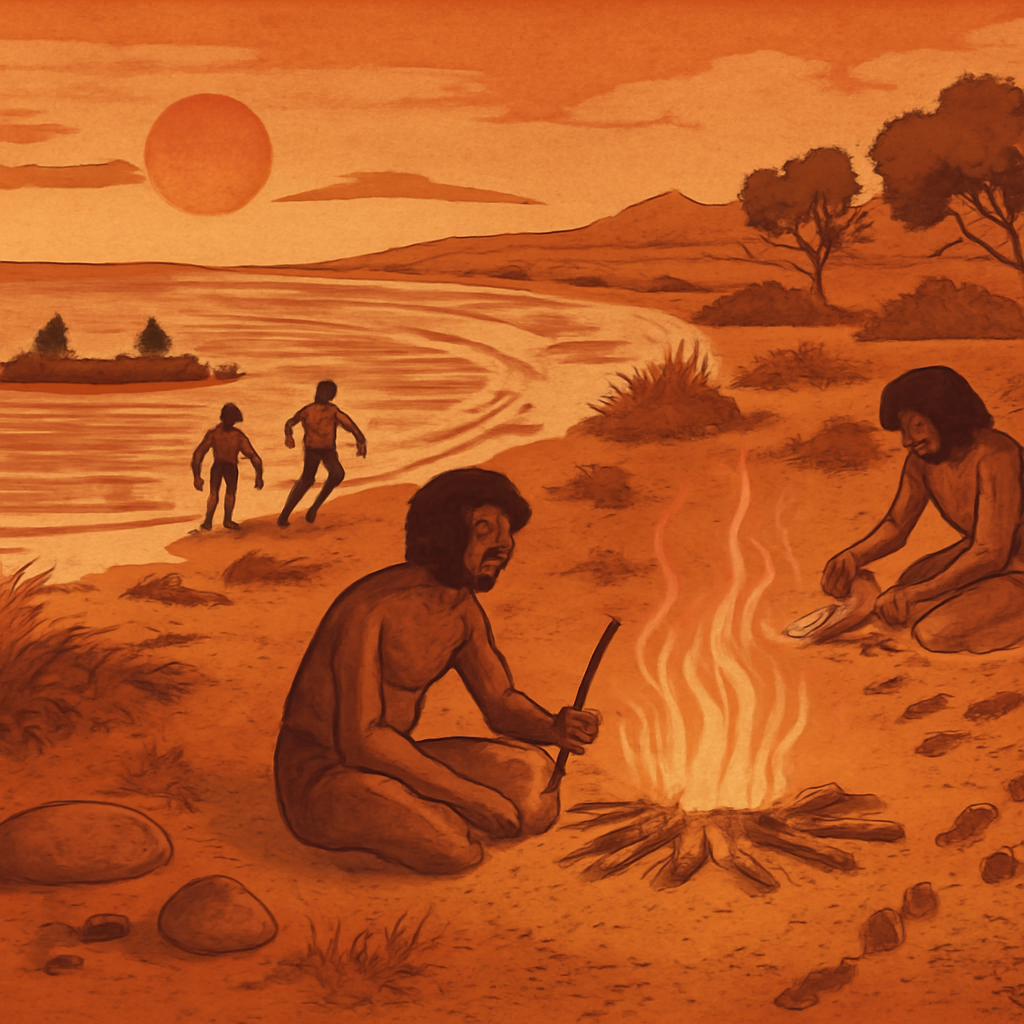
Long before later cities and texts reshaped global memory, human groups were already moving across continents and seas. In the world of c. 65,000 BCE, the landscapes of Sahul and the scattered islands of Oceania presented a range of opportunities and obstacles: coastlines, shallow seas, islands, freshwater and seasonal resources. The people who would be called the First Peoples of Australia brought capacities for travel and flexible lifeways and encountered existing geographies, local resource patterns, and social expectations that made certain choices more plausible than others. These pressures do not add up to a single cause.
Migration and settlement were pushed and pulled by many forces acting together — by immediate actors making route and camp decisions, and by longer-term patterns of environment, resource distribution, and social knowledge already present in the region. Crucially, this was not a one-off arrival: the crossing of sea gaps and the repeated occupation of place turned mobility into durable habitation and cultural continuity. The settlement of Australia needs a deep-time frame that feels alive rather than distant. During lower sea levels, Australia, New Guinea, and Tasmania formed Sahul, but reaching Sahul still required sea crossings. Those crossings imply planning, memory, watercraft, social coordination, and knowledge of coasts and islands. This was not accidental drift. Evidence also needs to be visible.
Archaeological sites such as Madjedbebe, debates over dates, stone tools, ochre, hearths, rock art, ancient landscapes, genetics, and oral traditions all help historians and archaeologists reconstruct early presence. The evidence is powerful, but it is also interpreted carefully because deep time rarely gives simple documents.
The Turning Point
What changed during this event was the shift from transient movement to lived settlement across northern Australia and Sahul. The actors were people — groups and households whose choices mattered: to attempt sea crossings, to linger on particular coasts or river systems, to carry and refine seasonal knowledge, and to pass story and place-based practice between generations. Crossing sea gaps made these choices possible in the first place; settling was the deliberate follow-through. Those decisions produced new daily routines and social arrangements: systems for finding food and water across seasons, ways of moving across known terrain, and the emergence of place-based knowledge embedded in story and ceremony.
The change was concrete and small-scale — camps became repeated camps, seasonal rounds lengthened into territorial familiarity — but its cumulative effect was to anchor communities in specific landscapes and waters. In short, the turning point was not merely arrival; it was the transformation of arrival into ongoing relationships of people to place. The turning point was not arrival alone; it was continuity. People learned water sources, seasonal foods, fire regimes, animal behavior, stone resources, and story routes. Movement became knowledge, and knowledge became responsibility to Country. Fire belongs in the story. Carefully used burning could shape vegetation, hunting grounds, pathways, and ecological mosaics.
Debate continues over the timing and scale of human effects on megafauna and environments, but the larger point is clear: First Peoples were not passive occupants of a wilderness. They managed and interpreted landscapes over immense stretches of time.
Consequences
Near-term, these settlements created communities that learned local ecologies and developed seasonal practices, oral traditions, and territorial knowledge tuned to the varieties of Australian environments. Those practices allowed people to use coasts, floodplains, woodlands and waterways reliably across generations. Over the long term, the settlement of Sahul anchored some of the world’s longest continuous cultural histories: oral knowledge, place-based institutions and seasonal calendars that tied identity to landscape and water. The broader consequence for global history is conceptual: Oceania becomes central to deep prehistory, a region whose antiquity forces historians to stop telling world history only from the vantage of later agriculture, writing, or Eurasian polities.
Finally, when historians ask why this migration happened, the hardest answer is causation itself: immediate human decisions mattered, but those decisions made sense only in a context of existing geography, resources, social expectations and institutions already woven into Sahul and the surrounding islands. That complexity cautions against single-factor explanations and invites attention to processes of long-term adaptation. The result is one of the longest continuous human histories on Earth. That continuity reframes world history because it gives Australia and Sahul a central place in the story of human movement, adaptation, memory, and environmental knowledge long before cities, writing, or states. The page should also connect deep past to present responsibility.
Archaeological evidence and Indigenous knowledge are not rival curiosities; they raise questions about custodianship, land rights, heritage protection, and how modern readers talk about histories that never stopped being lived.
Interpretation Notes
The hardest question around First Peoples Settle Australia is causation. The event had immediate actors, but its meaning also came from institutions, geography, resources, and expectations already present in Sahul and Oceania.
Why Keep Reading
Follow this thread to understand how early settlement set the terms for later cultural developments across Australia and Oceania: how seasonal knowledge became law and song, how stories mapped resources and routes, and how long-standing relationships with place shaped responses to later environmental and social changes. The settlement of Sahul reframes questions of human movement and belonging; the next entries trace the lives, technologies, and institutions those first settlements made possible and the ways they persisted into historical time. Read this page with out-of-Africa migration, Pacific voyaging, First Peoples' land management, Cook's 1770 claim, and native title. The path links deep migration to living sovereignty and keeps Australia inside the main map of world history.
Reading Path
Follow the story without losing the thread
Before This
- Out of Africa Migration Expandsc. 70,000 BCE
- Homo sapiens Emergesc. 300,000 BCE
After This
- Neolithic Farming Expandsc. 10,000 BCE
- Lapita Expansion Beginsc. 1600 BCE
- Fall of the Western Roman Empire, 476 AD: What Happened Next476 CE
Same Period
- Homo sapiens Emergesc. 300,000 BCE
- Out of Africa Migration Expandsc. 70,000 BCE
- Fall of the Aztec Empire1521 CE
Wider Timeline
Mind Map
How to think about First Peoples Settle Australia
sea gaps
crossing shallow seas and island steps that connected Sahul and Oceania
Map Layer
Where this event sits geographically
Gold pins mark the approximate locations of published event pages. This is a schematic locator map, not a historical border map.
Coordinates are approximate and are used to help readers orient themselves before opening a full event page.
References
Where to Check the Facts
- National Museum of Australia: Evidence of First PeoplesInstitutional reference for archaeological evidence and First Peoples' deep presence in Australia.
- Encyclopaedia Britannica: Australia, HistorySupporting reference for early human settlement and Australian historical context.
- The Metropolitan Museum of Art: TenochtitlanMuseum reference for Mexica urban power, Tenochtitlan, and pre-Columbian imperial context.
- Encyclopaedia Britannica: The Spanish Conquest of the AztecsReference for the Spanish conquest, alliances, Tenochtitlan siege, and Indigenous context.