At a Glance
The shape of the event
- Date
- c. 70,000 BCE
- Place
- Northeast Africa and Southwest Asia
- Type
- Migration
Groups of Homo sapiens expanded beyond Africa over many generations, carrying technologies, social practices, and genetic lineages into Southwest Asia and then wider Eurasia.
c. 70,000 BCE; place the event in Northeast Africa and Southwest Asia before comparing causes or consequences.
The migration makes world history global before agriculture or states, connecting African origins with later settlement across Asia, Europe, Australia, and the Pacific.
early human migrant communities are the first names or groups to compare before widening the story.
Human populations spread into new environments and began long processes of adaptation, contact, and cultural diversification.
Human populations spread into new environments and began long processes of adaptation, contact, and cultural diversification.
The migration makes world history global before agriculture or states, connecting African origins with later settlement across Asia, Europe, Australia, and the Pacific.
Follow this episode to see how those first expansions set patterns that recur across prehistory: regional adaptation, recurring mobility, and the layering of cultural practices over millennia.
Background
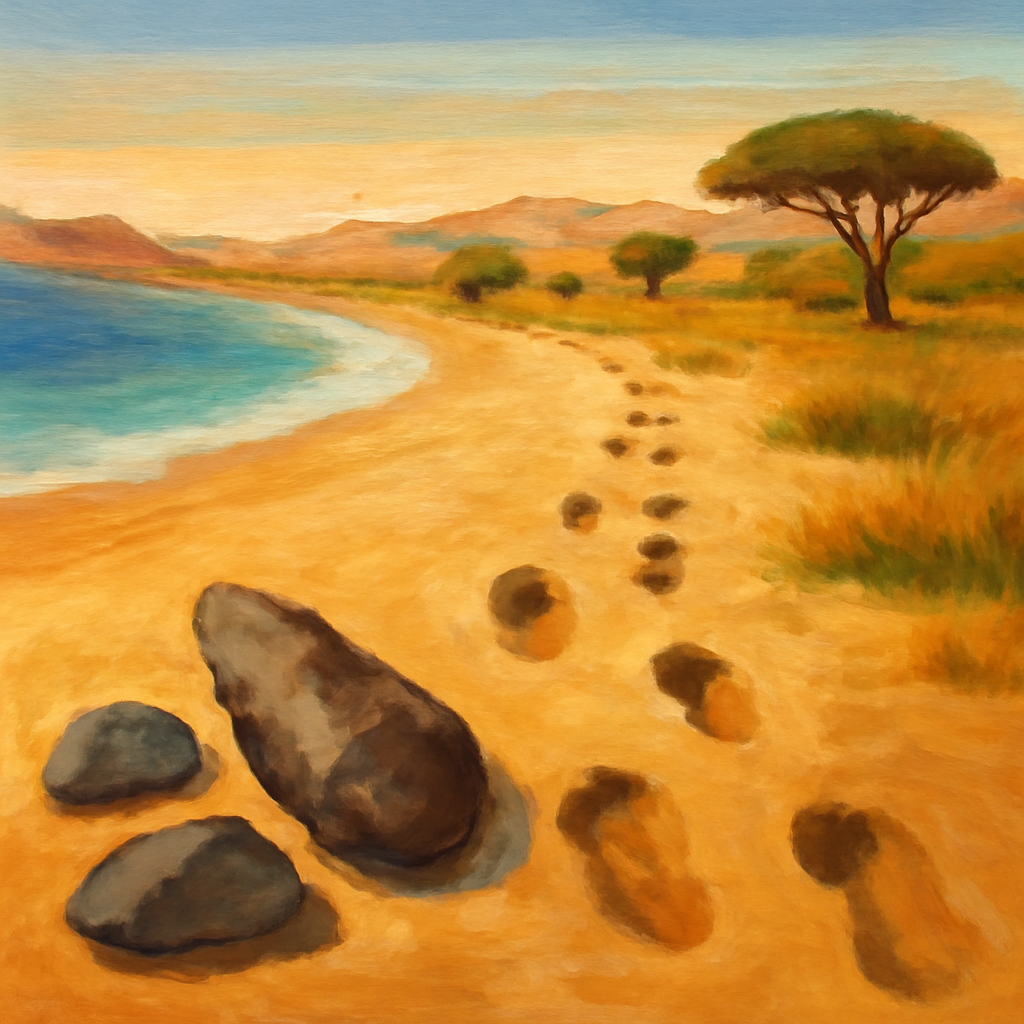
The expansion Out of Africa was the product of centuries of incremental decisions by people living in and around Northeast Africa. These communities transmitted know-how—tool use, foraging strategies, social ties—across generations. Environmental shifts, local resource patterns, and demographic rhythms created conditions in which groups sometimes moved, sometimes split, and sometimes stayed put; no single pressure explains the whole story. Movement occurred on human timescales: family groups and multi-generational networks testing new valleys, seasonal ranges, and river corridors. Those movements happened in a world without agriculture or hierarchic states, where survival relied on cooperation, memory, and flexible social arrangements.
From that position, the step beyond Africa was less a singular exodus than a widening of human presence: people carried useful practices and genetic lineages into neighboring lands, turning regional lifeways into lines of connection that would later shape even more distant migrations. The evidence base also needs to stay visible. Fossils, stone tools, genetic lineages, climate records, cave deposits, and shoreline archaeology do not tell the same story at the same resolution. A careful account lets readers see why migration dates are often ranges, why routes are debated, and why Northeast Africa, the Red Sea, Sinai, Arabia, and the Levant can all matter without turning the expansion into a single arrow on a map.
Out-of-Africa migration is a deep-history event about movement, adaptation, climate, coastlines, tools, language possibilities, and genetic evidence. It cannot be read as a single march; it was a long and uneven process of human dispersal across changing environments. The evidence comes from genetics, archaeology, fossils, stone tools, climate reconstruction, and debates over route timing. That mixture makes the event a method lesson as well as an origin story.
The Turning Point
What changed during the expansion was cumulative and social rather than instantaneous. Early human migrant communities made repeated choices to move into Southwest Asia’s different environments, bringing their technologies and patterns of living with them. These were concrete decisions by families and bands: to follow seasonal resources, to settle temporarily in new landscapes, to share knowledge across kinship ties, and to maintain links with groups left behind. By carrying workable tools and social arrangements into unfamiliar ecological zones, these groups created footholds beyond Northeast Africa. Over many generations those footholds expanded, producing networks of mobility and exchange that allowed human populations to persist and diversify outside their original range.
The actors were not abstractions but people making routine survival choices; the turning point was cumulative—an accumulation of migrations and adaptations that established new population centers and opened routes for future dispersals. The strongest reading follows repeated thresholds rather than one heroic departure. A group that crossed into a new ecological zone still had to find water, learn seasonal patterns, avoid isolation, exchange partners, and pass knowledge to children. Each successful foothold made the next movement more likely, so the turning point was a chain of survivable decisions across generations.
Consequences
In the near term, the expansion spread people into new environments where they adapted hunting, foraging, mobility, and shelter strategies to unfamiliar climates and landscapes. Those adaptations produced regional variation in material practices and social patterns. Over subsequent generations, the movement set in motion long processes of contact and cultural diversification: groups encountering different ecologies developed distinct ways of living, and the genetic lineages carried by early migrants became part of wider human diversity across Eurasia. In the long term, this migration makes world history more than a sequence of later civilizations; it anchors a global story in the deep past, showing how African origins connected to later human presence across Asia, Europe, Australia, and the Pacific.
How later societies remember and interpret this expansion has depended on who tells the story—courts, religious traditions, scholarly traditions, and modern nations have emphasized different causes and meanings—but the basic consequence remains: human life became truly intercontinental long before states and agriculture emerged. The consequences also include contact with other human populations and with unfamiliar animal and plant worlds. Movement did not produce instant global mastery; it produced experiment, failure, local adaptation, and new forms of social memory. That slower view makes the page more useful for students because it replaces a simple migration map with a living process of testing landscapes.
The consequences are enormous: human communities spread into Asia, Australia, Europe, and eventually the Americas, meeting varied ecologies and sometimes other hominins. The event matters because all later history rests on deep patterns of movement and adaptation.
Interpretation Notes
The memory of Out of Africa Migration Expands often depends on who tells the story. A court, army, religious community, merchant network, or later nation can emphasize different causes and make Northeast Africa and Southwest Asia stand for different lessons.
Why Keep Reading
Follow this episode to see how those first expansions set patterns that recur across prehistory: regional adaptation, recurring mobility, and the layering of cultural practices over millennia. Tracing the next chapters—how groups dispersed further into Eurasia, how technologies shifted with shifting environments, and how contacts deepened—reveals the connective tissue between early migrations and later histories. If you want to understand how global human presence began before written records, or how deep-time movements shaped later diversity of languages, genes, and lifeways, the timelines and regional stories that follow are the clearest place to continue. The next route should connect deep time to later human diversity without treating later cultures as predetermined.
Follow early settlement of Australia, Pacific voyaging, Neolithic farming, and city formation to see how mobility, adaptation, and inherited knowledge kept changing scale. Read this event with Neolithic agriculture, early cities, human migration explainers, and world prehistory routes.
Reading Path
Follow the story without losing the thread
Before This
- Homo sapiens Emergesc. 300,000 BCE
After This
- First Peoples Settle Australiac. 65,000 BCE
- Neolithic Farming Expandsc. 10,000 BCE
- Kingdom of Kush Risesc. 1070 BCE
Same Period
- Homo sapiens Emergesc. 300,000 BCE
- First Peoples Settle Australiac. 65,000 BCE
- Berlin Conference1884-1885
Wider Timeline
Mind Map
How to think about Out of Africa Migration Expands
mobility pressures
local resource patterns and seasonal needs encouraged movement without implying a single cause
Map Layer
Where this event sits geographically
Gold pins mark the approximate locations of published event pages. This is a schematic locator map, not a historical border map.
Coordinates are approximate and are used to help readers orient themselves before opening a full event page.
References
Where to Check the Facts
- Smithsonian Human Origins Program: Human Evolution EvidenceReference for fossil, archaeological, and genetic evidence used to study human origins and dispersal.
- Encyclopaedia Britannica: Human evolutionSupporting reference for the broad human-evolution and dispersal context.