At a Glance
The shape of the event
- Date
- c. 300,000 BCE
- Place
- Jebel Irhoud
- Type
- Human Origins
Early Homo sapiens fossils in Africa mark a deep human-origin horizon, showing that modern humans emerged through a long African evolutionary story rather than a sudden single event.
c. 300,000 BCE; place the event in Jebel Irhoud before comparing causes or consequences.
The event gives the atlas a deep-time opening: human history begins before cities, empires, writing, and states, with evidence from fossils, archaeology, genetics, and landscapes.
early Homo sapiens communities are the first names or groups to compare before widening the story.
Africa became the central starting point for later human migration, adaptation, language, toolmaking, and social development.
Africa became the central starting point for later human migration, adaptation, language, toolmaking, and social development.
The event gives the atlas a deep-time opening: human history begins before cities, empires, writing, and states, with evidence from fossils, archaeology, genetics, and landscapes.
Follow the threads from Jebel Irhoud to see how small, local choices multiplied into continental change.
Background
Human origins are a story of pressures and possibilities rather than a single dramatic invention. For hundreds of thousands of years across Africa, shifting climates, varied ecologies and the daily demands of finding food, shelter and allies created selective pressures on communities of early Homo sapiens. These pressures worked alongside social learning, incremental changes in stone-tool production, and patterns of mobility that let groups exchange ideas and genes across landscapes. The archaeological trace at places like Jebel Irhoud captures a particular slice of that long process: anatomical traits we recognise as Homo sapiens appear amid technologies and behaviours that continued to evolve. Scholars debate what scale of change matters most.
One view reads the Jebel Irhoud fossils as a visible origin—clear anatomical markers that mark the species we are used to naming Homo sapiens. Another stresses older, diffuse pressures: long-term population structure, intermittent contact among groups, and ecological constraints that narrowed the range of viable adaptations. Both perspectives illuminate parts of the truth. The point for this atlas is practical: these fossils anchor a horizon. They do not end the story; they provide a fixed point from which to trace the long prehistory of migration, social life, language precursors and toolmaking that would lead, only much later, to settled villages, cities and states. Homo sapiens emerging around 300,000 years ago is not a single birthday for humanity.
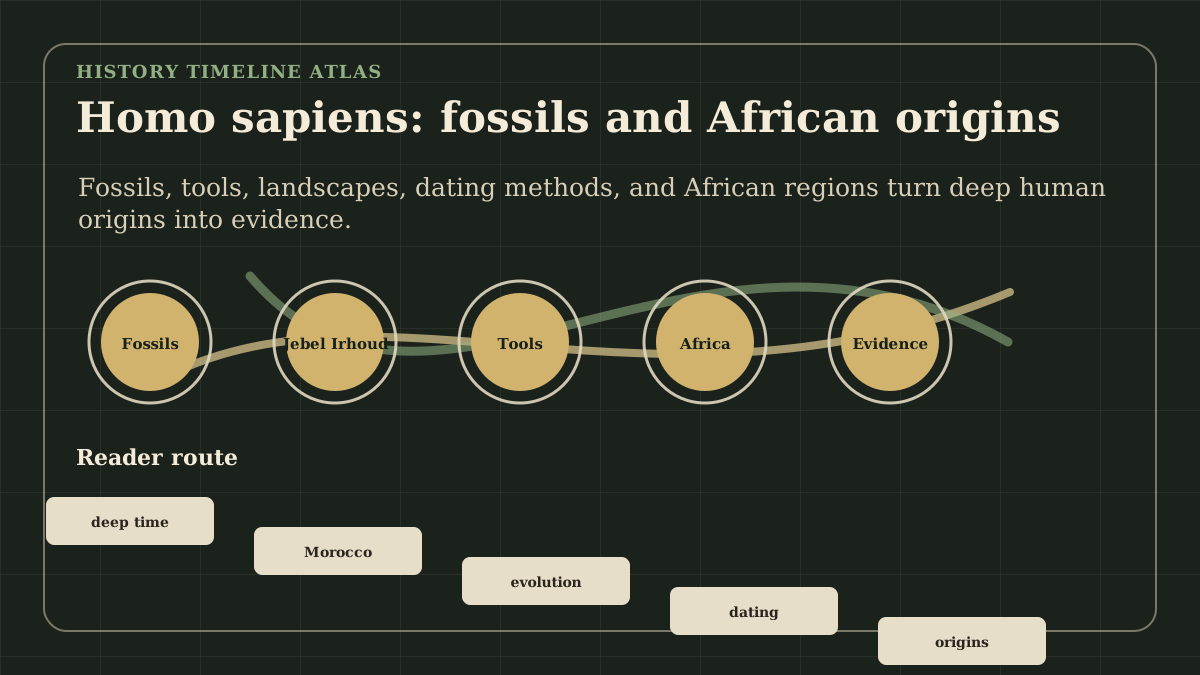
It is a cautious evidence horizon built from fossils, tools, dating methods, African landscapes, and comparison with other hominin populations. Readers need the uncertainty as much as the headline date because deep history is reconstructed from scattered traces rather than written testimony. Jebel Irhoud in Morocco matters because it widened the map of early Homo sapiens beyond one neat origin point. The evidence invites a network view of African human origins: different regions, climates, technologies, and populations contributed to a long biological and cultural process. The event is therefore better read as emergence across landscapes, not as one person, tribe, or sudden leap.
The page also needs to connect physical evidence to later human stories without collapsing hundreds of thousands of years. Fossils reveal anatomy, stone tools reveal learned practice, dating reveals chronology, and environmental evidence shows changing opportunity and risk. That combination helps readers move from deep time into migration, language, symbolism, farming, and the long routes that eventually made every region part of human history.
The Turning Point
The turning point signalled by the Jebel Irhoud evidence is not a single instant but a marked shift in the record: communities whose skeletal features align with what we call Homo sapiens occur alongside technologies and behaviours that were increasingly flexible and mobile. The concrete actors in this story are small groups of early Homo sapiens communities moving across North African landscapes. Their choices—how far to range each season, how to share and modify tools, whom to accept into social networks—altered patterns of survival and reproduction over generations. At Jebel Irhoud, the fossil assemblage makes those collective choices visible.
Bones show anatomical change; flint artefacts imply learned techniques passed between people; the site’s position in an African landscape points to routes of movement and resource use. That combination produced a widening adaptive repertoire: greater capacity to cope with ecological variability, to migrate in response to changing resources, and to carry cultural knowledge beyond a single valley or basin. Importantly, the change was distributed: no single leader or moment created Homo sapiens. It was a cumulative outcome of repeated behavioural decisions in many small communities across Africa. The decision-making operated at the scale of households and bands, but its aggregate effect framed later large-scale migrations and cultural diversification that define human prehistory.
The turning point is evidentiary rather than political: by roughly this period, fossils associated with early Homo sapiens show a pattern close enough to later humans that the story of our species can be discussed with firmer grounding. The date remains approximate, but it gives readers an anchor for deep time. Another turning point is interpretive. Human origins are no longer best presented as a straight ladder or a single migration arrow. The evidence supports a braided history of populations, exchanges, extinctions, environmental pressures, and regional adaptations across Africa before later dispersals carried Homo sapiens farther.
Consequences
In the near term, the emergence of anatomically recognisable Homo sapiens at Jebel Irhoud reoriented where researchers look for the roots of human behaviour. It foregrounded Africa as the central starting point for later episodes of dispersal: people who carried these anatomies and cultural practices would, over many millennia, venture beyond the continent and adapt to new continents and climates. The immediate archaeological implication was methodological: archaeologists and geneticists began to integrate fossil evidence with stone-tool sequences, landscape studies and ancient DNA to reconstruct how populations moved and mixed. Longer-term consequences reach into every chapter of human history.
Becoming Homo sapiens in Africa set the preconditions for the later development of more complex technologies, diverse subsistence strategies, expanded social networks and ultimately language systems capable of carrying cumulative culture. Those capacities fed migrations that populated Eurasia, Australia and, far later, the Americas. For the atlas, this event offers a deep-time opening: it reminds readers that the story of states and cities has a long preface in mobile foragers whose choices shaped genetic and cultural lineages. Caution is still needed: the Jebel Irhoud horizon is an anchor, not a closure. Debates about scale—whether decisive change was sudden or distributed—remain central to interpreting what 'emergence' truly meant. The immediate consequence was not empire, farming, writing, or cities.
It was the presence of a species capable of accumulating learned behavior across generations while adapting to changing environments. That slow accumulation is what makes later cultural leaps possible without making them automatic. The longer consequence is that every later page on the site rests on this deep foundation. Migrations, Indigenous continuity, agriculture, cities, religion, war, science, and modern politics all begin with human communities that learned, remembered, moved, adapted, and made meaning long before written history.
Interpretation Notes
Homo sapiens Emerges raises a debate about scale: did the decisive change come from the visible human origins, or from older pressures around Prehistory and Human Evolution that had already narrowed what people could do?
Why Keep Reading
Follow the threads from Jebel Irhoud to see how small, local choices multiplied into continental change. Read on to trace the archaeological and genetic evidence that tracks migration routes out of Africa, to compare early stone-tool traditions with later innovations, and to encounter the sites and landscapes where hunters and foragers tested new ways of living. The atlas will move from this deep-time origin to episodes of regional diversification, the spread of agriculture, and the eventual rise of cities. Keeping this deep origin in view alters how we read later events: migrations, empires and languages are continuations of a much older human experiment in adaptation and social learning.
Read this page before Out of Africa migration, settlement of Australia, Neolithic farming, and early city pages. That route keeps prehistory from becoming a prologue and shows how evidence, movement, environment, and continuity built the human world long before states appeared.
Reading Path
Follow the story without losing the thread
Before This
No direct path yet.
After This
- Out of Africa Migration Expandsc. 70,000 BCE
- First Peoples Settle Australiac. 65,000 BCE
- Neolithic Farming Expandsc. 10,000 BCE
Same Period
- Out of Africa Migration Expandsc. 70,000 BCE
- First Peoples Settle Australiac. 65,000 BCE
- Berlin Conference1884-1885
Wider Timeline
Mind Map
How to think about Homo sapiens Emerges
Climate variability
Shifting African climates created selective pressures that favoured flexible foraging and mobility
Map Layer
Where this event sits geographically
Gold pins mark the approximate locations of published event pages. This is a schematic locator map, not a historical border map.
Coordinates are approximate and are used to help readers orient themselves before opening a full event page.
References
Where to Check the Facts
- Smithsonian Human Origins Program: Homo sapiensReference for Homo sapiens fossils, chronology, and the African human-origins frame.
- Encyclopaedia Britannica: Homo sapiensSupporting reference for modern human classification, chronology, and evolutionary context.