At a Glance
The shape of the event
- Date
- April 26, 1986
- Place
- Chernobyl
- Type
- Nuclear Disaster
A reactor explosion at Chernobyl released radioactive material and exposed failures in technology, secrecy, emergency response, and public trust.
April 26, 1986; place the event in Chernobyl before comparing causes or consequences.
Chernobyl damaged confidence in Soviet governance and shaped debates over nuclear power, risk, and transparency.
Soviet authorities are the first names or groups to compare before widening the story.
Large areas were contaminated, communities were evacuated, and the disaster became a global nuclear safety crisis.
Large areas were contaminated, communities were evacuated, and the disaster became a global nuclear safety crisis.
Chernobyl damaged confidence in Soviet governance and shaped debates over nuclear power, risk, and transparency.
Follow the aftermath to see how immediate responses turned into policy change and public debate.
Background
By the mid-1980s, nuclear power was embedded in the politics and engineering of the Soviet Union. Reactors like the one at Chernobyl represented a commitment to large-scale technological solutions to energy needs, built within a system that prized rapid expansion and centralized control. At the same time, Cold War pressures and the interplay of professional hierarchies shaped decisions around safety, training and maintenance. Operational procedures, oversight mechanisms and a culture that discouraged public dissent meant that problems often stayed internal until they could not. Soviet authorities managed information tightly; that secrecy could limit timely warnings to local communities and to neighboring countries. Human factors—operator actions, training gaps, and emergency responses—interacted with technical design features of the reactor.
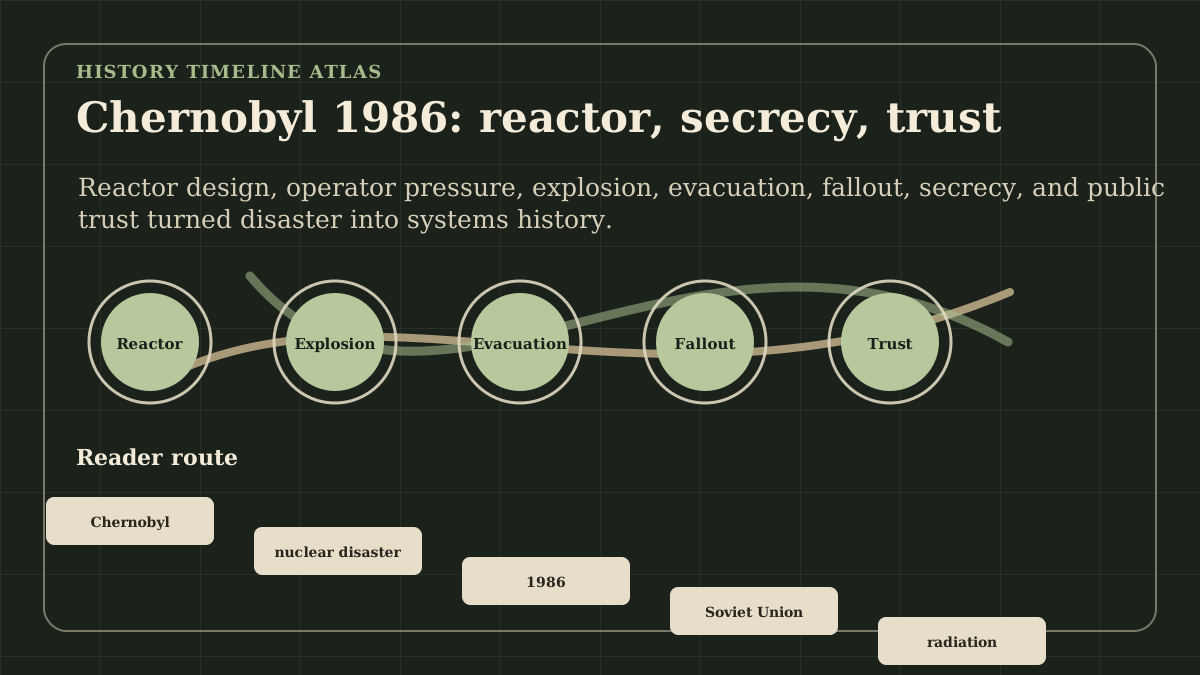
Historians and engineers disagree about how much weight to place on individual mistakes versus systemic pressures. This account keeps that uncertainty in view, presenting concrete failures and choices while acknowledging broader institutional forces that framed them. Chernobyl belongs in a history atlas because it reveals systems under stress: reactor design, safety culture, operator pressure, secrecy, emergency response, Soviet bureaucracy, public trust, and the environmental reach of modern technology. It was not only an accident at one plant. The disaster becomes clearer when the reactor room and the wider state are connected. Technical decisions happened inside institutions that shaped training, reporting, incentives, and what could be admitted.
A dangerous test, design weaknesses, and human decisions interacted with a political culture that made bad news hard to move upward. Radiation changed the map. Fallout crossed administrative borders, while evacuation, exclusion zones, health monitoring, contaminated land, and public fear turned an invisible hazard into a long-term social and environmental problem.
The Turning Point
The turning point came in a concentrated sequence of decisions and technical events inside the reactor complex. On the evening of April 26, a test and the actions surrounding it intersected with a reactor design that behaved unpredictably under certain conditions. When the explosion occurred, plant staff and nearby personnel became the first responders; their immediate task was rescue, containment and gathering information. Soviet authorities faced a choice about information and mobilization: local managers initially sought to manage the incident within established hierarchies, while higher authorities weighed the political and technical implications.
Time mattered—delays in evacuation orders, incomplete public alerts and limited disclosure to neighboring republics and the wider world allowed the release and spread of radioactive material to affect larger populations. Firefighters and workers entered hazardous areas with limited information about radiation levels; their efforts contained fires and stabilized damaged systems but exposed them to danger. International alarms rose only after radiation monitors in other countries registered anomalies. In short, the event changed from an internal plant accident to a transnational crisis through a combination of technical failure, emergency choices, and constrained communication by Soviet authorities. The turning point was the explosion and the delay in truthful communication.
Emergency workers, firefighters, plant staff, residents of Pripyat, and officials faced a crisis whose scale was not immediately acknowledged. Time mattered because radiation exposure, evacuation decisions, and public warnings all depended on information. Chernobyl also changed the politics of trust. Glasnost was already altering Soviet public life, but the disaster gave citizens and the world a concrete case in which secrecy, expertise, risk, and state credibility collided.
Consequences
In the weeks that followed, large areas of land became known as contaminated; towns and villages were evacuated and declared exclusion zones. The immediate human toll included displaced communities and emergency personnel exposed to radiation, and the longer-term consequences pushed into public health, environmental management and governance. Politically, the disaster undercut confidence in Soviet management and secrecy, fueling debates about transparency, accountability and the competence of the state apparatus. Globally, Chernobyl reframed discussions about nuclear safety standards, emergency preparedness and international cooperation on radiation monitoring. Scientific and medical communities engaged in long-term study of contamination, land use and health impacts, while governments adjusted regulatory regimes and safety oversight in response.
Important debates remain unsettled: scholars and practitioners continue to dispute the relative roles of operator errors, reactor design flaws and systemic pressures such as production targets and information control. The disaster established enduring symbols—abandoned settlements, a sealed reactor sarcophagus, and contested maps of contamination—that keep resurfacing in policy conversations about risk, technology and the obligations of states to citizens. The consequences included deaths and illness debates, displacement, environmental contamination, reactor policy changes, international nuclear safety cooperation, and a persistent memory of sacrifice and mistrust. The event also shaped how people think about technological risk when institutions hide uncertainty. The page connects science and politics. A reactor disaster is not explained by physics alone.
It also requires attention to bureaucracy, design, training, emergency planning, public communication, and the people who lived with evacuation and contamination.
Interpretation Notes
Chernobyl Disaster raises a debate about scale: did the decisive change come from the visible nuclear disaster, or from older pressures around Cold War and Nuclear Technology that had already narrowed what people could do?
Why Keep Reading
Follow the aftermath to see how immediate responses turned into policy change and public debate. The weeks and months after April 1986 reveal how evacuations were organized, how scientific teams mapped contamination, and how affected communities navigated displacement. Reading onward shows how Chernobyl influenced international safety standards and transparency norms during the late Cold War and into the post-Soviet era. If you want to understand how a single industrial accident reshaped public trust and technical governance, the next pages trace those institutional shifts and the human stories that drove them. Read Chernobyl beside the Cold War timeline, Soviet reform, the Partial Test Ban Treaty, Fukushima where available, and science-and-technology routes.
The path follows nuclear systems from weapons to energy, public trust, and institutional failure.
Reading Path
Follow the story without losing the thread
Before This
- Solidarity Movement in Poland1980
- Soviet-Afghan War BeginsDecember 1979
- Iranian Revolution1978-1979 CE
After This
- INF Treaty SignedDecember 8, 1987
- Fall of the Berlin WallNovember 9, 1989
- German ReunificationOctober 3, 1990
Same Period
- Cuban Missile CrisisOctober 1962
- Apollo 11 Moon LandingJuly 20, 1969
- Fall of the Berlin WallNovember 9, 1989
Wider Timeline
Mind Map
How to think about Chernobyl Disaster
Design features
Reactor characteristics that behaved unpredictably under certain test conditions
Map Layer
Where this event sits geographically
Gold pins mark the approximate locations of published event pages. This is a schematic locator map, not a historical border map.
Coordinates are approximate and are used to help readers orient themselves before opening a full event page.
References
Where to Check the Facts
- U.S. National Archives: The Cold WarArchive reference hub for Cold War records, federal documentation, and research guidance.
- Office of the Historian: The Early Cold War, 1945-1952Official diplomatic history reference for early Cold War foreign-policy context.
- Science Museum: Objects and StoriesMuseum reference hub for science, technology, medicine, invention, and public understanding.