At a Glance
The shape of the event
- Date
- 216 BCE
- Place
- Cannae
- Type
- Battle
Hannibal's Carthaginian army destroyed a much larger Roman force at Cannae during the Second Punic War.
216 BCE; place the event in Cannae before comparing causes or consequences.
Cannae became a classic study in battlefield tactics and in Rome's capacity to survive catastrophic loss.
Hannibal / Roman Republic are the first names or groups to compare before widening the story.
Rome suffered a severe defeat but refused to surrender or abandon the war.
Rome suffered a severe defeat but refused to surrender or abandon the war.
Cannae became a classic study in battlefield tactics and in Rome's capacity to survive catastrophic loss.
Follow the aftermath to see how a republic rebuilt after existential shock.
Background
The Second Punic War had already dragged on when two armies faced each other at Cannae. Rome and Carthage were locked in a struggle for Mediterranean primacy that combined sea power, shifting alliances, and campaigns fought across great distances. Hannibal, the Carthaginian general who had marched into Italy years earlier, remained the most immediate embodiment of the threat to Rome. On the Roman side stood a republic whose institutions prioritized mobilization, civic duty, and harsh penalties for failure. These political and military cultures created pressures on commanders, on recruitment, and on strategy. Economies, alliances among Italian communities, and the need to maintain prestige all pushed both sides toward decisive engagements.
Yet scholars caution against a single-cause reading: structural factors like logistics and state capacity mattered alongside the decisions of generals. Cannae therefore arrived at the intersection of personal command, institutional expectations, and the wider strategic war that framed those choices. Cannae rewards a reader who slows down before the famous encirclement. The battle came after Rome had already suffered shocks from Hannibal's crossing of the Alps, his victories in northern and central Italy, and the strain of keeping allies loyal while armies were destroyed. Roman commanders brought a huge force because the republic needed a decisive answer, but size created its own danger when deployed against an opponent who understood space, morale, and cavalry.
The battlefield was not just a flat backdrop. Heat, dust, river lines, infantry depth, and cavalry wings helped turn Roman confidence into vulnerability.
The Turning Point
What changed during the battle was not merely the collapse of a field army but the unmasking of vulnerabilities in Rome’s military practice and the stark demonstration of Carthaginian capability. On the plain at Cannae, Hannibal’s force met a Roman army described in contemporary and later accounts as far larger. The fighting that followed ended with the Roman formation broken and its fighting power effectively destroyed for that encounter. For Hannibal this was a clear, dramatic success: his army had achieved what it set out to do on the field. For Rome the immediate moment was a calamity that exposed how a single rout could translate into political crisis.
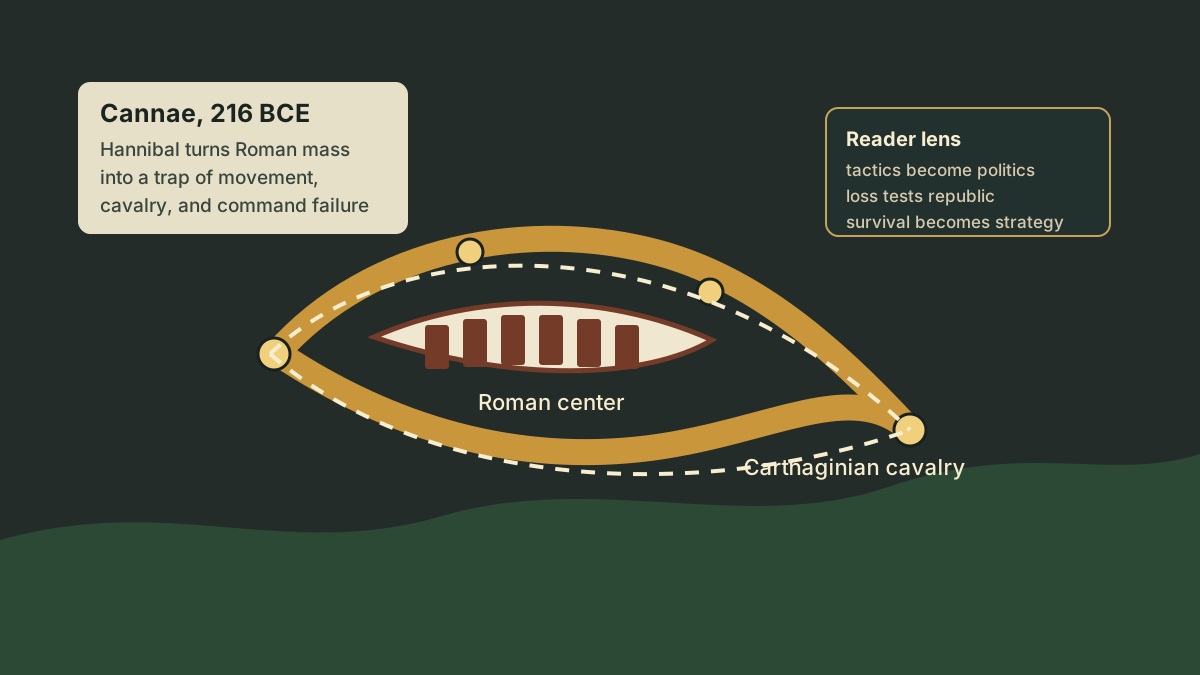
Yet Rome’s response in the aftermath—refusing to sue for peace or abandon the war effort—was itself a pivotal choice. Leaders in the Roman state reconstituted forces, tightened alliances where possible, and adapted strategy to avoid repeating the vulnerabilities showcased at Cannae. Historians differ on emphasis: some highlight Hannibal’s operational choices and tactical craft, others point to institutional habits and strategic limits that made a Roman defeat possible. Keeping those debates visible helps explain why Cannae remains a point of study rather than a closed case. The decisive turn came when Hannibal's center yielded without breaking while his stronger wings and cavalry shaped the Roman mass inward.
Roman soldiers pressed forward, believing they were winning, but their density reduced movement and command. Carthaginian cavalry success on the flanks mattered as much as infantry courage in the center. Once Roman units could not maneuver, the battle became an example of tactical design meeting political overconfidence. That is why Cannae became a model studied for centuries: it shows how an army can lose not because it lacked bravery, but because its formation made bravery unusable.
Consequences
In the near term, Cannae was a catastrophic defeat for Rome and a powerful triumph for Carthage. Politically, the Roman Senate confronted military disaster and social strain, while some of Rome’s allies reconsidered loyalties as the balance of intimidation shifted. For Hannibal, it provided the momentum to press his advantage in Italy and to win sympathy among certain Italian communities. But longer-term consequences tell a less simple story. Rome’s refusal to capitulate meant that the republic could draw on deeper reserves—administrative, economic, and civic—that undermined the strategic value of even a great tactical victory.
Cannae became a lesson not only in battlefield technique but in the limits of battlefield victory to decide wars when an opponent retains the will and resources to continue fighting. Over generations, military students and statesmen treated Cannae as a cautionary emblem: a demonstration of how operational success can fail to translate into strategic collapse of an enemy. Interpretations continue to diverge over whether the battle’s outcome flowed mainly from Hannibal’s command and immediate choices, or from larger structural forces—Rome’s recruitment systems, its alliance networks, and its political culture. Both perspectives help explain why the battle mattered as both a tactical masterpiece and a turning point that failed to end the war.
The aftermath was catastrophic, yet Rome did not collapse. That fact is as important as the defeat itself. Some allies defected, but many remained loyal; the Senate refused to negotiate; commanders shifted toward attrition, supply pressure, and avoiding Hannibal's preferred battles. Cannae therefore tells two stories at once: the brilliance of Hannibal's field command and the institutional resilience of the Roman Republic. Both patterns matter because the battle's meaning lies in the gap between military disaster and political survival.
Interpretation Notes
Battle of Cannae raises a debate about scale: did the decisive change come from the visible battle, or from older pressures around Rome and Carthage that had already narrowed what people could do?
Why Keep Reading
Follow the aftermath to see how a republic rebuilt after existential shock. The months and years after Cannae show how political institutions, local loyalties, and strategic adaptation can outlast a singular military disaster. Readers who continue to the next pages will encounter shifting alliances in Italy, Roman political reforms, and campaigns that reveal whether a battlefield victory can translate into lasting political advantage. If you want to understand the longer arc of the Second Punic War, the Roman recovery after Cannae is the watershed moment worth tracing. Read next into the Second Punic War, Roman alliance systems, Scipio Africanus, and Zama. Cannae is the battlefield shock; the later story explains why shock did not become strategic victory.
Reading Path
Follow the story without losing the thread
Before This
- Qin Unification of China221 BCE
- Ashoka Turns Toward Buddhismc. 260 BCE
- First Punic War Begins264 BCE
After This
- Han Dynasty Founded202 BCE
- Zhang Qian's Western Mission138 BCE
- Assassination of Julius CaesarMarch 15, 44 BCE
Same Period
Wider Timeline
Mind Map
How to think about Battle of Cannae
strategic rivalry
Longstanding competition between Rome and Carthage for Mediterranean dominance
Map Layer
Where this event sits geographically
Gold pins mark the approximate locations of published event pages. This is a schematic locator map, not a historical border map.
Coordinates are approximate and are used to help readers orient themselves before opening a full event page.
References
Where to Check the Facts
- Encyclopaedia Britannica: Battle of CannaeSpecific reference for the 216 BCE battle, Hannibal's tactics, and Rome's severe defeat.
- World History Encyclopedia: Battle of CannaeNarrative reference for Cannae's battlefield setting and Roman-Carthaginian war context.