At a Glance
The shape of the event
- Date
- c. 1050 CE
- Place
- Cahokia
- Type
- Urban Expansion
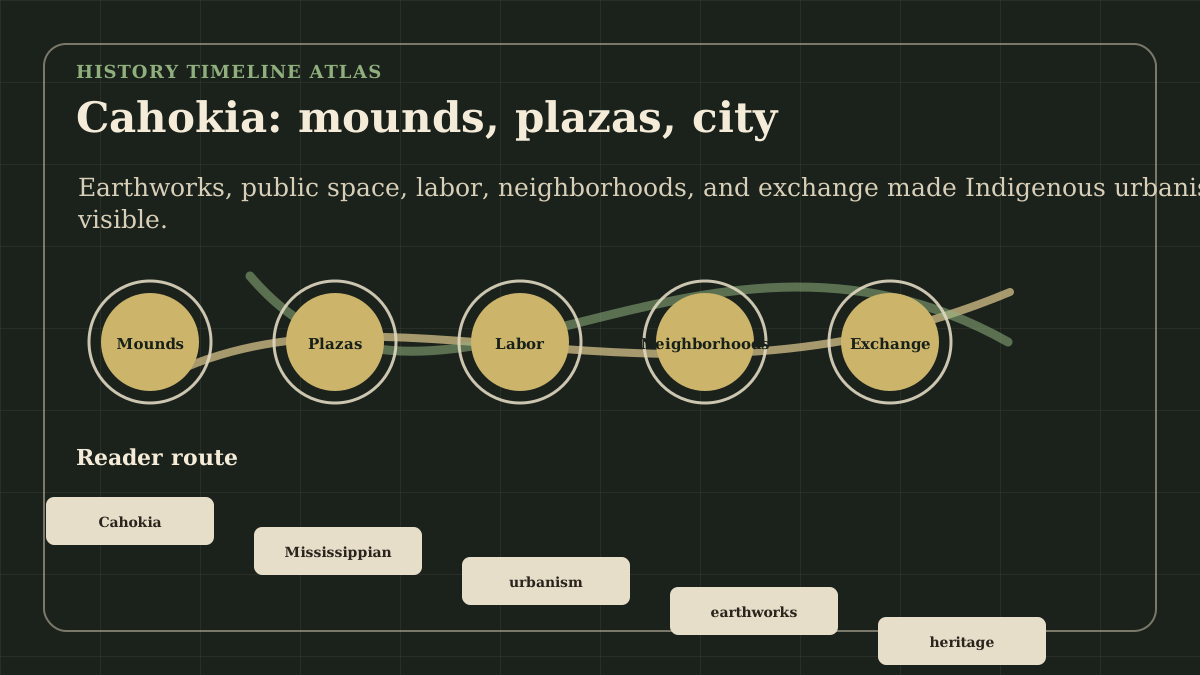
Cahokia expanded into the largest pre-Columbian urban center north of Mexico, with mounds, plazas, neighborhoods, and regional influence.
c. 1050 CE; place the event in Cahokia before comparing causes or consequences.
Cahokia prevents the Americas route from treating North America only through later colonial settlement.
Mississippian builders / Cahokia residents are the first names or groups to compare before widening the story.
The city became a central node in Mississippian political, ritual, and exchange networks.
The city became a central node in Mississippian political, ritual, and exchange networks.
Cahokia prevents the Americas route from treating North America only through later colonial settlement.
Follow Cahokia’s later chapters to see how centralization, ritual life and regional ties changed over time: did the city maintain its networks, or did rival centers emerge?
Background
Mississippian builders and Cahokia residents operated within traditions we now call Mississippian culture: a set of shared practices that favored large, shaped earthen architecture, organized plazas and visible neighborhoods. Those practices did not appear out of nowhere, nor did a single cause produce Cahokia’s growth. Multiple pressures converged—efforts to formalize ritual life, the need to coordinate labor across households, opportunities to control exchange routes through the Mississippi Valley, and political ambitions by emerging leaders. Archaeology reveals patterns of construction and settlement; oral memory and later public memory preserve different emphases; legal and diplomatic records do not speak for this time but shape later interpretations. None of these sources alone explains Cahokia’s rise.
Instead, the expansion reflects overlapping social choices, regional connections, and a willingness to invest human effort in visible, shared spaces. Cahokia becomes more compelling when readers stop treating mounds as static ruins. They were built environments that organized movement, sightlines, work, ritual, and authority. A mound was also time made visible: baskets of earth, repeated labor, planning, maintenance, and the decision to keep gathering around shared spaces. The city also challenges an old classroom habit of treating North American history before European arrival as scattered villages waiting for outside contact. Cahokia was urban, regional, and politically imaginative. It had neighborhoods, plazas, craft activity, food systems, long-distance exchange, ceremonial life, and social inequality.
Those features do not make it a copy of cities elsewhere; they make it a powerful Indigenous urban form on its own terms. Evidence matters because Cahokia speaks through archaeology, landscape, descendant communities, public interpretation, and contested heritage practices. Those traces invite careful questions from material remains without pretending that every social relationship can be recovered with certainty.
The Turning Point
What changed around c. 1050 CE was scale and visibility. Mississippian builders undertook coordinated programs of construction—mounds and plazas that restructured the landscape and created new focal points for public life. Cahokia residents rearranged daily routines around these public spaces: neighborhoods gathered near plazas, ritual specialists and political actors performed ceremonies on raised platforms, and exchange networks threaded out from the city into the wider Mississippi Valley. These were choices: to concentrate labor on earthworks rather than scattered features; to create open plazas that staged gatherings rather than simply fence off private areas; to cultivate links with distant communities through trade, marriage, and ritual.
The result was not merely a larger settlement but a new urban grammar—built visibility that supported claims to authority, created common time and place for large groups, and transmitted influence across the region. In short, Cahokia did not accidentally become big; its residents and builders made concrete decisions about how land, labor and ceremony would be used to make the city central. The turning point was the rapid reorganization of landscape and labor around monumental public space. Cahokia's rise made authority visible in earth, plazas, processions, feasting, residence patterns, and regional attraction. A second turning point was regional pull.
People and goods moved through Cahokia's orbit, and that movement made the city a reference point for surrounding communities, whether through attraction, obligation, exchange, or rivalry.
Consequences
In the near term, Cahokia’s expansion made the city a central node in Mississippian political, ritual and exchange networks: people traveled to its plazas, gifts and goods flowed along riverine paths, and political influence radiated outward from the mound complexes. Neighborhoods and public spaces changed how communities rehearsed power and belonging. In the longer view, Cahokia’s prominence reframes how historians and the public conceive of pre-contact North America. It challenges any narrative that treats the continent as marginal until European colonization by showing an indigenous urban phenomenon with regional reach.
At the same time, the story of Cahokia’s rise is contested: archaeological layers, oral memory, legal records and later public memory emphasize different actors and motives—rulers, laborers, affected communities—so the city’s meaning shifts depending on which evidence is centered. That plurality of perspectives is itself a consequence: modern debates over heritage, stewardship and interpretation trace back to who gets to tell Cahokia’s story and why. The immediate consequence was the growth of a major Mississippian center whose built environment could coordinate large gatherings and signal power across the Mississippi Valley. The longer consequence is interpretive. Cahokia forces readers to place Indigenous urbanism, engineering, agriculture, ritual authority, and regional exchange inside the history of cities.
It also raises modern questions about preservation, descendant communities, museums, and how public memory treats Indigenous places.
Interpretation Notes
Interpretations of Cahokia Rises depend on whose evidence is centered: rulers and official records, affected communities, oral memory, archaeology, law, diplomacy, labor, and later public memory do not always tell the same story.
Why Keep Reading
Follow Cahokia’s later chapters to see how centralization, ritual life and regional ties changed over time: did the city maintain its networks, or did rival centers emerge? Reading onward also reveals how different types of evidence—archaeology, oral history, and the records of later governments—build competing narratives about power and daily life. If you want to understand how monumental landscapes are made, remembered, and contested, tracing Cahokia’s trajectory offers key comparisons with other Mississippian towns and with the ways modern communities claim or challenge that past. Read Cahokia beside Teotihuacan, Pueblo Bonito, Tenochtitlan, and Indigenous Americas topic routes. That comparison widens the map of urban history and prevents cities from being defined only by Eurasian or colonial examples.
Reading Path
Follow the story without losing the thread
Before This
- Teotihuacan Reaches Its Urban Peakc. 450 CE
- Monte Alban Foundedc. 500 BCE
After This
- Pueblo Bonito Flourishesc. 1100 CE
- Tenochtitlan Founded1325
Same Period
- Monte Alban Foundedc. 500 BCE
- Teotihuacan Reaches Its Urban Peakc. 450 CE
- Pueblo Bonito Flourishesc. 1100 CE
Wider Timeline
Mind Map
How to think about Cahokia Rises
Communal labor
Coordinated effort to build mounds and plazas that reshaped the landscape and made public life possible.
Map Layer
Where this event sits geographically
Gold pins mark the approximate locations of published event pages. This is a schematic locator map, not a historical border map.
Coordinates are approximate and are used to help readers orient themselves before opening a full event page.
References
Where to Check the Facts
- Smithsonian National Museum of the American Indian: Native Knowledge 360Indigenous-centered educational reference for Native history, sovereignty, community knowledge, and public interpretation.
- Smithsonian NMAI: Haudenosaunee Guide for EducatorsCommunity-consulted educational reference for Haudenosaunee culture, history, continuity, and interpretation.
- Yale History: Ned Blackhawk, The Rediscovery of AmericaIndigenous historian's synthesis for centering Native peoples in broader American historical interpretation.
- Indigenous ChicagoCommunity-partnered public-history project for place-based Native history, maps, memory, and continuity.
- Encyclopaedia Britannica: Pre-Columbian civilizationsReference for pre-Columbian civilizations in Mesoamerica and the Andes before European conquest.
- Official UNESCO World Heritage Centre: Cahokia Mounds State Historic SiteReference for Cahokia as a major pre-Columbian settlement north of Mexico.