Fast Answer
Ottoman Empire and Safavid Empire both faced building gunpowder-era imperial authority across religious, military, and frontier competition, but the Ottomans built a long-lived transcontinental empire around Anatolia, the Balkans, Arab provinces, and Mediterranean politics, while the Safavids consolidated Iranian rule through Shi'a state identity, court culture, and rivalry with Ottoman power. The fastest answer starts with that contrast, then adds geography: Ottoman history moves through Istanbul, the Balkans, Anatolia, Egypt, the Black Sea, and Mediterranean routes; Safavid history centers Iran, Azerbaijan, Iraq frontier zones, and links toward Central and South Asia. The deeper answer keeps soldiers, tribal confederations, merchants, religious scholars, artisans, peasants, border communities, and court women lived inside the rivalry's costs and opportunities visible so the comparison does not become only a story of rulers, armies, or abstract systems.
Ottoman Empire and Safavid Empire become useful to compare when they are treated as answers to building gunpowder-era imperial authority across religious, military, and frontier competition. The comparison is not a scoreboard; it separates shared pressures from different institutions, geographies, vocabularies of legitimacy, and afterlives.
Reading Paths
Choose a reading path
Ottoman Empire vs Safavid Empire becomes clearer when the broad answer stays tied to sequence, place, and concrete next pages.
Follow the comparison through dated examples before returning to the grid.
Safavid Empire Founded
Ismail I founded the Safavid dynasty in Iran, creating a major early modern Islamic empire and making Twelver Shi'ism central to state identity.
Battle of Chaldiran
Ottoman forces defeated the Safavids at Chaldiran, exposing military differences, hardening an imperial frontier, and reshaping Sunni-Shi'a political rivalry.
Ottoman Conquest of Egypt
Ottoman conquest brought Egypt and the former Mamluk domains into the Ottoman imperial system, linking Cairo, Syria, the Red Sea, and pilgrimage paths to Istanbul.
Siege of Vienna
The Ottoman siege of Vienna tested the empire's ability to project power deep into Central Europe and made the Habsburg-Ottoman frontier a durable strategic zone.
Treaty of Zuhab
The Treaty of Zuhab stabilized parts of the Ottoman-Safavid frontier, making imperial rivalry visible through borders, diplomacy, and contested Iraqi and Iranian spaces.
Comparison Grid
Ottoman Empire
Ottoman Empire faced building gunpowder-era imperial authority across religious, military, and frontier competition through its own institutions and inherited expectations.
Safavid Empire
Safavid Empire faced the same broad problem through a different political, social, and geographic setting.
The shared question makes the comparison possible; the local setting prevents it from becoming flat.Ottoman Empire
Ottoman Empire becomes clearer when the map is read through routes, capitals, borders, and zones of contact.
Safavid Empire
Safavid Empire changes the map frame by emphasizing different corridors, centers, or frontiers.
Ottoman history moves through Istanbul, the Balkans, Anatolia, Egypt, the Black Sea, and Mediterranean routes; Safavid history centers Iran, Azerbaijan, Iraq frontier zones, and links toward Central and South AsiaOttoman Empire
Ottoman Empire shaped people who rarely appear as the main title of the event.
Safavid Empire
Safavid Empire also depended on ordinary labor, coercion, negotiation, and memory.
soldiers, tribal confederations, merchants, religious scholars, artisans, peasants, border communities, and court women lived inside the rivalry's costs and opportunitiesOttoman Empire
Ottoman Empire left institutions and symbols that later people reused.
Safavid Empire
Safavid Empire produced its own afterlife through law, memory, identity, or opposition.
Ottoman memory often carries empire, reform, and European diplomacy; Safavid memory carries Iranian state formation, Shi'a identity, art, and contested borderlandsWhy the Comparison Matters
Ottoman Empire and Safavid Empire are often named together because both look large on a map or central in a textbook sequence. That is only the entrance. The better comparison asks what problem each case tried to solve, which tools were available, and which costs were pushed onto people with less power. building gunpowder-era imperial authority across religious, military, and frontier competition gives the two cases a shared frame without pretending they were the same.
the Ottomans built a long-lived transcontinental empire around Anatolia, the Balkans, Arab provinces, and Mediterranean politics, while the Safavids consolidated Iranian rule through Shi'a state identity, court culture, and rivalry with Ottoman power. That difference changes the whole interpretation. A date, battle, law, treaty, or reform may look similar at first glance, but it worked through different institutions and expectations. The comparison becomes richer when readers track offices, ports, courts, religious authorities, armies, labor systems, taxes, and local communities rather than only matching one famous leader against another.
The comparison also protects the atlas from a narrow regional habit. It lets a familiar search query open into a wider world-historical method: keep one question constant, then let the evidence remain local. The result is more useful than a list of similarities and differences because it explains why the similarities appeared and why the differences mattered.
Causes, Pressures, and Turning Points
their rivalry emerged from state formation, frontier warfare, confessional politics, trade routes, military technology, and competition over legitimacy in the Islamic world. Causes here are layered. Some pressures were slow: fiscal strain, social hierarchy, trade routes, land hunger, legal tradition, religious authority, or inherited political memory. Others became visible as triggers: a battle, a treaty, a revolt, a reform, a crisis of succession, or a diplomatic failure.
For Ottoman Empire, the turning points reveal which institutions could absorb pressure and which could not. For Safavid Empire, the same question produces a different pattern because the political field, source record, and map were different. The strongest comparison keeps background pressure, immediate trigger, decision, and consequence in separate layers.
This separation matters for search intent as well as historical accuracy. A reader asking for causes usually needs more than a single origin story. The comparison shows how different causes can lead to apparently similar outcomes, and how similar pressures can produce different consequences when institutions, geography, and public memory diverge.
Geography and Institutions
Ottoman history moves through Istanbul, the Balkans, Anatolia, Egypt, the Black Sea, and Mediterranean routes; Safavid history centers Iran, Azerbaijan, Iraq frontier zones, and links toward Central and South Asia. Geography is not scenery in this comparison. It decides which routes mattered, where armies or officials could move, which ports or capitals collected information, and which borderlands became pressure zones. A map changes the answer because it makes distance, environment, and connection visible.
Institutions turn that geography into durable behavior. Courts, charters, councils, fleets, land systems, tribute, parliaments, assemblies, religious offices, companies, schools, and armies all created habits that outlasted individual decisions. Ottoman Empire and Safavid Empire differed most when those institutions translated ambition into ordinary practice.
The comparison therefore moves between scale and texture. Scale explains why the cases mattered across regions; texture explains how people experienced them locally. A capital city, a plantation, a frontier settlement, a treaty port, a courtroom, a village, and a battlefield each reveal a different part of the same historical structure.
People, Labor, and Affected Groups
soldiers, tribal confederations, merchants, religious scholars, artisans, peasants, border communities, and court women lived inside the rivalry's costs and opportunities. This is the layer that prevents the comparison from becoming too clean. Power operated through workers, soldiers, enslaved people, migrants, merchants, officials, women in households and courts, religious communities, students, colonized subjects, and local elites who had to live with decisions made elsewhere.
The human scale also changes causation. People did not only suffer systems; they adapted, resisted, interpreted, collaborated, fled, petitioned, organized, and remembered. Their actions often forced institutions to change. A comparison that includes affected groups can explain both top-down command and bottom-up pressure.
That wider lens is especially important when later memory turns complex histories into simplified symbols. Some groups become visible in monuments and schoolbooks; others survive in court records, petitions, oral traditions, material culture, or the silences of archives. The comparison invites readers to ask who is easy to see and who requires more careful reconstruction.
Consequences and Memory
Ottoman memory often carries empire, reform, and European diplomacy; Safavid memory carries Iranian state formation, Shi'a identity, art, and contested borderlands. Consequences did not stop when the main event sequence ended. Institutions, borders, categories of citizenship, racial systems, religious identities, economic habits, and political vocabulary often survived in altered forms. Memory then selected certain lessons and pushed others aside.
The afterlife of Ottoman Empire may appear in law, identity, statecraft, monuments, political language, or public arguments. The afterlife of Safavid Empire may appear through different channels. The point is not to flatten both into the same legacy, but to ask which institutions and memories continued to organize later choices.
A useful comparison ends with unresolved questions. Which consequences were immediate, which were medium-term, and which became durable? Which groups gained language for new claims? Which injuries remained unaddressed? Which later movements reused the memory for purposes the original actors could not have predicted?
How to Read the Evidence Trail
The linked events give the comparison a route. Start with the earliest event to see the background pressure, then follow the turning points in chronological order. Each event page adds a map, actors, causes, consequences, sources, and reading questions that keep the comparison grounded in evidence rather than analogy alone.
The timeline links keep chronology visible. They show whether the comparison concerns a short crisis, a long institutional transformation, or a memory that changed meaning across generations. The topic links widen the frame so the reader can move from a single comparison into empire, rights, trade, religion, science, decolonization, or global exchange.
The strongest reading method is recursive. Read the fast answer, inspect the comparison grid, follow one event, return to the map, and then ask whether the original contrast still holds. Good comparisons survive that test because they become more precise as evidence accumulates.
The final habit is humility about sources. Court chronicles, official treaties, newspapers, museum collections, oral memory, legal documents, diplomatic records, inscriptions, and later histories do not preserve the same voices. A comparison is strongest when it admits what the evidence shows clearly and where the record remains uneven.
A second pass through the route can use one factor at a time. Read only the geography first, then read only institutions, then read affected groups, then read memory. The comparison becomes easier to hold because each pass asks one focused question instead of demanding that the whole argument arrive at once.
The comparison also points outward. Related topic hubs explain the broader vocabulary, timeline pages keep the sequence visible, and event pages slow down the causal chain. That structure lets the reader move from a quick answer into deeper study without creating duplicate pages for every similar search phrase.
When the cases seem too far apart, return to the shared problem. When they seem too similar, return to the map. That two-step habit keeps the comparison flexible: the shared question creates coherence, and the local evidence restores difference.
The Ottoman-Safavid comparison becomes clearer when the frontier is treated as a living zone rather than a line. Eastern Anatolia, Azerbaijan, Iraq, the Caucasus, and trade corridors connected soldiers, tribal confederations, merchants, scholars, pilgrims, and tax communities. The rivalry was fought by armies, but it was also lived by people who crossed, guarded, negotiated, or suffered along frontier routes.
Chaldiran gives the page a dramatic entry point, but the battle does not explain the whole rivalry. Ottoman artillery, Janissary organization, cavalry, supply, and imperial command met Safavid charisma, Qizilbash support, frontier mobilization, and claims around Shi'a kingship. The battle revealed military differences, yet the long story remained about how each empire governed people after the battlefield moved on.
Religious identity mattered deeply, but it did not operate alone. Sunni and Shi'a claims were tied to dynastic legitimacy, legal institutions, court patronage, frontier politics, taxation, and alliances. A village, shrine, merchant route, tribal confederation, or court appointment could make confessional identity politically consequential. The page avoids making religion a simple label pasted onto two states.
The Ottoman state connected Istanbul, the Balkans, Anatolia, Egypt, the Arab provinces, the Black Sea, the Red Sea, and Mediterranean diplomacy. Safavid rule concentrated Iranian political identity, court culture, Shi'a authority, and connections toward Central and South Asia. The map matters because the two empires faced different pressures even when they fought over the same borderlands.
Trade adds another layer. Silk, horses, metal goods, textiles, taxes, caravan routes, and port access shaped policy as much as ideology. A frontier that looked like a religious divide could also be a commercial hinge. Merchants and local brokers often had to survive between imperial claims, and their choices reveal how rivalry affected ordinary exchange.
The Treaty of Zuhab gives the comparison a second anchor because it shows diplomacy after cycles of war. Treaties did not remove rivalry, but they stabilized expectations, named borders, and gave officials a framework for future negotiation. A good comparison follows war and treaty together: military competition made borders urgent; diplomacy made them administratively usable.
Court culture keeps the Safavid side from being reduced to conflict with the Ottomans. Isfahan, patronage, architecture, poetry, painting, religious scholarship, and commercial life made Safavid legitimacy visible in ways not captured by battlefield summaries. Ottoman court, law, military households, provincial administration, and reform politics carried a different institutional memory.
The nineteenth-century Ottoman reform route also belongs here because it shows afterlife. Tanzimat reforms were not Safavid history, but they reveal how Ottoman imperial memory adapted under European pressure, internal diversity, and administrative modernization. The comparison therefore stretches from gunpowder rivalry to later questions of empire, reform, and regional political memory.
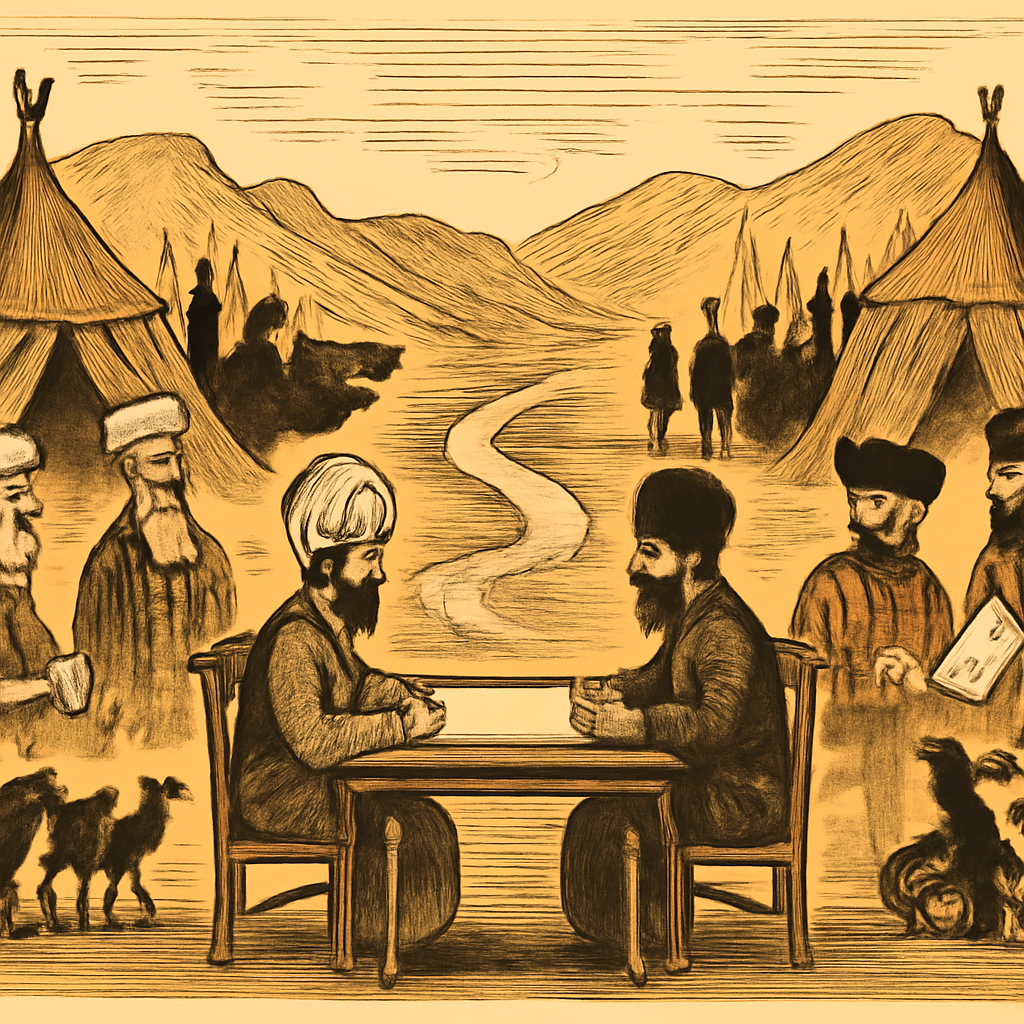
The visual focuses on camps, negotiation, routes, and documents because the comparison needs more than two rulers facing each other. It invites the reader to ask where rivalry became daily life: a frontier village, a caravan stop, a religious school, a tax district, a soldier's camp, a treaty table, or a court workshop.
The comparison also benefits from separating three kinds of border. There was a military border where forts, campaigns, and supply routes mattered. There was a confessional border where scholars, shrines, law, and dynastic legitimacy mattered. There was a commercial border where silk, horses, textiles, customs revenue, and caravan protection mattered. The same place could be all three, which is why a simple map line cannot explain the rivalry.
State capacity looked different on each side. Ottoman institutions drew on military households, provincial governors, legal-administrative practice, and an imperial capital with long connections to the Mediterranean and Balkans. Safavid capacity depended heavily on Qizilbash power, royal patronage, Persian administrative traditions, Shi'a scholarly authority, and the creation of a court culture able to outlast factional violence. Both states were gunpowder empires, but gunpowder did not make them administratively identical.
A strong reading path asks readers to move from foundation to shock, from shock to border-making, and from border-making to memory. Safavid foundation explains religious and dynastic energy. Chaldiran explains military asymmetry and rivalry. Egypt and Vienna show Ottoman scale beyond the eastern frontier. Zuhab shows diplomacy. Tanzimat shows the later Ottoman afterlife. Together those links turn the page into a route through power, not a detached comparison table.
The result is a comparison about systems under pressure. Each empire claimed universal authority in religious and political language, but each had to make deals with local power, military labor, merchants, scholars, and frontier communities. That tension between universal claim and local bargain is what makes the Ottoman-Safavid rivalry historically durable.
A final check is to name one institution, one place, one affected group, and one memory for each side. If any slot stays empty, the comparison still has a blind spot worth following through the linked pages.
Reader Lenses
building gunpowder-era imperial authority across religious, military, and frontier competition
the Ottomans built a long-lived transcontinental empire around Anatolia, the Balkans, Arab provinces, and Mediterranean politics, while the Safavids consolidated Iranian rule through Shi'a state identity, court culture, and rivalry with Ottoman power
Ottoman history moves through Istanbul, the Balkans, Anatolia, Egypt, the Black Sea, and Mediterranean routes; Safavid history centers Iran, Azerbaijan, Iraq frontier zones, and links toward Central and South Asia
soldiers, tribal confederations, merchants, religious scholars, artisans, peasants, border communities, and court women lived inside the rivalry's costs and opportunities
Ottoman memory often carries empire, reform, and European diplomacy; Safavid memory carries Iranian state formation, Shi'a identity, art, and contested borderlands
Map Layer
Ottoman Empire vs Safavid Empire geography
Gold pins mark the approximate locations of published event pages. This is a schematic locator map, not a historical border map.
Coordinates are approximate and are used to help readers orient themselves before opening a full event page.
Linked Events
Read the Evidence Trail
Safavid Empire Founded
Ismail I founded the Safavid dynasty in Iran, creating a major early modern Islamic empire and making Twelver Shi'ism central to state identity.
Battle of Chaldiran
Ottoman forces defeated the Safavids at Chaldiran, exposing military differences, hardening an imperial frontier, and reshaping Sunni-Shi'a political rivalry.
Ottoman Conquest of Egypt
Ottoman conquest brought Egypt and the former Mamluk domains into the Ottoman imperial system, linking Cairo, Syria, the Red Sea, and pilgrimage paths to Istanbul.
Siege of Vienna
The Ottoman siege of Vienna tested the empire's ability to project power deep into Central Europe and made the Habsburg-Ottoman frontier a durable strategic zone.
Treaty of Zuhab
The Treaty of Zuhab stabilized parts of the Ottoman-Safavid frontier, making imperial rivalry visible through borders, diplomacy, and contested Iraqi and Iranian spaces.
Tanzimat Reforms Begin
The Tanzimat reforms began with an imperial reform program that aimed to reorganize Ottoman law, administration, taxation, military service, and subjecthood.
References
Where to Check the Facts
- Encyclopaedia Britannica: Ottoman EmpireReference for Ottoman state formation, expansion, and reform.
- Encyclopaedia Britannica: Safavid dynastyReference for Safavid Iran and Shi'a state formation.
- The Metropolitan Museum of Art: The Ottoman and Safavid EmpiresMuseum reference for Safavid art, court culture, and imperial context.