How to Read the Year
Why does 830 make Abbasid scholarship visible without turning the House of Wisdom into a myth?
830 CE is anchored by the flourishing of the House of Wisdom in Abbasid Baghdad. The year is useful because it gives readers a doorway into translation, mathematics, astronomy, medicine, philosophy, paper culture, court patronage, and book circulation. It is not the birthday of learning in the Islamic world. It marks a visible moment inside a much larger scholarly ecology.
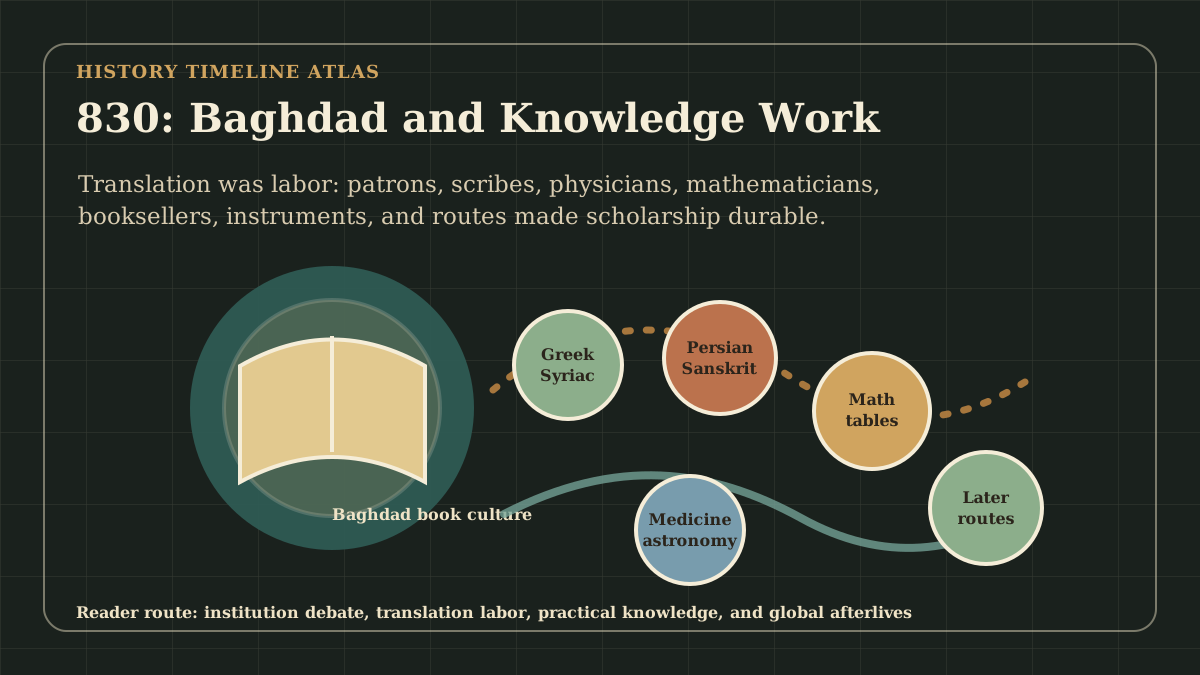
Baghdad matters as the setting. A capital could gather money, officials, scholars, translators, physicians, astronomers, scribes, merchants, and texts from many routes. Greek, Syriac, Persian, Sanskrit, and Arabic materials did not move by magic. They moved through patrons, multilingual specialists, libraries, schools, book markets, religious communities, and administrative needs.
The House of Wisdom is sometimes described too neatly, as if it were a modern university with a single campus and stable charter. The better reading is cautious: Bayt al-Hikmah stands for a cluster of translation, collection, patronage, and scholarly activity associated with Abbasid Baghdad. The exact institutional form is debated, but the broader movement of knowledge is historically important.
830 also helps readers connect science to government. Astronomy, calculation, geography, medicine, and translation were not isolated hobbies. They mattered for calendars, administration, prestige, court culture, legal and religious timekeeping, medical practice, and the intellectual confidence of a world empire.
For the atlas, the year opens a route from Abbasid political consolidation to global intellectual exchange. It links al-Mansur's Baghdad, al-Khwarizmi, paper transmission, Indian Ocean routes, and later European reception without pretending knowledge moved in one straight line.
The human texture matters because translation was labor. Patrons paid, scribes copied, translators compared languages, physicians tested inherited knowledge, mathematicians solved practical problems, and book dealers made texts available to readers beyond the court. A richer 830 page lets the reader imagine desks, instruments, book markets, workshops, libraries, debate, and correction rather than a vague golden-age glow.
The date also invites a careful source lesson. Modern readers often ask whether the House of Wisdom was a specific academy, library, translation bureau, or symbolic shorthand. The honest answer keeps uncertainty visible while still explaining why Baghdad's scholarly ecology mattered. Historical caution does not weaken the page; it makes the achievement more believable.
830 CE in History gathers events that help readers move from a single date into wider historical patterns. A useful year entry does more than answer what happened; it shows why people keep using the year as a marker for change.
The connected events show how decisions, institutions, conflicts, ideas, and consequences crossed beyond one location or one person. The event links explain the immediate story, while the topic routes and timelines show what came before and after.
The year also helps organize broad questions. It gives readers a concise answer and a direct path into deeper event pages where causes, turning points, consequences, maps, and references are easier to inspect.
Read the date in three passes. First ask what happened inside the year itself. Then ask which older pressures made the event possible. Finally ask which later pages reuse the same vocabulary, institutions, borders, technologies, or memories. That sequence keeps the page from becoming a trivia answer.
Even when only one event is currently attached, the year still has a job: it gives students and curious visitors a stable chronological doorway into the atlas. The page makes the doorway useful by pointing to the event, the topic route, the timeline, the map, and the evidence trail that can turn a date into a broader explanation.
This year matters because it connects House of Wisdom Flourishes to a wider sequence of causes and consequences. It gives the reader a chronological anchor while still pointing outward to people, places, institutions, and later effects. A thin year page would only name the event; a useful year page explains why this date is a handle for a larger route through history. 830 matters because it gives a memorable date to a broader Abbasid knowledge world. It helps readers ask how translation, patronage, paper, mathematics, medicine, and astronomy crossed languages and institutions. Used carefully, the date turns a search for the House of Wisdom into a lesson about cities, routes, source limits, and the social life of knowledge.
Reader Lenses
Look for the pressures that made change possible.
Identify who acted and what options were available.
Follow what changed after the event.
Ask why this date still appears in historical summaries.
Ask what can be said about Bayt al-Hikmah as an institution and what belongs to wider scholarly culture.
Follow Greek, Syriac, Persian, Sanskrit, and Arabic materials through people, books, patrons, and routes.
Connect mathematics, astronomy, medicine, and geography to calendars, administration, prestige, and practice.
How This Year Connects
830 CE in History is anchored by House of Wisdom Flourishes. Read those pages together and the year stops being a date label; it becomes a crossroads where immediate choices met older pressures and opened later consequences.
The setting matters as much as the date. The year moves through Baghdad and belongs to Abbasid Caliphate. That combination helps readers avoid treating the year as isolated; geography, institutions, conflict, belief, economy, and communication all shape what a date can mean.
The year also opens into people and themes. Figures such as Al-Ma'mun, Al-Khwarizmi, and Hunayn ibn Ishaq appear because their choices made the year visible, while themes such as Abbasid Caliphate, Science, Translation, and Islamic World explain why the consequences outlived the moment. A useful next step is usually an event page, then a topic route, then a timeline.
Evidence changes the way a date reads. A treaty, battle report, inscription, newspaper, census, court record, memoir, photograph, or archaeological trace does not answer the same question. Looking at source type helps separate what happened in the year from how later people remembered it.
A year page is most useful when it keeps two scales open at once. The first scale is immediate: what happened, where, and who was involved. The second scale is interpretive: why later readers use this date to organize a wider story. Holding both scales together makes the page a starting point for deeper reading rather than a dead-end answer.
The before-and-after frame matters too. A date rarely begins the forces it reveals. Earlier pressures made the linked event possible, while later pages show which effects were temporary, which became institutions, and which turned into memory. Reading the year this way helps students avoid the false impression that history changes only when the calendar flips.
Use this page as a junction. If the event feels too brief, follow the topic route for background; if the cause feels too abstract, open the event page for sequence; if the consequence feels larger than the date, move into the timeline. The value of a year page is that it lets readers change scale without losing their place.
Read 830 beside Baghdad Founded, al-Mansur, al-Khwarizmi, and the Science / Technology timeline. That sequence keeps scholarship connected to capital formation and patronage.
Then compare 830 with 762, 969, 1206, and 1453. The comparison asks how capitals and courts gather scholars, texts, instruments, and political legitimacy.
Events in This Year
- c. 830 CEHouse of Wisdom Flourishes
The Abbasid court's Bayt al-Hikmah, or House of Wisdom, became a symbol of translation, scholarship, and mathematical and scientific work in Baghdad.
Map Layer
830 CE in History geography
Gold pins mark the approximate locations of published event pages. This is a schematic locator map, not a historical border map.
Coordinates are approximate and are used to help readers orient themselves before opening a full event page.
References
Where to Check the Facts
- Encyclopaedia Britannica: Bayt al-HikmahReference for the House of Wisdom, Abbasid patronage, translation, and Baghdad setting.
- Encyclopaedia Britannica: Abbasid caliphateReference for Abbasid chronology and cultural context.
- Science Museum: Objects and StoriesMuseum reference hub for science, technology, medicine, invention, and public understanding.