How to Read the Year
Why did 1956 reveal the limits of both old empires and Soviet control?
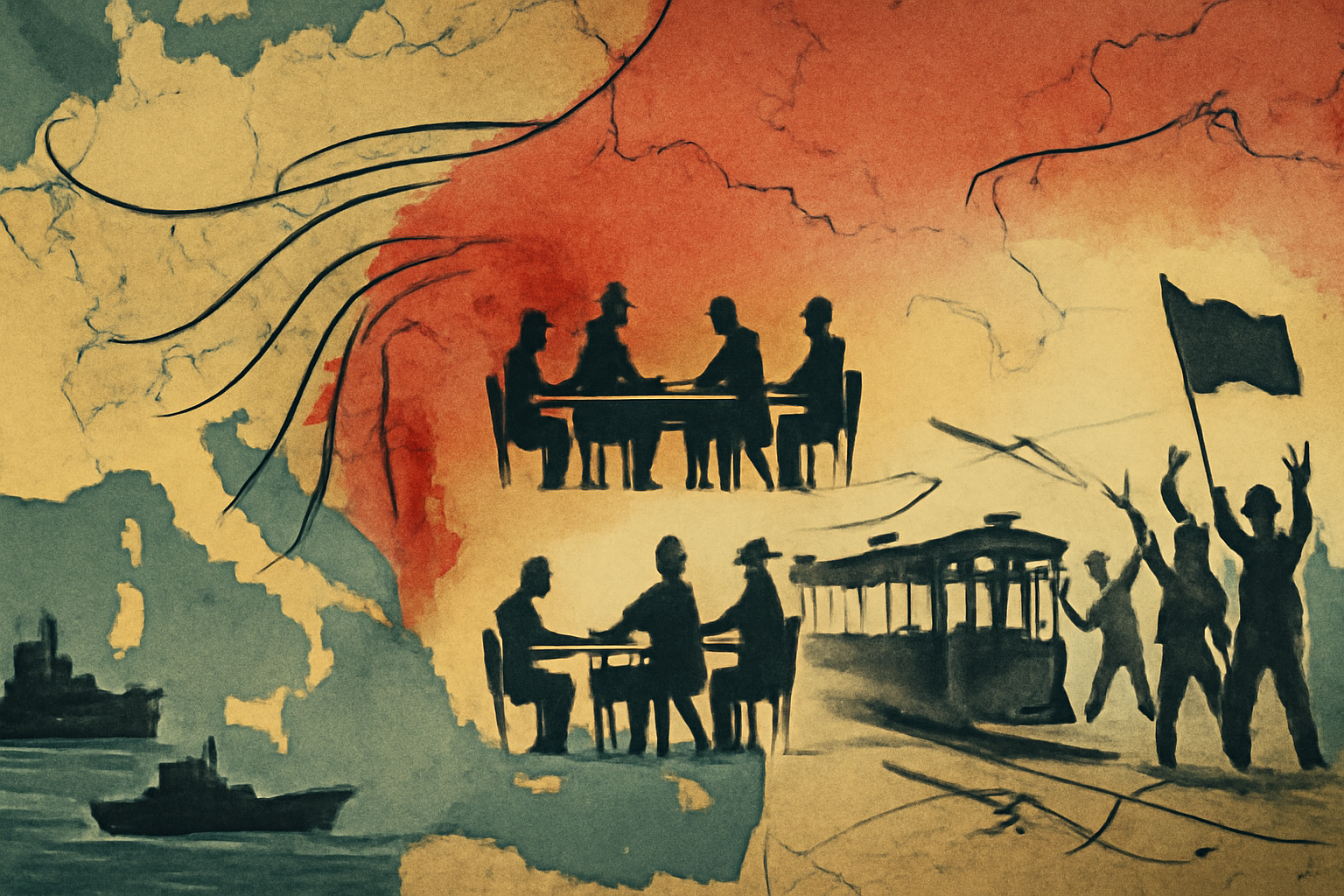
1956 is anchored by the Suez Crisis and the Hungarian Revolution, a pairing that makes the year one of the clearest Cold War stress tests. In Egypt, Britain, France, Israel, the United States, the Soviet Union, and Gamal Abdel Nasser collided over the Suez Canal, imperial prestige, Arab nationalism, and control of a strategic waterway. In Hungary, protesters and reformers challenged Soviet-backed rule before Soviet military force crushed the uprising.
Suez exposed the weakness of older imperial power. Britain and France could still act militarily, but they could not ignore U.S. financial pressure, Soviet threats, world opinion, Egyptian nationalism, and the changing legitimacy of colonial-era intervention. The crisis made Nasser a larger symbol and showed that the postwar world no longer obeyed nineteenth-century imperial habits.
Hungary exposed the limits of reform inside the Soviet bloc. De-Stalinization raised hopes that political space might widen, but Moscow's response showed that Soviet control in Eastern Europe still rested on tanks, party authority, and the fear that one break could spread. The revolution's defeat became a lasting symbol of courage and abandonment.
The two events belong together because both tested power that claimed to be stable. Old European empires found that military action could backfire in a decolonizing world. The Soviet Union found that ideological control could not erase demands for national autonomy and political freedom. The United States also faced contradictions, opposing Suez while not preventing Soviet repression in Hungary.
A useful 1956 page moves readers toward Nasser, Khrushchev, Cold War diplomacy, decolonization, Middle Eastern politics, and Eastern European dissent. The year is compelling because it shows several kinds of power being exposed at once.
The media and symbolism of 1956 also mattered. Images of canal fighting, speeches by Nasser, reports from Budapest, refugee movement, and United Nations debate turned distant crises into public tests of legitimacy. The year shows how power can lose authority even when it still commands armies.
The year also clarifies the difference between influence and control. Britain and France could still project force, but not dictate diplomatic legitimacy. The Soviet Union could restore obedience in Hungary, but not erase the memory of revolt. That gap between action and authority is what makes 1956 so revealing.
1956 CE in History gathers events that help readers move from a single date into wider historical patterns. A useful year entry does more than answer what happened; it shows why people keep using the year as a marker for change.
The connected events show how decisions, institutions, conflicts, ideas, and consequences crossed beyond one location or one person. The event links explain the immediate story, while the topic routes and timelines show what came before and after.
The year also helps organize broad questions. It gives readers a concise answer and a direct path into deeper event pages where causes, turning points, consequences, maps, and references are easier to inspect.
Read the date in three passes. First ask what happened inside the year itself. Then ask which older pressures made the event possible. Finally ask which later pages reuse the same vocabulary, institutions, borders, technologies, or memories. That sequence keeps the page from becoming a trivia answer.
Even when only one event is currently attached, the year still has a job: it gives students and curious visitors a stable chronological doorway into the atlas. The page makes the doorway useful by pointing to the event, the topic route, the timeline, the map, and the evidence trail that can turn a date into a broader explanation.
This year matters because it connects Suez Crisis, Hungarian Revolution to a wider sequence of causes and consequences. It gives the reader a chronological anchor while still pointing outward to people, places, institutions, and later effects. A thin year page would only name the event; a useful year page explains why this date is a handle for a larger route through history. 1956 matters because it revealed that the postwar order was not simply bipolar. Decolonization, Arab nationalism, European imperial decline, Soviet domination, U.S. strategy, and popular uprising all collided in the same year. The page helps readers understand why Cold War history must include the Middle East, Eastern Europe, empire, and public protest.
Reader Lenses
Look for the pressures that made change possible.
Identify who acted and what options were available.
Follow what changed after the event.
Ask why this date still appears in historical summaries.
Use Suez to ask why military capacity no longer guaranteed imperial legitimacy.
Read Hungary through reform hopes, national autonomy, party control, and military repression.
Notice how the United States, Soviet Union, and European powers each spoke freedom while protecting interests.
How This Year Connects
1956 CE in History is anchored by Suez Crisis and Hungarian Revolution. Read those pages together and the year stops being a date label; it becomes a crossroads where immediate choices met older pressures and opened later consequences.
The setting matters as much as the date. The year moves through Suez Canal and Budapest and belongs to Cold War and Decolonization and Cold War. That combination helps readers avoid treating the year as isolated; geography, institutions, conflict, belief, economy, and communication all shape what a date can mean.
The year also opens into people and themes. Figures such as Gamal Abdel Nasser, Anthony Eden, Dwight D. Eisenhower, Hungarian protesters, and Imre Nagy appear because their choices made the year visible, while themes such as Suez Crisis, Egypt, Decolonization, Cold War, and Soviet Bloc explain why the consequences outlived the moment. A useful next step is usually an event page, then a topic route, then a timeline.
Evidence changes the way a date reads. A treaty, battle report, inscription, newspaper, census, court record, memoir, photograph, or archaeological trace does not answer the same question. Looking at source type helps separate what happened in the year from how later people remembered it.
A year page is most useful when it keeps two scales open at once. The first scale is immediate: what happened, where, and who was involved. The second scale is interpretive: why later readers use this date to organize a wider story. Holding both scales together makes the page a starting point for deeper reading rather than a dead-end answer.
The before-and-after frame matters too. A date rarely begins the forces it reveals. Earlier pressures made the linked event possible, while later pages show which effects were temporary, which became institutions, and which turned into memory. Reading the year this way helps students avoid the false impression that history changes only when the calendar flips.
Use this page as a junction. If the event feels too brief, follow the topic route for background; if the cause feels too abstract, open the event page for sequence; if the consequence feels larger than the date, move into the timeline. The value of a year page is that it lets readers change scale without losing their place.
Read 1956 beside the Suez Crisis, Hungarian Revolution, Nasser, Khrushchev, Cold War timeline, decolonization, and modern Middle East routes.
Then compare 1956 with 1948, 1955, 1962, 1968, and 1973. The comparison asks how crisis reveals the real limits of power.
Events in This Year
- 1956 CESuez Crisis
The Suez Crisis followed Egypt's nationalization of the canal and a British, French, and Israeli attack that exposed the limits of old imperial power.
- October-November 1956Hungarian Revolution
Hungarians rose against Soviet-backed rule and demanded political reform before Soviet military intervention crushed the revolution.
Map Layer
1956 CE in History geography
Gold pins mark the approximate locations of published event pages. This is a schematic locator map, not a historical border map.
Coordinates are approximate and are used to help readers orient themselves before opening a full event page.
References
Where to Check the Facts
- Encyclopaedia Britannica: Suez CrisisReference for the crisis, nationalization, invasion, and diplomatic outcome.
- Encyclopaedia Britannica: Arab oil embargoReference for the 1973-1974 embargo and its energy, diplomatic, and economic consequences.
- U.S. National Archives: The Cold WarArchive reference hub for Cold War records, federal documentation, and research guidance.
- Office of the Historian: The Early Cold War, 1945-1952Official diplomatic history reference for early Cold War foreign-policy context.