How to Read the Year
Why does 1832 make Zanzibar's clove economy a route into slavery, trade, and the Indian Ocean?
1832 is anchored by the expansion of Zanzibar's clove economy under Omani-linked rule. The year matters because it turns an island crop into a larger story about Indian Ocean commerce, plantation labor, port cities, merchant credit, and political power. Zanzibar was not simply a spice island in a romantic trade network. It was a place where wealth, land, coerced labor, maritime routes, and urban authority became tightly connected.
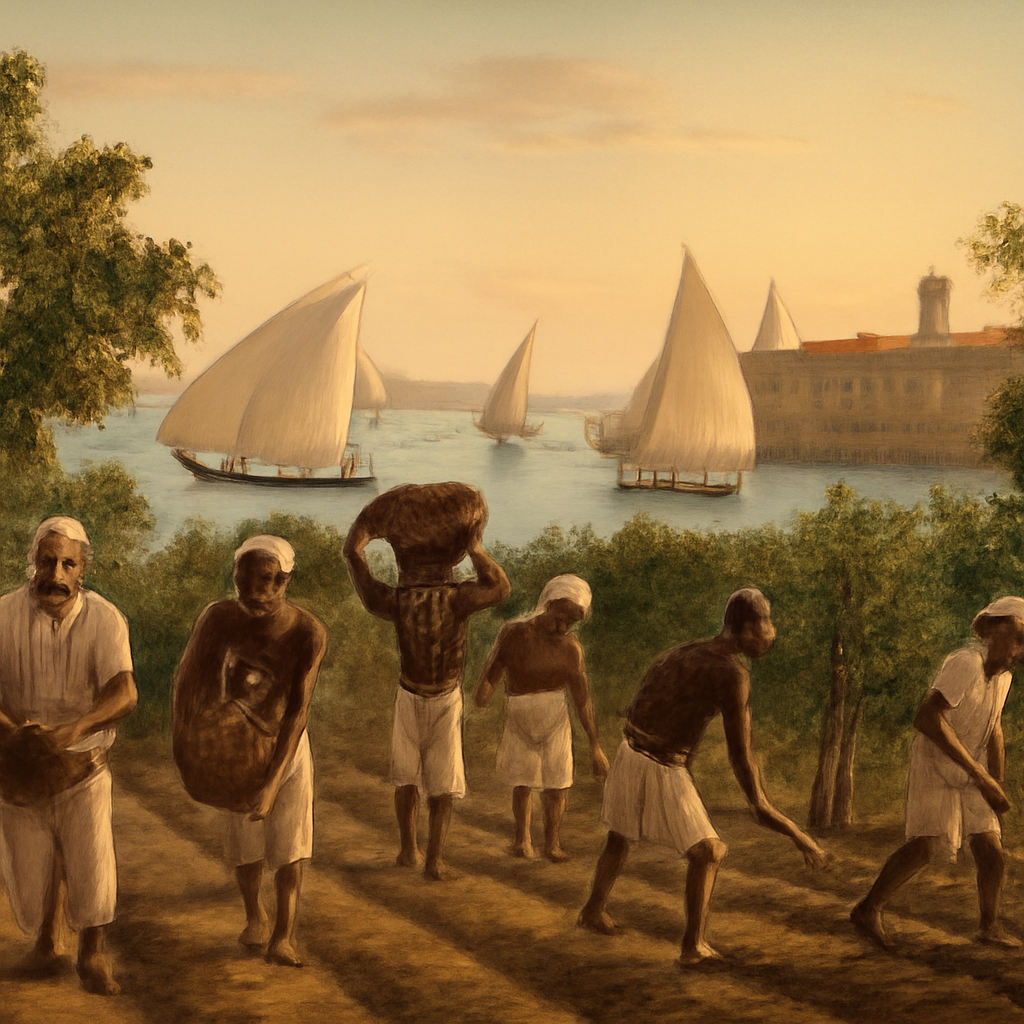
A strong reading starts with geography. Zanzibar and nearby Pemba sat within monsoon routes linking the Swahili Coast, Oman, Arabia, South Asia, and global markets. Dhows, merchants, plantation owners, enslaved workers, port brokers, and rulers all shaped the clove boom. The harbor and the plantation were not separate worlds. Stone Town's commercial growth depended on fields, labor regimes, shipping, credit, and the ability of ruling elites to make the island useful to long-distance trade.
The page also needs moral clarity without flattening the evidence. Clove wealth rested heavily on enslaved and coerced labor. That fact belongs in the center of the explanation, not in a footnote after scenery. At the same time, the story includes African, Arab, Swahili, South Asian, and European commercial actors whose relationships were layered, unequal, and changing. The year helps readers see how commodity booms can make everyday life more dependent on distant demand.
1832 points forward to abolition pressure, British diplomacy, Omani-Zanzibari politics, plantation society, and East African coastal memory. The date is useful because it gives readers a concrete entrance into how a single commodity could reorganize land, labor, status, and maritime connection.
The everyday texture matters too. A clove economy meant planting cycles, harvesting labor, shipping schedules, debt, household service, urban markets, religious patronage, and elite display. When readers see those pieces together, Zanzibar becomes more than a port name; it becomes a working system where ocean routes and plantation discipline reinforced one another.
The year also helps readers connect Indian Ocean slavery to later abolition without assuming one legal timeline. British pressure, Omani-Zanzibari politics, merchant interests, enslaved people's lives, and plantation profitability moved at different speeds. That uneven timing makes 1832 a strong bridge from commerce into coercion and reform.
1832 CE in History gathers events that help readers move from a single date into wider historical patterns. A useful year entry does more than answer what happened; it shows why people keep using the year as a marker for change.
The connected events show how decisions, institutions, conflicts, ideas, and consequences crossed beyond one location or one person. The event links explain the immediate story, while the topic routes and timelines show what came before and after.
The year also helps organize broad questions. It gives readers a concise answer and a direct path into deeper event pages where causes, turning points, consequences, maps, and references are easier to inspect.
Read the date in three passes. First ask what happened inside the year itself. Then ask which older pressures made the event possible. Finally ask which later pages reuse the same vocabulary, institutions, borders, technologies, or memories. That sequence keeps the page from becoming a trivia answer.
Even when only one event is currently attached, the year still has a job: it gives students and curious visitors a stable chronological doorway into the atlas. The page makes the doorway useful by pointing to the event, the topic route, the timeline, the map, and the evidence trail that can turn a date into a broader explanation.
This year matters because it connects Zanzibar Clove Economy Expands to a wider sequence of causes and consequences. It gives the reader a chronological anchor while still pointing outward to people, places, institutions, and later effects. A thin year page would only name the event; a useful year page explains why this date is a handle for a larger route through history. 1832 matters because it connects Zanzibar, cloves, Omani-linked rule, Stone Town, enslaved labor, Swahili Coast exchange, South Asian merchant networks, and Indian Ocean capitalism. It gives readers a way to study trade without turning trade into a neutral good. The year shows how prosperity, coercion, port growth, and global commodity demand could reinforce one another.
Reader Lenses
Look for the pressures that made change possible.
Identify who acted and what options were available.
Follow what changed after the event.
Ask why this date still appears in historical summaries.
Follow how cloves tied land, labor, credit, ships, prices, and merchant networks together.
Keep enslaved and coerced labor visible when reading about port wealth and plantation growth.
Use Zanzibar to connect East Africa, Oman, South Asia, monsoon routes, and global demand.
How This Year Connects
1832 CE in History is anchored by Zanzibar Clove Economy Expands. Read those pages together and the year stops being a date label; it becomes a crossroads where immediate choices met older pressures and opened later consequences.
The setting matters as much as the date. The year moves through Zanzibar and belongs to Nineteenth-Century Indian Ocean. That combination helps readers avoid treating the year as isolated; geography, institutions, conflict, belief, economy, and communication all shape what a date can mean.
The year also opens into people and themes. Figures such as Said bin Sultan and Swahili and Omani merchants appear because their choices made the year visible, while themes such as Zanzibar, Swahili Coast, Cloves, Indian Ocean, and Slavery explain why the consequences outlived the moment. A useful next step is usually an event page, then a topic route, then a timeline.
Evidence changes the way a date reads. A treaty, battle report, inscription, newspaper, census, court record, memoir, photograph, or archaeological trace does not answer the same question. Looking at source type helps separate what happened in the year from how later people remembered it.
A year page is most useful when it keeps two scales open at once. The first scale is immediate: what happened, where, and who was involved. The second scale is interpretive: why later readers use this date to organize a wider story. Holding both scales together makes the page a starting point for deeper reading rather than a dead-end answer.
The before-and-after frame matters too. A date rarely begins the forces it reveals. Earlier pressures made the linked event possible, while later pages show which effects were temporary, which became institutions, and which turned into memory. Reading the year this way helps students avoid the false impression that history changes only when the calendar flips.
Use this page as a junction. If the event feels too brief, follow the topic route for background; if the cause feels too abstract, open the event page for sequence; if the consequence feels larger than the date, move into the timeline. The value of a year page is that it lets readers change scale without losing their place.
Read 1832 beside Zanzibar Clove Economy Expands, Kilwa, the Swahili Coast and East Africa timeline, Indian Ocean routes, and later abolition pages. The path shows continuity and change along the East African coast.
Then compare 1832 with 1505, 1602, 1807, 1884, and 1905. The comparison tracks how port power, company power, abolition pressure, formal empire, and anti-colonial resistance overlapped.
Events in This Year
- 1832 CEZanzibar Clove Economy Expands
Zanzibar's clove economy expanded under Omani-linked rule, tying plantation labor, slavery, Indian Ocean commerce, port politics, and global demand together.
Map Layer
1832 CE in History geography
Gold pins mark the approximate locations of published event pages. This is a schematic locator map, not a historical border map.
Coordinates are approximate and are used to help readers orient themselves before opening a full event page.
References
Where to Check the Facts
- Encyclopaedia Britannica: ZanzibarReference for Zanzibar's Indian Ocean position, port economy, and later clove-export history.
- Official UNESCO World Heritage Centre: Stone Town of ZanzibarReference for Stone Town as an Indian Ocean Swahili trading center shaped by maritime commerce and cultural exchange.