How to Read the Year
Why did Vasco da Gama's arrival in India change the balance of oceanic trade?
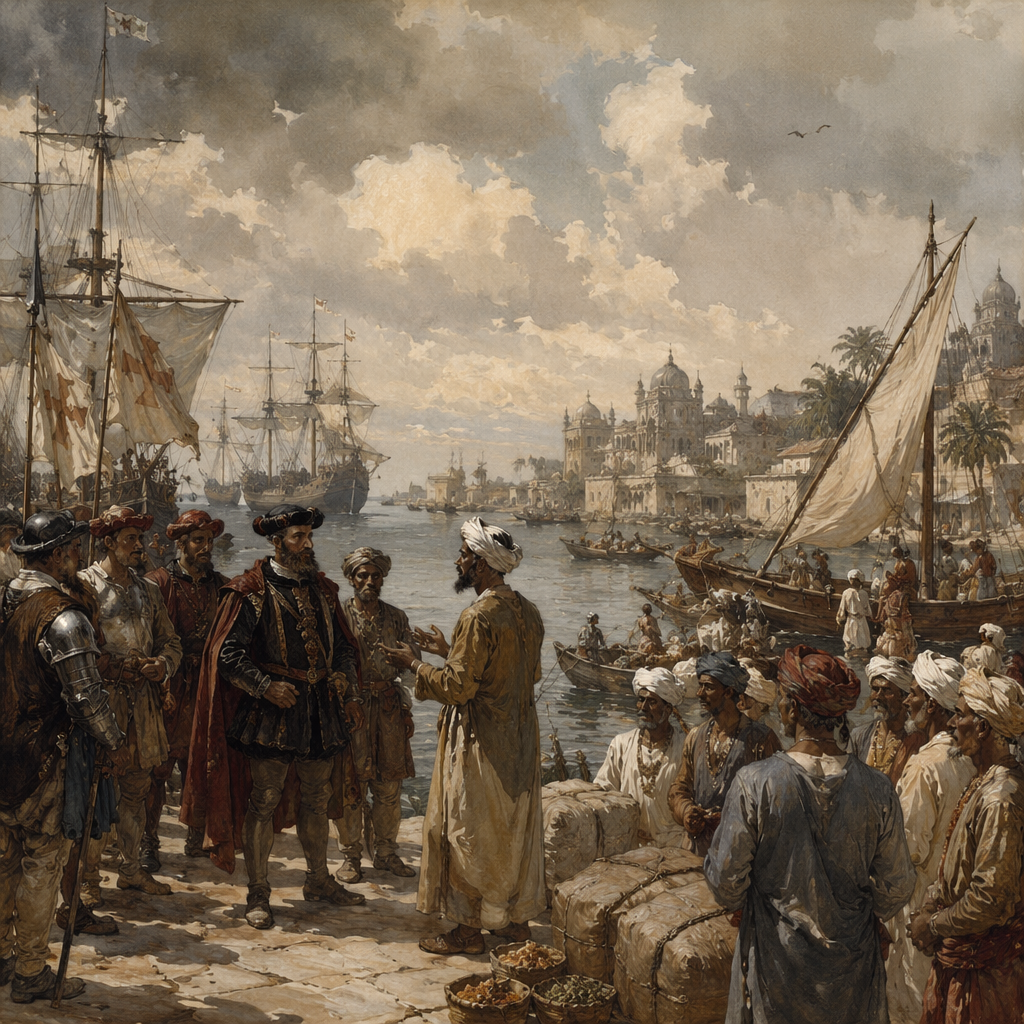
1498 is anchored by Vasco da Gama's arrival at Calicut, but the year is not just an exploration milestone. It marks the moment when Portuguese oceanic strategy entered an Indian Ocean commercial world that was already old, wealthy, literate, and highly connected. Europe did not discover an empty sea; it forced itself into existing routes.
The Indian Ocean before 1498 connected East Africa, Arabia, Persia, India, Southeast Asia, and China through monsoon sailing, port cities, merchant communities, credit, pilgrimage, luxury goods, and political brokerage. Da Gama's voyage mattered because Portuguese rulers wanted direct access to spices and status without depending on older Mediterranean and Islamic commercial intermediaries.
Monsoon knowledge made the voyage possible but also showed Portuguese dependence. Pilots, winds, currents, provisioning stops, Swahili ports, Arab and Gujarati merchant knowledge, and diplomatic gifts shaped what the fleet could do. A richer reading therefore treats navigation as shared knowledge, contested service, and political bargaining rather than as a lone European technical breakthrough.
Calicut was not a passive destination. Local rulers, Muslim merchants, interpreters, pilots, and port officials all shaped the encounter. Portuguese arrival created opportunity and friction because the newcomers brought royal ambition, naval violence, Christian crusading language, and a commercial strategy that did not fit the norms of many Indian Ocean ports.
The encounter also exposed a clash of commercial expectations. In Calicut, merchants worked through credit, reputation, brokers, taxes, religious communities, and long-term port relationships. Portuguese envoys arrived with royal letters, limited goods, crusading confidence, and a demand for privileged access. That mismatch helps explain why diplomacy so quickly moved toward coercion.
The long consequence was not instant Portuguese control. It was escalation: armed trading, fortified ports, cartaz passes, attacks on rivals, alliances with some local powers, and repeated attempts to turn commerce into coercive maritime empire. 1498 therefore leads forward to Kilwa, Goa, Malacca, Hormuz, and later European chartered-company expansion.
The cartaz pass system and the Estado da India later turned the route into a new kind of problem for Indian Ocean actors. Some rulers and merchants resisted, some negotiated, and some used Portuguese force against rivals. The year matters because it begins a pattern in which European power entered Asian and African waters unevenly, violently, and through local politics as much as through ships.
For readers, the year works best as a scale change. A single voyage connects Atlantic shipbuilding, Iberian monarchy, African coastal contact, Swahili cities, Arab and Gujarati merchants, spice markets, religious rivalry, and the early modern globalization of violence.
1498 CE in History gathers events that help readers move from a single date into wider historical patterns. A useful year entry does more than answer what happened; it shows why people keep using the year as a marker for change.
The connected events show how decisions, institutions, conflicts, ideas, and consequences crossed beyond one location or one person. The event links explain the immediate story, while the topic routes and timelines show what came before and after.
The year also helps organize broad questions. It gives readers a concise answer and a direct path into deeper event pages where causes, turning points, consequences, maps, and references are easier to inspect.
Read the date in three passes. First ask what happened inside the year itself. Then ask which older pressures made the event possible. Finally ask which later pages reuse the same vocabulary, institutions, borders, technologies, or memories. That sequence keeps the page from becoming a trivia answer.
Even when only one event is currently attached, the year still has a job: it gives students and curious visitors a stable chronological doorway into the atlas. The page makes the doorway useful by pointing to the event, the topic route, the timeline, the map, and the evidence trail that can turn a date into a broader explanation.
This year matters because it connects Vasco da Gama Reaches India to a wider sequence of causes and consequences. It gives the reader a chronological anchor while still pointing outward to people, places, institutions, and later effects. A thin year page would only name the event; a useful year page explains why this date is a handle for a larger route through history. 1498 matters because it shows how exploration language can hide entry into another people's commercial system. Da Gama's voyage did not create the Indian Ocean world, but it changed how European states tried to use ships, guns, forts, and royal monopolies to redirect that world. The year is a bridge between medieval trade and early modern colonial coercion.
Reader Lenses
Look for the pressures that made change possible.
Identify who acted and what options were available.
Follow what changed after the event.
Ask why this date still appears in historical summaries.
Start with Indian Ocean merchants and ports before centering Portuguese arrival.
Follow how trade shifted toward armed passes, forts, naval force, and imperial claims.
Connect Calicut to East Africa, Arabia, Lisbon, spice markets, and later colonial routes.
How This Year Connects
1498 CE in History is anchored by Vasco da Gama Reaches India. Read those pages together and the year stops being a date label; it becomes a crossroads where immediate choices met older pressures and opened later consequences.
The setting matters as much as the date. The year moves through Calicut and belongs to Early Modern World. That combination helps readers avoid treating the year as isolated; geography, institutions, conflict, belief, economy, and communication all shape what a date can mean.
The year also opens into people and themes. Figures such as Vasco da Gama appear because their choices made the year visible, while themes such as Exploration, Indian Ocean, and Trade explain why the consequences outlived the moment. A useful next step is usually an event page, then a topic route, then a timeline.
Evidence changes the way a date reads. A treaty, battle report, inscription, newspaper, census, court record, memoir, photograph, or archaeological trace does not answer the same question. Looking at source type helps separate what happened in the year from how later people remembered it.
A year page is most useful when it keeps two scales open at once. The first scale is immediate: what happened, where, and who was involved. The second scale is interpretive: why later readers use this date to organize a wider story. Holding both scales together makes the page a starting point for deeper reading rather than a dead-end answer.
The before-and-after frame matters too. A date rarely begins the forces it reveals. Earlier pressures made the linked event possible, while later pages show which effects were temporary, which became institutions, and which turned into memory. Reading the year this way helps students avoid the false impression that history changes only when the calendar flips.
Use this page as a junction. If the event feels too brief, follow the topic route for background; if the cause feels too abstract, open the event page for sequence; if the consequence feels larger than the date, move into the timeline. The value of a year page is that it lets readers change scale without losing their place.
Read 1498 beside Vasco da Gama Reaches India, Swahili Coast, Indian Ocean World, and Exploration / Colonialism routes. That path keeps Calicut, East Africa, Arabia, and Portugal in one maritime map.
Then move to 1602 and the VOC. The comparison shows how Portuguese armed trade helped prepare later company empires that mixed commerce with sovereignty.
Events in This Year
- 1498 CEVasco da Gama Reaches India
Vasco da Gama reached India by sea from Europe, opening a Portuguese path into established Indian Ocean trade networks.
Map Layer
1498 CE in History geography
Gold pins mark the approximate locations of published event pages. This is a schematic locator map, not a historical border map.
Coordinates are approximate and are used to help readers orient themselves before opening a full event page.
References
Where to Check the Facts
- Encyclopaedia Britannica: Vasco da GamaSpecific reference for Vasco da Gama's 1498 arrival in India near Calicut and Portuguese entry into Indian Ocean trade.
- Encyclopaedia BritannicaBackground reference for chronology, names, and historical context.
- WikidataStructured reference for dates, places, alternate names, and entity links.