How to Read the Year
Why did the fall of Constantinople become more than the end of a siege?
The year 1453 is often remembered through the fall of Constantinople, but the event matters because the city carried more than local importance. Constantinople was a capital, a symbol of Roman continuity, a Christian imperial center, and a strategic hinge between the Black Sea, the Mediterranean, the Balkans, and Anatolia.
Reading 1453 as a year page helps separate the dramatic moment of conquest from the slower change around it. The Byzantine state had been weakened for generations, while Ottoman power was becoming more organized, ambitious, and geographically connected. The siege made that imbalance visible in a form that later readers could remember.
A deeper 1453 page starts with the city's long survival. Constantinople had endured as Roman capital, Christian imperial center, fortified city, trading hinge, and symbolic prize long after Byzantine power had narrowed. The Ottoman siege mattered because it ended a weakened state but captured a city with enormous inherited meaning.
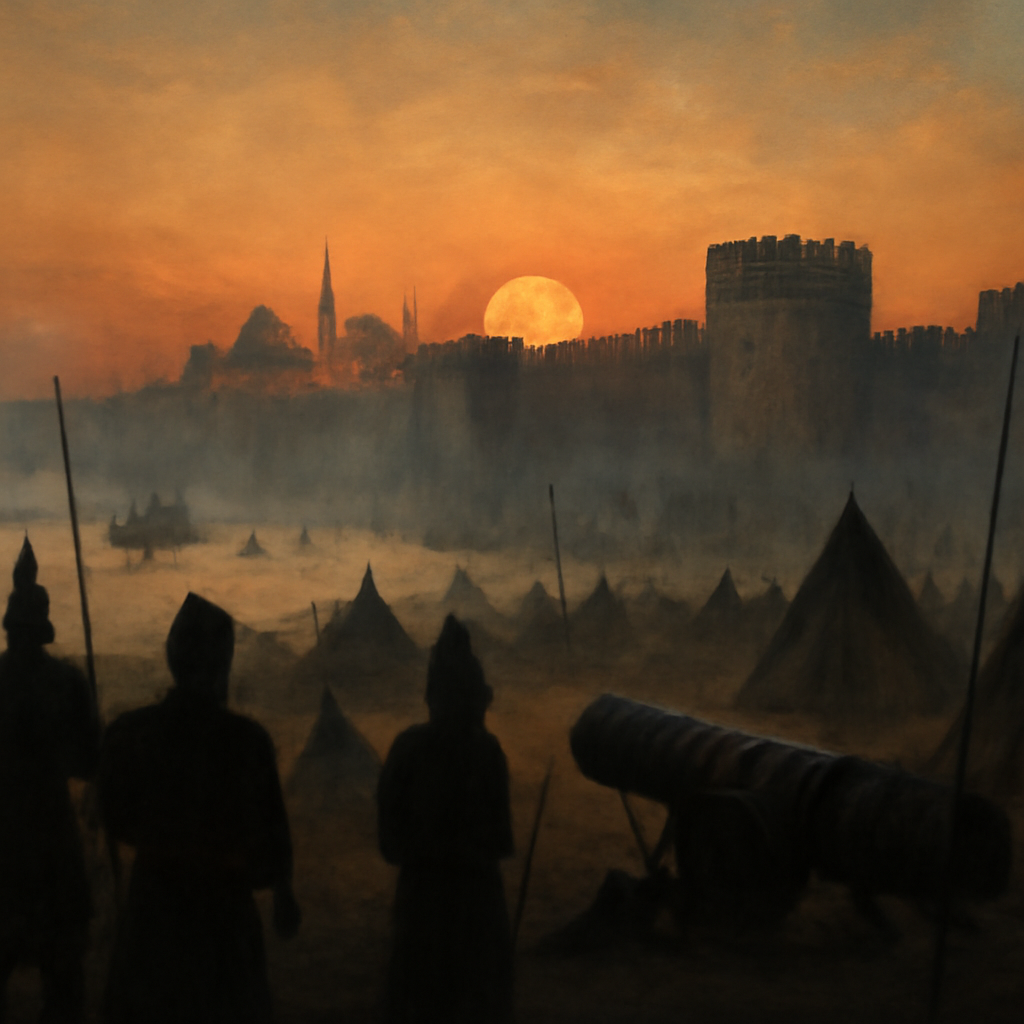
The walls were not only scenery. They shaped tactics, morale, artillery use, naval access, and the drama of breach. Mehmed II's preparations, Ottoman cannon, ships, logistics, and political ambition met Byzantine desperation, limited manpower, religious hope, and appeals for western help that arrived too weakly to change the outcome.
The year is also about transformation after conquest. A conquered city had to become an Ottoman capital. Repopulation, administration, religious conversion of spaces, trade revival, court ceremony, and imperial memory turned military victory into a new urban order.
1453 became a period marker because later readers needed a date for several transitions: Byzantine ending, Ottoman expansion, gunpowder warfare, Mediterranean trade anxiety, Renaissance migration stories, and Christian-Muslim political rivalry. Those transitions did not all begin or end in one year, but the siege made them memorable.
The best reading path moves backward to Constantine and Byzantine survival, then forward to Ottoman rule, Mediterranean diplomacy, exploration, and early modern empire. The date works as a hinge rather than a simple wall between medieval and modern worlds.
The human scale of the siege matters too. Soldiers repaired and assaulted walls, civilians carried fear into churches and streets, merchants wondered what would happen to routes and property, and Ottoman commanders had to turn victory into order quickly. The city's fall was a military event, but its memory endured because people experienced it as the remaking of a world.
The year also needs diplomacy. Byzantium searched for western aid while religious union remained controversial, Italian merchants watched their interests, and Ottoman strategy balanced military pressure with claims to legitimate rule. That diplomatic layer prevents the page from becoming only a story of cannons versus walls.
After the conquest, property, population, worship, markets, and administration became the practical tests of victory. Mehmed II's achievement was not limited to taking the city; it included making the city usable as an imperial capital. That distinction gives readers a reason to continue from the year page into the Mehmed and Ottoman routes.
The migration of people and skills also belongs in the story. Scholars, merchants, artisans, soldiers, clergy, and administrators moved through the aftermath in uneven ways, carrying manuscripts, craft knowledge, commercial ties, and memories into new settings. That movement is part of why 1453 became a Mediterranean event rather than only a local conquest.
1453's afterlife differs across communities. Ottoman, Greek, western European, Orthodox, Muslim, and later nationalist memories gave the same date different meanings. A search-friendly page can name the famous 'fall' while also teaching readers that historical memory is plural.
1453 matters because it gives readers a concrete entry point into questions about imperial endings, city power, gunpowder warfare, trade routes, religious memory, and Ottoman statecraft. The year is not useful because history suddenly changed overnight; it is useful because one event concentrated many long-running pressures into a single date. 1453 matters because one city's capture concentrated questions about imperial memory, military technology, urban rule, religion, and Mediterranean power. The year should not be treated as a magic endpoint for the Middle Ages. Its value is more precise: it shows how a symbolic capital can outlive its political strength, and how a conqueror can turn inherited prestige into a new imperial center.
Reader Lenses
Ask how a city can hold political, religious, commercial, and symbolic power at the same time.
Watch how Roman and Byzantine inheritance changed meaning after Ottoman conquest.
Read the siege through walls, artillery, naval access, logistics, and morale.
Follow how the city became an Ottoman capital rather than only a conquered prize.
Use fortifications, artillery, ships, and logistics to understand the siege as a material event.
Ask how conquest became government, repopulation, ceremony, and urban transformation.
Treat 1453 as a hinge for several stories rather than a single clean boundary.
How This Year Connects
1453 CE in History is anchored by Fall of Constantinople, 1453: Siege Timeline, Causes, Aftermath. Read those pages together and the year stops being a date label; it becomes a crossroads where immediate choices met older pressures and opened later consequences.
The setting matters as much as the date. The year moves through Constantinople and belongs to Late Medieval World. That combination helps readers avoid treating the year as isolated; geography, institutions, conflict, belief, economy, and communication all shape what a date can mean.
The year also opens into people and themes. Figures such as Mehmed II and Constantine XI Palaiologos appear because their choices made the year visible, while themes such as Byzantine Empire, Ottoman Empire, and Warfare explain why the consequences outlived the moment. A useful next step is usually an event page, then a topic route, then a timeline.
Evidence changes the way a date reads. A treaty, battle report, inscription, newspaper, census, court record, memoir, photograph, or archaeological trace does not answer the same question. Looking at source type helps separate what happened in the year from how later people remembered it.
A year page is most useful when it keeps two scales open at once. The first scale is immediate: what happened, where, and who was involved. The second scale is interpretive: why later readers use this date to organize a wider story. Holding both scales together makes the page a starting point for deeper reading rather than a dead-end answer.
The before-and-after frame matters too. A date rarely begins the forces it reveals. Earlier pressures made the linked event possible, while later pages show which effects were temporary, which became institutions, and which turned into memory. Reading the year this way helps students avoid the false impression that history changes only when the calendar flips.
Use this page as a junction. If the event feels too brief, follow the topic route for background; if the cause feels too abstract, open the event page for sequence; if the consequence feels larger than the date, move into the timeline. The value of a year page is that it lets readers change scale without losing their place.
Read 1453 beside Constantine, Justinian, the Crusades, Mehmed II, Ottoman expansion, and Mediterranean trade. That route keeps the siege inside long Byzantine and Ottoman histories.
Then compare 1453 with 1204, 1492, and 1517. Each date became a shorthand for transition, but each also hides slower processes that began before and continued after the famous year.
Events in This Year
- May 29, 1453Fall of Constantinople, 1453: Siege Timeline, Causes, Aftermath
The Fall of Constantinople happened on May 29, 1453, when Mehmed II's Ottoman forces captured the city after a 55-day siege. Read the event through a four-step sequence: Ottoman artillery and blockade pressure on the Bosporus map, Byzantine wall defense, the final assault before dawn, and the aftermath in which Constantinople became an Ottoman imperial capital.
Map Layer
1453 CE in History geography
Gold pins mark the approximate locations of published event pages. This is a schematic locator map, not a historical border map.
Coordinates are approximate and are used to help readers orient themselves before opening a full event page.
References
Where to Check the Facts
- Encyclopaedia Britannica: Fall of ConstantinopleSpecific reference for the 1453 CE anchor event, chronology, and historical setting.
- Encyclopaedia BritannicaBackground reference for chronology, names, and historical context.
- WikidataStructured reference for dates, places, alternate names, and entity links.