Historical Role
Mehmed II appears here as the Ottoman ruler who made Constantinople the center of a new imperial phase. The conquest of 1453 ended the Byzantine Empire, but it also gave the Ottomans a capital with unmatched symbolic weight: Roman, Christian, Mediterranean, and Eurasian meanings all attached to the city.
Read this biography through urban power. Mehmed's achievement was not only breaching walls. It was claiming, repopulating, governing, and reimagining a city that carried centuries of imperial memory.
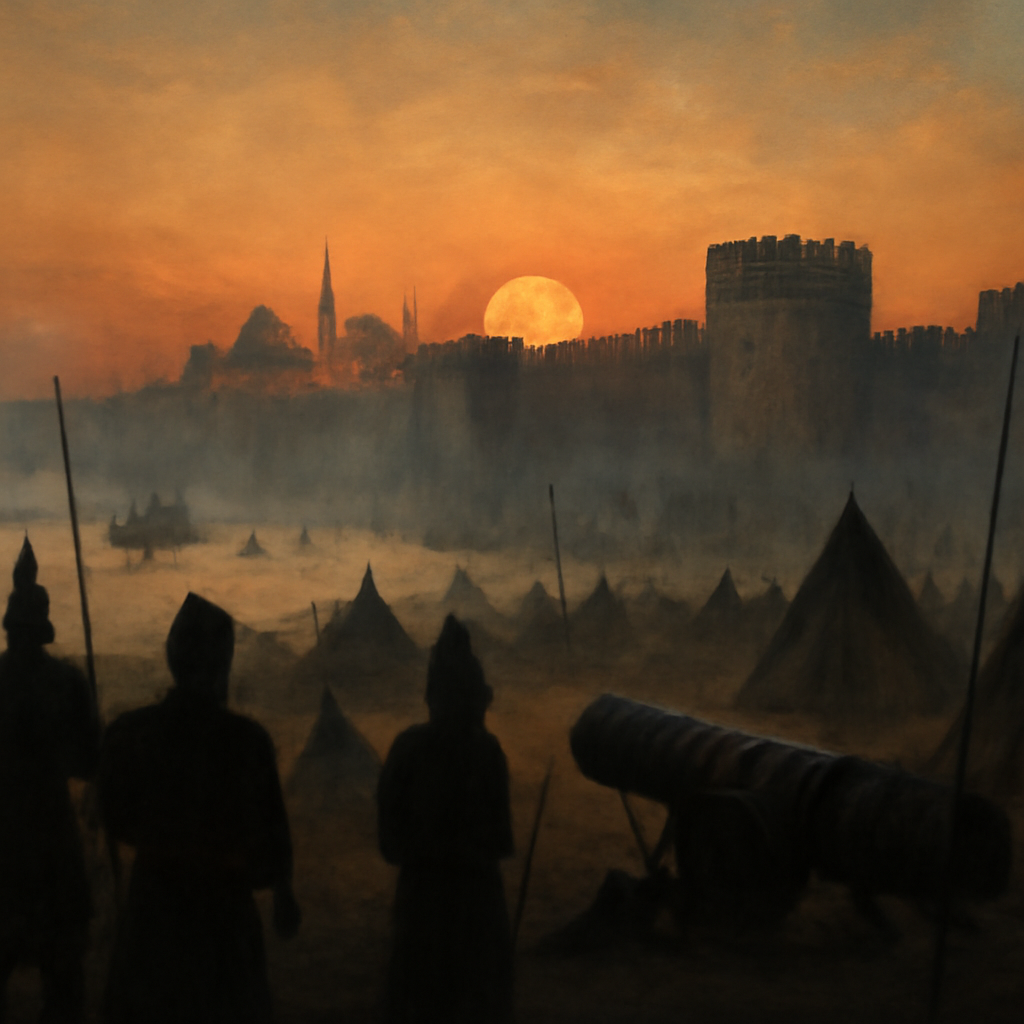
Mehmed II is often introduced through the fall of Constantinople in 1453, but his historical role is larger than one siege. He turned conquest into capital-making. The capture of the Byzantine city gave the Ottoman dynasty a new imperial center, a Roman and Islamic language of legitimacy, and a stage on which military victory, urban policy, law, commerce, religion, and memory could be reorganized. The siege itself deserves close attention because it was a test of technology, patience, coordination, and political will. Ottoman artillery, naval pressure, siege engineering, diplomacy, and the long vulnerability of the Byzantine Empire all mattered. Constantinople's walls were famous, but walls do not fight alone; the outcome depended on supply, morale, alliances, religious expectation, and the inability of the late Byzantine state to summon enough outside help. After 1453, Mehmed's significance shifted from conqueror to ruler of a transformed city. Repopulation, rebuilding, religious institutions, markets, palaces, administrative offices, and symbolic claims turned Constantinople into Istanbul as an Ottoman capital. That process reminds readers that conquest is not finished when gates fall. It continues through property, settlement, law, worship, taxation, and the stories rulers tell about themselves. Mehmed's page works best when it joins the military drama of 1453 to the slower creation of an imperial order that reshaped eastern Mediterranean politics for centuries.
The urban layer makes the biography richer. A captured capital had to be fed, repaired, repopulated, taxed, defended, and made credible to Muslim, Christian, Jewish, merchant, military, and court communities. Mehmed used settlement policies, religious endowments, market life, palatial space, learned patronage, and administrative ordering to make the city usable again. That work matters because it shows readers the difference between winning a spectacular siege and creating a capital that could hold people, documents, warehouses, workshops, ceremonies, and imperial ambition.
Mehmed also sits at the edge of early modern state formation. His reign drew together Balkan campaigns, Anatolian consolidation, naval strategy, legal ordering, court culture, and claims to universal sovereignty. Calling him only 'the conqueror' can hide the harder question: how did the Ottoman state turn military success into an imperial system that could manage diversity, distance, and memory? The answer runs through law, fiscal extraction, elite service, religious institutions, and control of routes between the Black Sea, the Aegean, and the eastern Mediterranean.
Mehmed II also works as a navigation point. Open the linked event pages to see where the biography becomes chronology, then use the topic routes to test whether the same pattern appears beyond one life. That extra step matters because historical importance is rarely contained inside a single decision; it usually spreads through institutions, witnesses, opponents, imitators, and later arguments over memory.
Sources and Method
Source trail: the page uses Britannica's Mehmed II biography, broader reference entries, and the related Fall of Constantinople material to connect siege narrative with Ottoman state formation.
Method note: late Byzantine and Ottoman perspectives do not preserve the same memories of 1453, so the page treats the conquest as both an event and a contested imperial memory.
Evidence Notes
How Sensitive Claims Are Sourced
- 1
The siege as coordinated pressure
The page reads 1453 through artillery, walls, naval movement, diplomacy, supplies, morale, and the weakened Byzantine position.
- 2
Conquest after the gates
Mehmed's importance continues after the capture of the city, when urban rebuilding and imperial symbolism made Constantinople an Ottoman capital.
Why This Person Matters
Mehmed II matters because he helps readers see conquest as more than military success. The fall of Constantinople changed trade routes, diplomatic assumptions, religious politics, and the balance between Europe and western Asia. His rule shows how a victorious state turns a captured city into a capital and a historical argument. Mehmed matters because he shows how conquest becomes government. He helps readers move from cannons and walls to urban policy, religious authority, imperial legitimacy, and the long afterlife of 1453 in both Ottoman and European historical imagination.
What changes when a conquered city becomes the center of a new imperial order?
How to Read This Life
Mehmed II is easiest to understand when the biography is read beside Fall of Constantinople, 1453: Siege Timeline, Causes, Aftermath. Those events show the historical setting in motion: dates, places, institutions, conflict, and consequences give the life a structure that a short biography alone cannot provide.
The surrounding route crosses Late Medieval World and locations such as Constantinople. That matters because influence rarely stays inside one person. It moves through offices, armies, movements, laws, texts, speeches, institutions, and later memory.
A useful reading path starts with the role labels, then opens the event pages to see what changed, and finally compares this person with other actors facing similar pressures.
For readers who arrive on a biography first, this page is meant to become a doorway rather than a stop. Read one paragraph for the answer, then use the turning points, topic routes, and event links to test whether the person's reputation matches the wider evidence.
Read Mehmed II with the Fall of Constantinople, Byzantine and Ottoman routes, medieval power, and early modern empire pages. That order links siege warfare to capital-making.
Then compare 1453 with 1204, 1492, 1517, and later Mediterranean turning points where available. The comparison shows how cities become symbols when empire, religion, trade, and memory meet.
The strongest next path is from Mehmed to the Roman Empire timeline and then to the Ottoman-Safavid-Middle East timeline. That path lets readers see why one city could carry Byzantine inheritance, Ottoman legitimacy, Mediterranean strategy, and later European historical imagination at the same time.
Read Mehmed II through the roles of Ottoman sultan, Conqueror rather than as reputation alone.
Place the biography inside Ottoman Empire and the wider events linked below.
Ask which choices were personal and which were constrained by institutions or crisis.
Follow how later memory simplified, contested, or reused this person's role.
Read artillery, walls, ships, supplies, morale, and diplomacy as one system of pressure.
Follow rebuilding, settlement, administration, religion, and commerce after the conquest.
Compare Ottoman, Byzantine, European, and later national memories of 1453.
Place the city between the Black Sea, Balkans, Anatolia, Aegean, and eastern Mediterranean.
Legacy, Limits, and Memory
A useful biography keeps scale in view. Mehmed II mattered because individual choices met a wider structure: institutions, enemies, allies, audiences, technologies, beliefs, and inherited conflicts. The related event pages help separate personal agency from conditions that no single person controlled.
Memory is part of the biography too. Later readers often simplify a figure into a hero, villain, founder, reformer, conqueror, prophet, scientist, or symbol. Those labels can be helpful, but they become misleading when they hide conflict, compromise, exclusion, uncertainty, or the experiences of people outside the main biography.
For the next step, compare this life with a topic route rather than stopping at the name. If the same pattern appears across several figures, the reader has found a historical structure; if this person breaks the pattern, the contrast is usually where the most interesting question begins.
The conquest can be told as Ottoman triumph, Byzantine catastrophe, Christian-Muslim clash, or early modern turning point. A stronger reading holds those frames apart and asks what each one reveals and hides.
Mehmed's role also warns against stopping at military success. His enduring significance lies in turning a conquered city into a functioning capital and a claim to universal imperial authority.
Constantinople was not empty before Mehmed or instantly Ottoman after him. The city carried older populations, sacred spaces, memories, and commercial habits; Ottoman rule changed those structures through policy, settlement, and time.
Turning Points to Read Next
Fall of Constantinople, 1453: Siege Timeline, Causes, Aftermath
The Fall of Constantinople happened on May 29, 1453, when Mehmed II's Ottoman forces captured the city after a 55-day siege. Read the event through a four-step sequence: Ottoman artillery and blockade pressure on the Bosporus map, Byzantine wall defense, the final assault before dawn, and the aftermath in which Constantinople became an Ottoman imperial capital.
Related Timeline
- May 29, 1453Fall of Constantinople, 1453: Siege Timeline, Causes, Aftermath
The Fall of Constantinople happened on May 29, 1453, when Mehmed II's Ottoman forces captured the city after a 55-day siege. Read the event through a four-step sequence: Ottoman artillery and blockade pressure on the Bosporus map, Byzantine wall defense, the final assault before dawn, and the aftermath in which Constantinople became an Ottoman imperial capital.
References
Where to Check the Facts
- Encyclopaedia Britannica: Mehmed IIBiographical reference for Mehmed II's life dates, roles, institutions, and historical setting.
- Encyclopaedia BritannicaBackground reference for chronology, names, and historical context.
- WikidataStructured reference for dates, places, alternate names, and entity links.