At a Glance
The shape of the event
- Date
- c. 30 CE
- Place
- Bactria
- Type
- Imperial Formation
The Kushan ruling line emerged from Yuezhi groups in Bactria and built a state linking Central Asia, northern India, and long-distance trade routes.
c. 30 CE; place the event in Bactria before comparing causes or consequences.
The empire became important for commerce, coinage, Buddhist patronage, and the cultural geography of the Silk Road.
Kujula Kadphises / Yuezhi groups are the first names or groups to compare before widening the story.
Kushan power connected frontier zones between Han China, South Asia, Iran, and the Roman world.
Kushan power connected frontier zones between Han China, South Asia, Iran, and the Roman world.
The empire became important for commerce, coinage, Buddhist patronage, and the cultural geography of the Silk Road.
Follow the Kushan story into the decades after c.
Background
By the first century CE the old Hellenistic kingdoms of Bactria had long ceased to be uniform political actors. Successive waves of migration, shifting alliances among steppe confederations, and the steady movement of people along transcontinental routes created a landscape of overlapping authorities. The Yuezhi, a set of groups originating west of the Tarim Basin, had moved into Bactria in earlier generations and established themselves among local elites and economies. At the same time, long-distance trade—later called the Silk Road—was increasingly important: caravans linked Central Asian oases with markets in the Indian subcontinent, Parthian Iran, Han China, and the Mediterranean. Religious networks were mobile too.
Buddhist communities in northwestern India and along corridor towns were expanding and relied on patrons for monasteries and pilgrim facilities. These pressures—military mobility, economic opportunity, and religious patronage—interacted. Historians debate which pressure mattered most; here we treat them as simultaneous forces that made an imperial trajectory possible without insisting any single cause explains everything. The Kushan Empire rose from the movement of Yuezhi groups into Bactria and northern India, but its importance comes from what happened after migration. Kushan rulers occupied a strategic zone where Iranian, Central Asian, Indian, and Hellenistic traditions met. They used coins, titles, inscriptions, and royal images to speak to different audiences.
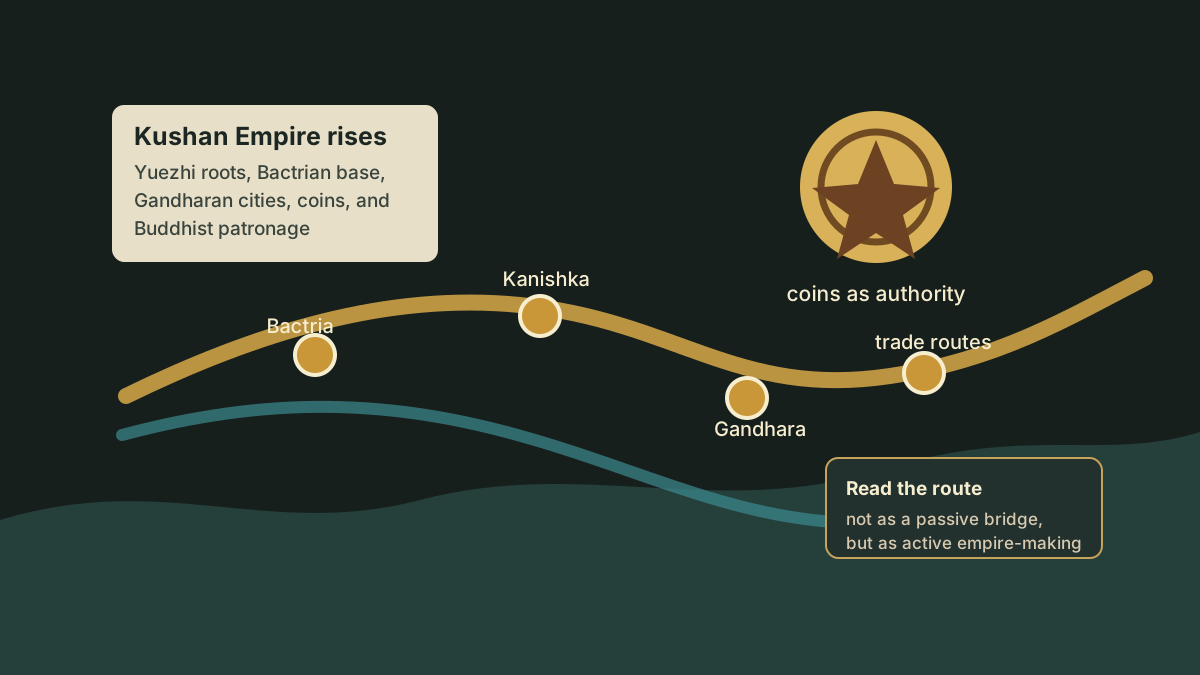
Merchants and monks moved along routes that connected the Roman world, Parthia, Central Asia, India, and Han China. Gandhara became famous for artistic forms that translated Buddhist themes into new visual languages. The empire was not simply a bridge between others. It was an active maker of political and cultural forms.
The Turning Point
The decisive change came when a Kushan ruling line, associated with Kujula Kadphises and Yuezhi groups, consolidated power in and around Bactria and began to project authority across adjacent regions. Rather than a sudden conquest of a single polity, this was an act of political entrepreneurship: local Yuezhi leaders negotiated marriages, forged alliances with urban elites, adopted administrative techniques from neighboring models, and issued coinage that signaled new legitimacy. Kujula Kadphises emerges in later sources as a focal figure for that consolidation; under his leadership the Kushan line secured frontier towns, controlled key passes and marketplaces, and established a more continuous political presence between Central Asia and northern India.
Those concrete choices—where to garrison, which monetary standards to mint, which monasteries to support—converted a network of mobile groups and scattered cities into a recognizable imperial formation. Importantly, the process blended opportunistic decisions by leaders with deeper structural shifts in trade, migration, and religious exchange, a balance that remains debated by scholars. The rise of Kushan power depended on consolidating territories that sat across caravan routes and agricultural zones. Rulers such as Kanishka later became central to the empire's memory because they combined conquest, patronage, and religious display. Coinage is especially useful evidence: royal portraits, deities from multiple traditions, Greek and Bactrian scripts, and claims to authority show a court speaking in several registers at once.
By placing kingship within this mixed vocabulary, the Kushans made rule legible to merchants, soldiers, monks, and neighboring courts. The turning point was not a single battle around 30 CE, but the formation of a durable political language across cultural frontiers.
Consequences
In the near term, Kushan power created a more coherent political space across frontier zones. Merchants found more consistent protection along long-distance routes; coinage bearing Kushan symbols spread into diverse markets, easing transactions; and Buddhist institutions in northwestern India and corridor towns gained patrons who could fund new monasteries and artistic programs. Over decades the Kushan polity functioned as an intermediary between major imperial spheres: Han China, South Asia, Parthian/Iranian worlds, and markets connected to the Mediterranean. In the longer view, the empire shaped the cultural geography of the Silk Road. Art, religious ideas, and commercial practices moved along routes under Kushan auspices and became visible in sculpture, coin types, and bilingual inscriptions.
That influence was neither uniform nor permanent—local elites continued to exercise autonomy, and later political transformations would reshape the map—but the Kushan era established patterns of exchange and patronage that influenced the region’s historical trajectory. Because interpretations differ about how much credit to give individual rulers versus long-term structural forces, this narrative highlights both the choices leaders made and the larger currents that enabled them. The consequences included stronger long-distance exchange, new patterns of Buddhist patronage, and a political corridor linking Central and South Asia. Kushan support helped Buddhist institutions flourish in ways that affected art, pilgrimage, and transmission toward Central Asia and China. Their coins and inscriptions give historians rare evidence for how rulers advertised legitimacy across diverse communities.
Over the longer arc, the Kushan example warns against treating Silk Road history as trade without states. Roads and markets needed protection, taxation, diplomacy, and courtly imagination. The empire's significance lies in that combination: commercial routes, religious networks, and imperial authority reinforcing one another.
Interpretation Notes
Kushan Empire Rises raises a debate about scale: did the decisive change come from the visible imperial formation, or from older pressures around Kushan Empire and Silk Road that had already narrowed what people could do?
Why Keep Reading
Follow the Kushan story into the decades after c. 30 CE to see how the state matured, how its coinage and art evolved, and how Buddhist institutions expanded across borders. If you want to understand why sculptures in Gandhara mix Hellenistic and Indian forms, or why certain trade goods flowed between Chang’an and the Arabian Sea, the next pages trace concrete links: administrative practices, caravan routes, and episodes of diplomatic contact. Read on to watch a frontier polity become a hinge between empires—and to judge for yourself how much of that hinge rested on individual leadership versus wider commercial and cultural forces. Follow Kushan history into Gandharan art, Buddhist transmission, Han frontier diplomacy, and Central Asian trade.
This route shows how cultural exchange often depended on states that could make movement profitable and safe enough to repeat.
Reading Path
Follow the story without losing the thread
Before This
- Founding of the Roman Empire27 BCE
- Assassination of Julius CaesarMarch 15, 44 BCE
- Zhang Qian's Western Mission138 BCE
After This
Same Period
Wider Timeline
Mind Map
How to think about Kushan Empire Rises
Nomadic movement
Migration of Yuezhi groups into Bactria created new power bases and military capacity.
Map Layer
Where this event sits geographically
Gold pins mark the approximate locations of published event pages. This is a schematic locator map, not a historical border map.
Coordinates are approximate and are used to help readers orient themselves before opening a full event page.
References
Where to Check the Facts
- Encyclopaedia Britannica: Kushan DynastySpecific reference for Kushan origins, geography, and early imperial formation.
- Encyclopaedia Britannica: KushanContext reference for Kushan identity and Central Asian background.