Historical Role
Sengbe Pieh's page should begin with resistance rather than with a court case label. He was among the Africans illegally carried into Atlantic captivity who took control of the Amistad, forcing U.S. courts and publics to confront the difference between law, property claims, kidnapping, and freedom.
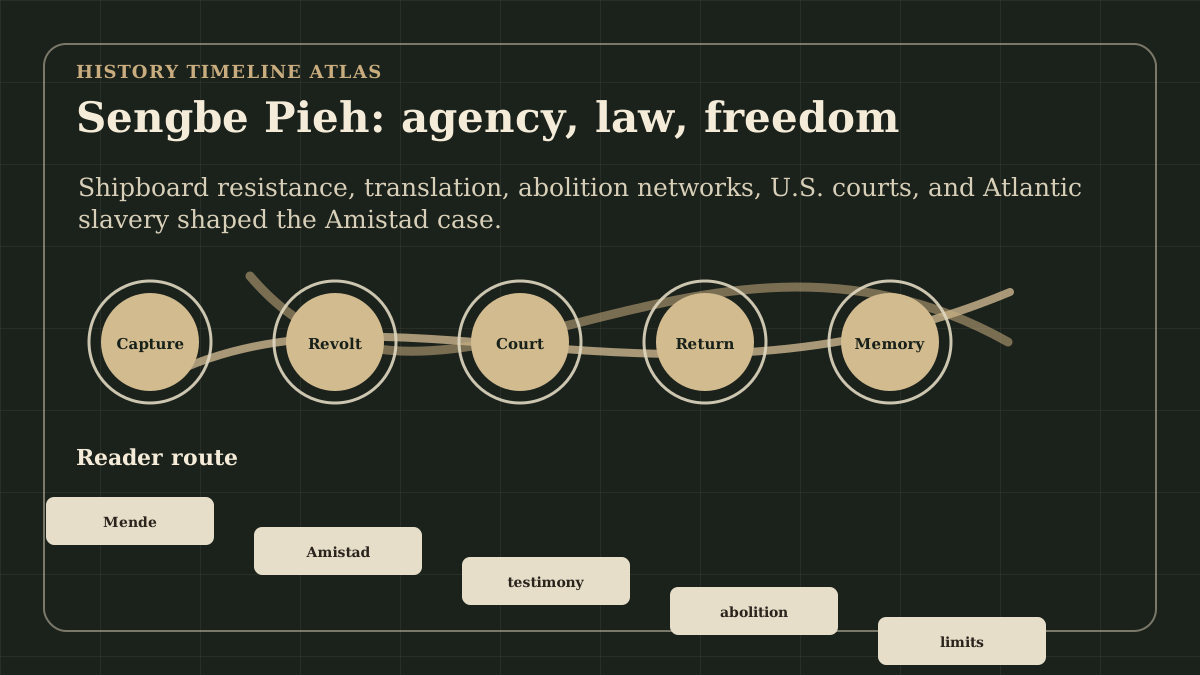
The human route begins before the ship reached American law. Capture, forced movement, language barriers, violence aboard vessels, sale in Cuba, and the attempt to move captives again created the conditions for revolt. Without that sequence, the case can look like a legal puzzle instead of a struggle by people resisting unlawful enslavement.
The Amistad case matters because it combined self-liberation with legal advocacy. Sengbe Pieh and the other captives acted first; abolitionist supporters, translators, lawyers, and public campaigns then helped carry their claim through U.S. institutions. The courtroom did not create their desire for freedom; it became one arena where that claim had to be translated.
A strong biography keeps Africa visible. The captives were not anonymous victims entering history only when Americans noticed them. They came from communities, languages, kinship worlds, and political landscapes disrupted by slave trading. Their personhood is historical evidence, not an afterthought.
The ruling's meaning was also limited. It did not end slavery in the United States, Cuba, or the Atlantic world. It did, however, expose the illegality of a specific captivity and gave abolitionists a story where African testimony, revolt, law, and public opinion could be joined.
The reading path should move from Sengbe Pieh to the Amistad case, Atlantic slavery, abolition, and later emancipation routes. His page is a reminder that legal milestones often begin with people who refused the categories imposed on them.
Translation should be treated as historical action. Courts needed names, origins, language, age, route, sale, and status to decide what they were hearing. Interpreters and abolitionist networks helped make testimony legible to U.S. institutions, but the facts they translated came from people whose lives had already been violently moved across Atlantic systems.
The return route matters too. Victory in court did not simply end the story with a legal principle. The surviving captives had to return across the same Atlantic world that had tried to turn them into property, and later memory had to decide whether the Amistad was an abolitionist triumph, an African resistance story, a U.S. legal precedent, or all of these at once.
A stronger biography keeps the limits of law in view. The United States could recognize that these captives had been illegally enslaved while still protecting slavery within its own borders. That contradiction helps readers see why one court victory could become morally powerful without dismantling the larger system.
Audience also becomes a force. Newspapers, abolitionist meetings, pamphlets, fundraising, and public curiosity shaped how the case traveled. Sengbe Pieh's life was interpreted by people with different goals, which makes memory part of the history rather than a decorative afterword.
For readers searching his name, the biography makes clear that Sengbe Pieh is not important only because American courts ruled on his case. He matters because resistance by captive Africans forced law, abolitionism, and public opinion to respond.
Sengbe Pieh helps connect individual action with wider historical change in Mende and Atlantic World. The biography works best when it keeps the surrounding world visible: authority, conflict, belief, reform, or discovery moved through decisions made under pressure.
The related events show how roles such as Amistad captive, Resistance leader can be read through dates, places, institutions, and consequences rather than through reputation alone. The biography explains why this person matters, while the linked events explain what changed around them.
A richer reading starts with the limits around the person. Some figures acted through offices, armies, courts, laboratories, churches, parties, ships, trade networks, or protest movements; others became important because later communities turned their lives into symbols. The page therefore asks what this person could actually change, what was already moving before them, and which consequences later readers attached to the name.
Read the biography against absence as well. Many lives around Sengbe Pieh are less visible in the record: opponents, collaborators, family members, workers, soldiers, students, subjects, victims, translators, scribes, or local communities. Keeping those surrounding people in view makes the page less like a name card and more like an entry point into historical systems.
Sengbe Pieh also works as a navigation point. Open the linked event pages to see where the biography becomes chronology, then use the topic routes to test whether the same pattern appears beyond one life. That extra step matters because historical importance is rarely contained inside a single decision; it usually spreads through institutions, witnesses, opponents, imitators, and later arguments over memory.
Sources and Method
Source trail: the page uses the Amistad case event, Yale archival slavery material, and abolition route sources to keep African agency visible before U.S. legal interpretation.
Method note: the page separates self-liberation, court advocacy, abolitionist publicity, and later memory. Each layer used Sengbe Pieh's story differently.
Evidence Notes
How Sensitive Claims Are Sourced
- 1
Agency before the courtroom
The biography begins with forced movement and shipboard resistance so the Amistad case does not become only a U.S. legal drama.
Why This Person Matters
Sengbe Pieh matters because the connected events make a larger historical pattern easier to follow. The page links biography to consequences so readers can move from a life story into the wider atlas, compare the person with contemporaries, and understand why later memory kept returning to this figure. Sengbe Pieh matters because his life turns the Amistad from a courtroom case into a history of African agency, shipboard resistance, translation, abolitionist support, legal constraint, and Atlantic memory. His page helps readers understand that freedom claims often reached courts only after people had already risked their lives to make those claims unavoidable.
What becomes clearer when this person's life is read through connected events instead of isolated biography, and where do the consequences outgrow the person?
How to Read This Life
Sengbe Pieh is easiest to understand when the biography is read beside Amistad Case. Those events show the historical setting in motion: dates, places, institutions, conflict, and consequences give the life a structure that a short biography alone cannot provide.
The surrounding route crosses Abolition and Atlantic Law and locations such as United States Supreme Court. That matters because influence rarely stays inside one person. It moves through offices, armies, movements, laws, texts, speeches, institutions, and later memory.
A useful reading path starts with the role labels, then opens the event pages to see what changed, and finally compares this person with other actors facing similar pressures.
For readers who arrive on a biography first, this page is meant to become a doorway rather than a stop. Read one paragraph for the answer, then use the turning points, topic routes, and event links to test whether the person's reputation matches the wider evidence.
Read Sengbe Pieh through the roles of Amistad captive, Resistance leader rather than as reputation alone.
Place the biography inside Mende and Atlantic World and the wider events linked below.
Ask which choices were personal and which were constrained by institutions or crisis.
Follow how later memory simplified, contested, or reused this person's role.
Start with resistance by the captives before following lawyers and courts.
Ask how language, testimony, identity, and law shaped what institutions could hear.
Separate victory in one case from the continued existence of Atlantic slavery.
Legacy, Limits, and Memory
A useful biography keeps scale in view. Sengbe Pieh mattered because individual choices met a wider structure: institutions, enemies, allies, audiences, technologies, beliefs, and inherited conflicts. The related event pages help separate personal agency from conditions that no single person controlled.
Memory is part of the biography too. Later readers often simplify a figure into a hero, villain, founder, reformer, conqueror, prophet, scientist, or symbol. Those labels can be helpful, but they become misleading when they hide conflict, compromise, exclusion, uncertainty, or the experiences of people outside the main biography.
For the next step, compare this life with a topic route rather than stopping at the name. If the same pattern appears across several figures, the reader has found a historical structure; if this person breaks the pattern, the contrast is usually where the most interesting question begins.
A careful reading avoids treating abolitionists as the only actors. Support networks mattered, but Sengbe Pieh and the other captives made the case possible through resistance.
The biography also asks readers to compare legality and justice. A system can process a case while leaving the larger violence of slavery intact.
Turning Points to Read Next
Amistad Case
The Amistad case centered on Africans who had been illegally transported and who resisted captivity aboard a Spanish vessel.
Related Timeline
- 1841Amistad Case
The Amistad case centered on Africans who had been illegally transported and who resisted captivity aboard a Spanish vessel.
References
Where to Check the Facts
- The National Archives: British transatlantic slave trade recordsOfficial research guide reference for British slave-trade records and digitised legislation including the Abolition of the Slave Trade Act 1807 and Slavery Abolition Act 1833.
- Official archive: Emancipation ProclamationReference for the United States Emancipation Proclamation and its legal setting.
- Legifrance: French abolition decree, 1848Official legal reference for the 1848 abolition of slavery in French colonies and possessions.
- Gilder Lehrman Institute: Frederick Douglass, 1852Primary-source teaching reference for Douglass's abolitionist Fourth of July address.
- Yale Archives: Cuban slavery collectionArchival reference for Cuban slavery and the 1886 abolition date.
- Encyclopaedia Britannica: William WilberforceBiographical reference for Wilberforce, parliamentary abolitionism, the 1807 slave-trade abolition, and the 1833 slavery abolition act.
- Encyclopaedia Britannica: Slavery Abolition ActReference for British abolition of slavery in much of the empire.