Historical Role
Lee Kuan Yew's biography should begin with Singapore's vulnerability after separation from Malaysia in 1965. The city-state had a port, a strategic location, and a disciplined political leadership, but it also faced questions about defense, housing, unemployment, ethnic balance, water, regional security, and how a small island could survive among larger neighbors.
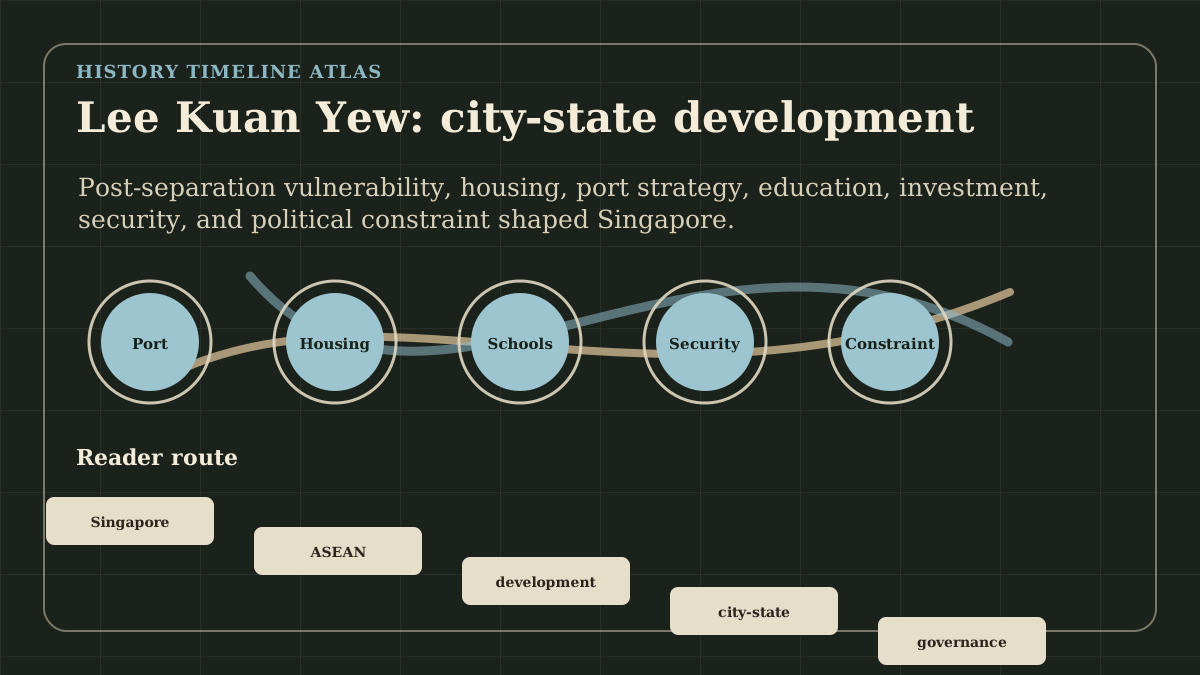
His historical role was to turn vulnerability into a governing project. Public housing, anti-corruption institutions, education, industrial policy, port development, English-language pragmatism, and foreign investment became parts of a state-building strategy. The result was not only economic growth; it was a particular model of order, competence, and political control.
The Cold War setting matters. Singapore's choices were made in a region shaped by decolonization, communist insurgencies, Indonesia-Malaysia confrontation, British military withdrawal, U.S. power, ASEAN diplomacy, and rapidly changing Asian economies. Lee's success cannot be read as a management case study detached from those pressures.
The biography also needs its hard question: what did development cost politically? Supporters point to stability, safety, prosperity, housing, education, and global relevance. Critics point to limits on opposition, press pressure, libel suits, preventive detention, and a political culture that narrowed dissent. Both sides are part of the historical record because the model joined capacity with constraint.
Lee's global afterlife is powerful because many leaders and readers look to Singapore as proof that small states can matter. The deeper lesson is not a simple recipe. It is that institutions, geography, global trade, disciplined administration, and restricted politics were tied together in a specific postcolonial setting.
A useful final layer is citizenship. Singaporeans encountered Lee's state through housing queues, schools, national service, language policy, public campaigns, courts, and workplace discipline. That daily texture keeps the biography from becoming only a leadership doctrine; it asks how ordinary people experienced security, opportunity, pressure, conformity, and pride inside a highly managed postcolonial society.
Housing is one of the most concrete ways to read his rule. Public flats, land acquisition, savings policy, neighborhood planning, and ethnic integration rules made state capacity visible in daily life. Development was not only GDP; it was where families lived, which schools children attended, and how the state organized belonging.
Foreign policy also deserves weight. Singapore used ASEAN, defense partnerships, port relevance, and careful relations with larger powers to make smallness less dangerous. Lee's statecraft depended on being useful to global trade while staying alert to regional vulnerability.
The page becomes richer when it separates administrative competence from democratic openness. Efficient bureaucracy, low corruption, and long planning horizons can build public trust, but they can also support a political system that treats opposition as risk. That tension is the core of the biography.
Readers leave Lee's page with a systems question: how did a small port city turn geography, discipline, capital, education, and law into sovereignty that felt practical rather than merely formal?
Lee Kuan Yew helps connect individual action with wider historical change in Singapore. The biography works best when it keeps the surrounding world visible: authority, conflict, belief, reform, or discovery moved through decisions made under pressure.
The related events show how roles such as Prime minister, State builder can be read through dates, places, institutions, and consequences rather than through reputation alone. The biography explains why this person matters, while the linked events explain what changed around them.
A richer reading starts with the limits around the person. Some figures acted through offices, armies, courts, laboratories, churches, parties, ships, trade networks, or protest movements; others became important because later communities turned their lives into symbols. The page therefore asks what this person could actually change, what was already moving before them, and which consequences later readers attached to the name.
Read the biography against absence as well. Many lives around Lee Kuan Yew are less visible in the record: opponents, collaborators, family members, workers, soldiers, students, subjects, victims, translators, scribes, or local communities. Keeping those surrounding people in view makes the page less like a name card and more like an entry point into historical systems.
Lee Kuan Yew also works as a navigation point. Open the linked event pages to see where the biography becomes chronology, then use the topic routes to test whether the same pattern appears beyond one life. That extra step matters because historical importance is rarely contained inside a single decision; it usually spreads through institutions, witnesses, opponents, imitators, and later arguments over memory.
Sources and Method
Source trail: the page uses Lee Kuan Yew biography references, Singapore independence material, ASEAN context, and Cold War Southeast Asia route sources.
Method note: the page treats Singapore as a city-state problem, not only as a leadership story. Housing, port strategy, education, foreign investment, regional diplomacy, and political constraints all shape the interpretation.
Evidence Notes
How Sensitive Claims Are Sourced
- 1
City-state statecraft after 1965
Lee Kuan Yew's importance is tied to the way post-separation Singapore built institutions for housing, trade, security, education, investment, and political discipline.
Why This Person Matters
Lee Kuan Yew matters because the connected events make a larger historical pattern easier to follow. The page links biography to consequences so readers can move from a life story into the wider atlas, compare the person with contemporaries, and understand why later memory kept returning to this figure. Lee Kuan Yew matters because his biography turns postcolonial state-building into a concrete problem of housing, ports, water, defense, education, investment, ethnicity, and political control. The page helps readers see Singapore as a city-state system rather than a simple success slogan. It also keeps daily life visible, because sovereignty became practical through flats, schools, work, transport, law, security routines, and constant negotiation with larger neighbors.
That mix makes the biography useful for comparing development, authority, consent, legitimacy, regional vulnerability, and long-term public trust.
When does state capacity become a democratic strength, and when does it become a limit on political freedom?
How to Read This Life
Lee Kuan Yew is easiest to understand when the biography is read beside ASEAN Founded. Those events show the historical setting in motion: dates, places, institutions, conflict, and consequences give the life a structure that a short biography alone cannot provide.
The surrounding route crosses Cold War and Regionalism and locations such as Bangkok. That matters because influence rarely stays inside one person. It moves through offices, armies, movements, laws, texts, speeches, institutions, and later memory.
A useful reading path starts with the role labels, then opens the event pages to see what changed, and finally compares this person with other actors facing similar pressures.
For readers who arrive on a biography first, this page is meant to become a doorway rather than a stop. Read one paragraph for the answer, then use the turning points, topic routes, and event links to test whether the person's reputation matches the wider evidence.
Read Lee Kuan Yew beside Singapore independence and Cold War Southeast Asia. That order keeps the page from becoming a generic leadership profile.
Then compare Singapore with Ghana, India, Indonesia, Vietnam, and South Korea. The comparison asks why postcolonial state-building produced such different mixtures of democracy, discipline, welfare, security, and growth.
Read Lee Kuan Yew through the roles of Prime minister, State builder rather than as reputation alone.
Place the biography inside Singapore and the wider events linked below.
Ask which choices were personal and which were constrained by institutions or crisis.
Follow how later memory simplified, contested, or reused this person's role.
Ask how geography, ports, water, defense, and scale shaped Singapore's options.
Track housing, schools, investment, corruption control, and infrastructure as statecraft.
Hold prosperity and political limits in the same frame.
Legacy, Limits, and Memory
A useful biography keeps scale in view. Lee Kuan Yew mattered because individual choices met a wider structure: institutions, enemies, allies, audiences, technologies, beliefs, and inherited conflicts. The related event pages help separate personal agency from conditions that no single person controlled.
Memory is part of the biography too. Later readers often simplify a figure into a hero, villain, founder, reformer, conqueror, prophet, scientist, or symbol. Those labels can be helpful, but they become misleading when they hide conflict, compromise, exclusion, uncertainty, or the experiences of people outside the main biography.
For the next step, compare this life with a topic route rather than stopping at the name. If the same pattern appears across several figures, the reader has found a historical structure; if this person breaks the pattern, the contrast is usually where the most interesting question begins.
The page avoids flattening Singapore into either miracle or repression. Its history is the relationship between competence, constraint, geography, and global markets.
Leadership mattered, but so did port geography, British colonial legacies, regional insecurity, labor discipline, education policy, and international capital.
The reader leaves with a better question than whether Lee was admirable: how do small states make sovereignty practical?
Turning Points to Read Next
ASEAN Founded
ASEAN was founded by Indonesia, Malaysia, the Philippines, Singapore, and Thailand to promote cooperation, development, and regional stability during the Cold War.
Related Timeline
- August 8, 1967ASEAN Founded
ASEAN was founded by Indonesia, Malaysia, the Philippines, Singapore, and Thailand to promote cooperation, development, and regional stability during the Cold War.
References
Where to Check the Facts
- Encyclopaedia Britannica: Lee Kuan YewBiographical reference for Lee's leadership and Singapore's development.
- Encyclopaedia Britannica: ASEANReference for ASEAN and regional context.