Historical Role
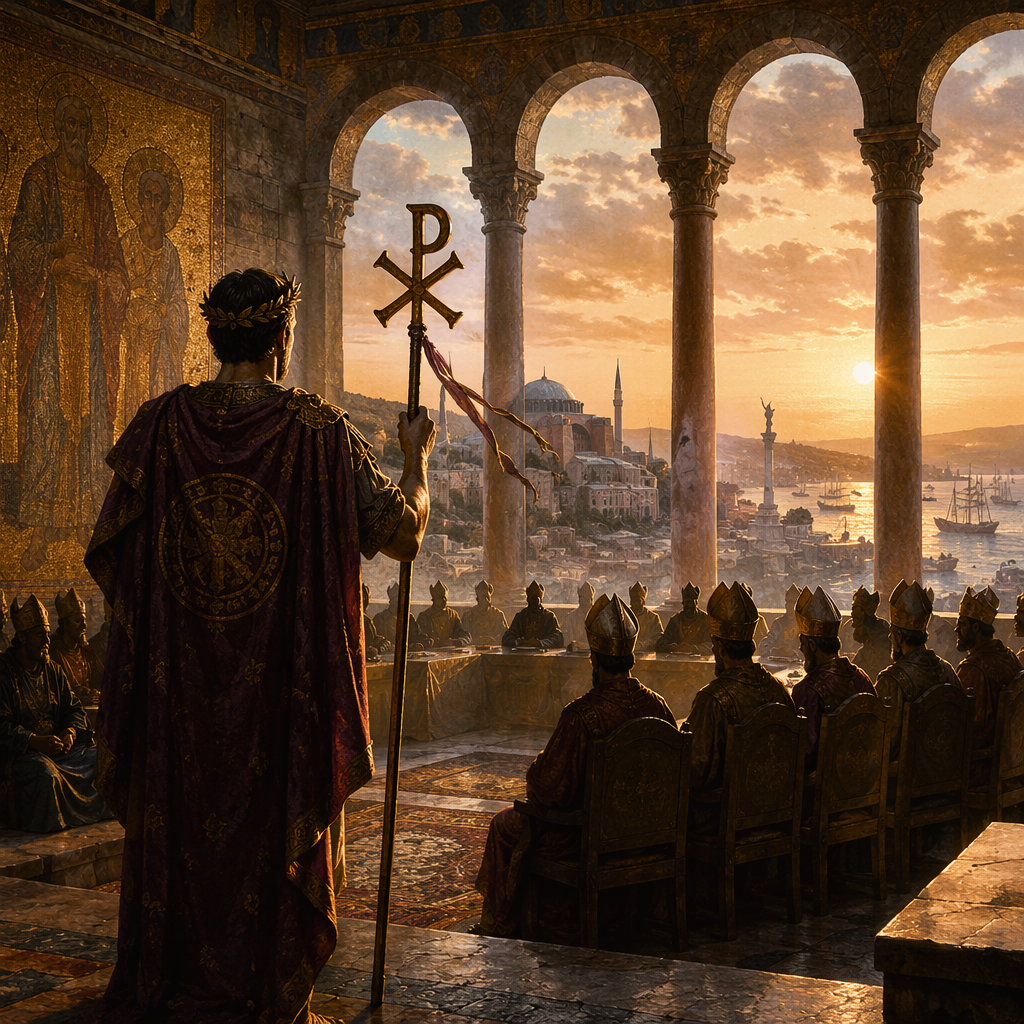
Constantine the Great belongs at the crossing of Roman imperial power and Christian public history. His importance is not only that he favored Christianity. It is that an emperor used law, patronage, councils, building, coinage, military authority, and a new capital to reshape what public religion could look like inside a Roman world still full of older traditions.
The Edict of Milan and the Council of Nicaea show two different kinds of power. One concerns legal toleration and the end of formal persecution; the other shows imperial involvement in church dispute, creed-making, bishops, and public order. Constantine did not make Christianity appear from nowhere, and he did not settle every doctrine. He changed the conditions under which Christian institutions could operate.
Constantinople matters because biography becomes geography. A new imperial capital on the Bosporus linked Roman memory, military strategy, eastern administration, trade routes, and Christian monumental space. The city outlived its founder as an argument about where Roman authority, Christian patronage, and eastern imperial strategy could meet.
The military layer belongs beside the religious layer. Constantine emerged from civil war, imperial rivalry, frontier pressure, army loyalty, and the need to stabilize authority after decades of crisis. His Christian patronage did not float above politics; it worked inside a world where emperors needed victory, legitimacy, tax revenue, soldiers, law, and public ceremonies to hold the empire together. That context helps readers see why religion, administration, and military power became intertwined.
A richer page also keeps ordinary Christian and non-Christian communities in view. Legal toleration, church building, episcopal authority, imperial patronage, and doctrinal dispute changed incentives for bishops, urban congregations, local elites, and people who continued older practices. Constantine's importance lies in changing the public conditions of religion, not in making all belief suddenly uniform.
Constantine the Great helps connect individual action with wider historical change in Roman Empire. The biography works best when it keeps the surrounding world visible: authority, conflict, belief, reform, or discovery moved through decisions made under pressure.
The related events show how roles such as Roman emperor can be read through dates, places, institutions, and consequences rather than through reputation alone. The biography explains why this person matters, while the linked events explain what changed around them.
A richer reading starts with the limits around the person. Some figures acted through offices, armies, courts, laboratories, churches, parties, ships, trade networks, or protest movements; others became important because later communities turned their lives into symbols. The page therefore asks what this person could actually change, what was already moving before them, and which consequences later readers attached to the name.
Read the biography against absence as well. Many lives around Constantine the Great are less visible in the record: opponents, collaborators, family members, workers, soldiers, students, subjects, victims, translators, scribes, or local communities. Keeping those surrounding people in view makes the page less like a name card and more like an entry point into historical systems.
Constantine the Great also works as a navigation point. Open the linked event pages to see where the biography becomes chronology, then use the topic routes to test whether the same pattern appears beyond one life. That extra step matters because historical importance is rarely contained inside a single decision; it usually spreads through institutions, witnesses, opponents, imitators, and later arguments over memory.
Sources and Method
Source method: Constantine is read through Edict of Milan, Nicaea, Constantinople, and late Roman routes so law, church politics, and capital-building remain connected.
Evidence Notes
How Sensitive Claims Are Sourced
- 1
Christianity enters public law
The biography treats toleration and imperial patronage as a change in Christianity's public position, not as a simple instant conversion of the whole empire.
- 2
Council and capital as imperial tools
Nicaea and Constantinople show how Constantine used gathering, building, and imperial presence to make religious and political order visible.
Why This Person Matters
Constantine the Great matters because the connected events make a larger historical pattern easier to follow. The page links biography to consequences so readers can move from a life story into the wider atlas, compare the person with contemporaries, and understand why later memory kept returning to this figure. Constantine matters because his reign changed the relationship between Roman power and Christianity. The biography gives readers a route into late antiquity: toleration, doctrine, councils, capital-building, imperial memory, and the long afterlife of Christian public authority.
What changes when an emperor supports a once-persecuted religion and then uses imperial authority to shape its public institutions?
How to Read This Life
Constantine the Great is easiest to understand when the biography is read beside Edict of Milan, Council of Nicaea. Those events show the historical setting in motion: dates, places, institutions, conflict, and consequences give the life a structure that a short biography alone cannot provide.
The surrounding route crosses Late Antiquity and locations such as Milan, Nicaea. That matters because influence rarely stays inside one person. It moves through offices, armies, movements, laws, texts, speeches, institutions, and later memory.
A useful reading path starts with the role labels, then opens the event pages to see what changed, and finally compares this person with other actors facing similar pressures.
For readers who arrive on a biography first, this page is meant to become a doorway rather than a stop. Read one paragraph for the answer, then use the turning points, topic routes, and event links to test whether the person's reputation matches the wider evidence.
Read Constantine beside Edict of Milan, Nicaea, Constantinople, 476, Justinian, and Roman Empire routes. That path keeps late antique transformation visible.
Then compare him with Abd al-Malik, Ashoka, Akbar, and Justinian where available. The comparison asks how rulers used religion, law, monuments, and capitals to stabilize authority.
The best navigation path runs backward to Roman crisis and forward to Byzantine survival. That sequence prevents the page from becoming only a conversion story; it becomes a route through civil war, toleration, doctrine, capital-building, and the long survival of eastern Roman power.
Read Constantine the Great through the roles of Roman emperor rather than as reputation alone.
Place the biography inside Roman Empire and the wider events linked below.
Ask which choices were personal and which were constrained by institutions or crisis.
Follow how later memory simplified, contested, or reused this person's role.
Track toleration, patronage, and public status rather than assuming a whole empire changed belief overnight.
Use Nicaea to ask how doctrine, bishops, dispute, and imperial power met.
Read Constantinople as strategy, memory, administration, and sacred landscape.
Place religious policy beside military victory, dynastic rivalry, and the search for imperial stability.
Legacy, Limits, and Memory
A useful biography keeps scale in view. Constantine the Great mattered because individual choices met a wider structure: institutions, enemies, allies, audiences, technologies, beliefs, and inherited conflicts. The related event pages help separate personal agency from conditions that no single person controlled.
Memory is part of the biography too. Later readers often simplify a figure into a hero, villain, founder, reformer, conqueror, prophet, scientist, or symbol. Those labels can be helpful, but they become misleading when they hide conflict, compromise, exclusion, uncertainty, or the experiences of people outside the main biography.
For the next step, compare this life with a topic route rather than stopping at the name. If the same pattern appears across several figures, the reader has found a historical structure; if this person breaks the pattern, the contrast is usually where the most interesting question begins.
The main risk is treating Constantine as a simple founder of Christian empire. Christian communities already existed, imperial motives were mixed, and doctrine remained contested.
A second risk is separating religion from administration. For Constantine, legal favor, bishop politics, military authority, urban patronage, and imperial unity were connected.
Another useful caution is scale. Constantine's policies altered imperial politics and Christian institutions, but local practice changed unevenly. The biography distinguishes law, patronage, theology, public memory, and lived religion.
Turning Points to Read Next
Edict of Milan
The Edict of Milan recognized religious toleration for Christians within the Roman Empire, changing the relationship between imperial power and Christianity.
Council of Nicaea
Bishops gathered at Nicaea under Constantine to address doctrinal disputes and define shared Christian teaching within an imperial setting.
Related Timeline
- 313 CEEdict of Milan
The Edict of Milan recognized religious toleration for Christians within the Roman Empire, changing the relationship between imperial power and Christianity.
- 325 CECouncil of Nicaea
Bishops gathered at Nicaea under Constantine to address doctrinal disputes and define shared Christian teaching within an imperial setting.
References
Where to Check the Facts
- Encyclopaedia Britannica: Constantine IBiographical reference for Constantine I's life dates, roles, institutions, and historical setting.
- Encyclopaedia BritannicaBackground reference for chronology, names, and historical context.
- WikidataStructured reference for dates, places, alternate names, and entity links.