Central Question
When ideas challenge authority, how do institutions absorb, resist, or weaponize them?
Start With These Dates
- 313 CEEdict of Milan
The Edict of Milan recognized religious toleration for Christians within the Roman Empire, changing the relationship between imperial power and Christianity.
- 325 CECouncil of Nicaea
Bishops gathered at Nicaea under Constantine to address doctrinal disputes and define shared Christian teaching within an imperial setting.
- c. 610 CEBeginning of Muhammad's Revelations
Islamic tradition places the first revelations to Muhammad near Mecca, beginning a religious movement that would transform Arabia and much of the wider world.
- 622 CEHijra to Medina
Muhammad and his followers migrated from Mecca to Medina, creating a new community that linked religious authority with social and political organization.
- 1095 CEFirst Crusade Begins
Pope Urban II called for armed pilgrimage to the eastern Mediterranean, launching the First Crusade and a new phase of Latin Christian warfare.
- 1545-1563Council of Trent
The Council of Trent clarified Catholic doctrine and reform measures in response to Protestant challenges and internal pressures.
- 1648 CEPeace of Westphalia
The Peace of Westphalia ended major phases of the Thirty Years' War and adjusted political and religious arrangements in Europe.
Sources Used Here
- Encyclopaedia Britannica: Religion
Broad reference for religion as social practice, belief, institution, ritual, and cultural system.
- Fordham University Internet History Sourcebooks
University sourcebook reference for primary and teaching texts across religious, reform, medieval, and modern history.
Religion, Reform, and Ideas is designed as a route, not a folder. It gathers events that answer related reader questions about power, belief, conflict, exchange, institutions, and memory. The strongest way to read the page is to move from the earliest events toward the later ones, watching how one kind of pressure changes form across different places.
The route currently runs from 313 CE to 1543 CE. That span lets readers compare immediate turning points with slower consequences: the founding of institutions, the spread of ideas, the shock of war or disease, and the way later societies reused earlier events as warnings, models, or symbols.
Start with Edict of Milan, Council of Nicaea, Beginning of Muhammad's Revelations, Hijra to Medina, Great Schism of 1054 and then follow the internal links into people, timelines, years, maps, and source lists. The route structure stays visible when each event explains why it belongs with the others and where the next useful page is.
Compare the events by scale. Some are concentrated moments, such as a battle, proclamation, trial, or publication. Others are long processes, such as a reform movement, pandemic, trade route, or diplomatic order. Reading both types together helps prevent the page from becoming a list of dates.
A useful route keeps uncertainty visible. Historical change rarely has one cause or one clean ending, so the reader can separate background pressure, immediate trigger, turning point, result, and later memory. That pattern is what makes the atlas expandable without making the reader start over each time.
This route is also a comparison tool. After reading one event, compare it with a later event on the same page and ask what changed in scale, language, geography, technology, authority, or public memory. The comparison is often more useful than the individual summary because it reveals the pattern the topic page is built to expose. When a claim feels too neat, open the full event page and check whether the evidence supports one cause, several causes, or a contested interpretation before moving on.
Religion, reform, and ideas follows belief as a force that changes institutions, calendars, law, education, art, violence, ethics, and public memory. It avoids treating religion as private opinion floating above history. The route asks how communities organize sacred authority, how texts and teachers travel, how reform movements challenge institutions, and how states use or fear religious legitimacy.
The ancient and late antique layers show religion becoming public structure. Ashoka's Buddhist patronage, the Edict of Milan, the Council of Nicaea, Aksum's Christianity, and early Islam all reveal belief moving through rulers, inscriptions, councils, cities, missionaries, law, and memory. The common pattern is not that rulers simply convert and everything changes. The stronger pattern is negotiation between conviction, authority, institutions, and communities.
Ashoka is useful because he turns conquest and moral language into one difficult question. His inscriptions and Buddhist patronage cannot be read only as personal remorse or only as propaganda. They show how a ruler used public messages to imagine ethical rule after violence. That makes the event a bridge between empire, religion, writing, and memory across South Asia and beyond.
The Christian imperial route shows belief entering the machinery of state. Milan changed the legal position of Christians in the Roman Empire, while Nicaea shows doctrinal debate under imperial attention. These events do not mean that theology became politics in a simple way. They show that disputes over belief could become disputes over unity, authority, language, councils, bishops, and imperial order.
Early Islam adds migration, revelation, community, law, and political leadership to the route. The Hijra and the first Muslim community are central because they show reform as lived organization, not only doctrine. Belief created obligations, institutions, calendars, alliances, and eventually imperial questions about succession and legitimacy. This keeps Islamic history connected to late antiquity and world history rather than isolated in a separate religious box.
The Reformation is the route's early modern hinge. Luther's challenge, printing, vernacular reading, church authority, princes, peasants, schools, and confessional states all interact. It is too thin to call the Reformation a dispute over doctrine alone. It was also a communication revolution, a political crisis, a reorganization of authority, and a long social transformation whose consequences reached law, education, migration, and war.
Ideas also move through non-European routes. Buddhist, Islamic, Hindu, Confucian, Christian, Indigenous, and secular reform traditions all interacted with power in different ways. The route needs future pages on Song Neo-Confucianism, Bhakti and Sufi movements, Sikh formation, Protestant missions, Islamic reform, abolitionist religion, liberation theology, and modern secular ideologies. Naming these gaps keeps the atlas honest while giving the current route a direction for expansion.
Reform movements often begin by arguing over sources of authority. Is authority in scripture, tradition, ruler, council, scholar, community, conscience, reason, ritual, or revelation? The answer shapes schools, courts, family law, calendars, worship, public speech, censorship, and rebellion. This route turns abstract ideas into institutional consequences, which is what makes the subject readable for students and curious readers.
Conflict is part of the route, but it is not the only part. Religious change can produce violence, persecution, iconoclasm, exile, polemic, and war. It can also produce care networks, schools, hospitals, art, pilgrimage, poetry, law, reform, anti-slavery arguments, civil rights language, and new forms of solidarity. The best reading keeps both possibilities visible and asks which institutions and pressures pushed a community toward one outcome or the other.
Geography matters because ideas travel through routes. Monasteries, courts, mosques, churches, universities, pilgrimage roads, printing towns, port cities, caravan networks, mission stations, and diaspora communities all shape how reform spreads. A belief can cross a border, but it changes when it enters a new language, patronage system, legal order, or local memory.
Evidence varies widely. Councils leave canons and creeds; inscriptions preserve royal messages; printed pamphlets show polemic; chronicles show memory; legal records show enforcement; art and architecture show patronage; oral traditions preserve community experience; missionary and colonial archives require careful reading. The route teaches readers to ask what kind of source carries an idea and whose voice is missing.
The modern route connects religious ideas with rights, nationalism, science, and social movements. Civil rights sermons, anti-colonial reform, secular republics, religious nationalism, feminist theology, and public health debates all show that religion and ideas did not retreat from modern history. They changed arenas. The public square, school, courtroom, parliament, newspaper, radio, television, and social media became new settings for older arguments about authority and belonging.
Ideas also have material lives. A doctrine becomes durable when it is copied, taught, sung, argued in court, painted on walls, memorized in schools, funded by patrons, protected by law, or carried by migrants. That material life explains why intellectual history belongs in the same atlas as battles and states. Ideas need bodies, buildings, books, roads, rituals, and audiences.
Reform can also create backlash. Institutions under pressure may censor, persecute, compromise, negotiate, or absorb critique into a new settlement. The outcome depends on allies, rulers, printing or media systems, economic interests, military pressure, and the ability of ordinary communities to keep practices alive. That is why religious and intellectual change often appears as a long struggle rather than a single declaration.
For students, the useful method is to separate message, medium, institution, and memory. The message may be theological, philosophical, moral, or political. The medium may be sermon, inscription, book, council, school, or protest. The institution decides whether the idea can endure. Memory decides what later communities keep arguing about.
The route becomes stronger when reform is read from below as well as above. Bishops, scholars, princes, and philosophers appear clearly in many sources, but ordinary believers, parishioners, women, converts, teachers, printers, students, enslaved people, migrants, and dissenters often carried reform into daily practice. Ideas survive when they enter household routines, schools, songs, calendars, legal habits, and local arguments.
Translation is one of the route's most important historical forces. Sacred texts, philosophical works, legal concepts, sermons, catechisms, scientific treatises, and political pamphlets changed as they moved between Greek, Latin, Syriac, Arabic, Sanskrit, Persian, Chinese, vernacular European languages, and many other language worlds. Translation opened access, created dispute, and sometimes shifted authority away from older gatekeepers.
Councils and assemblies make the institutional layer visible. Nicaea, church synods, imperial diets, scholarly gatherings, reform conferences, and later political assemblies show that ideas often become durable through meeting formats, voting procedures, decrees, creeds, minutes, and enforcement. A council is not only a theological moment. It is a technology for turning disagreement into public rule.
Print and manuscript culture need to be compared rather than opposed. Manuscripts carried authority, commentary, beauty, and slow scholarly transmission. Print multiplied copies, accelerated controversy, standardized some texts, and created new publics. The Reformation becomes easier to understand when readers see print as an amplifier of existing disputes, not as a machine that automatically caused reform.
The route also needs non-European reform paths. Buddhist councils and monastic reforms, Islamic legal and devotional renewals, Bhakti and Sufi movements, Sikh formation, Confucian and Neo-Confucian learning, abolitionist religion, liberation theology, and civil rights sermons all show that reform is not one Protestant template. These future paths keep the category wide enough for world history.
Religious conflict becomes more intelligible when material stakes stay visible. Land, taxation, offices, schools, marriage law, inheritance, printing privileges, military alliance, and urban control often sit behind doctrinal language. Belief mattered deeply, but institutions made belief politically consequential. The route therefore asks what a religious argument changed in law, property, education, or public order.
Secular ideas belong in the same route when they reorganize authority in similar ways. Enlightenment, nationalism, socialism, human rights, anti-colonial thought, feminism, and scientific naturalism all argued over legitimacy, truth, personhood, obligation, and public life. They did not simply replace religion. They interacted with religious language, borrowed institutional forms, and created their own rituals, schools, texts, and memories.
The evidence layer must stay careful around belief. A devotional source can preserve meaning that an administrative source misses; a polemical source can reveal conflict while exaggerating opponents; a legal source can show enforcement while hiding everyday practice; a hymn, sermon, image, or pilgrimage object can show affect and community. The route works when readers compare source purpose before judging historical effect.
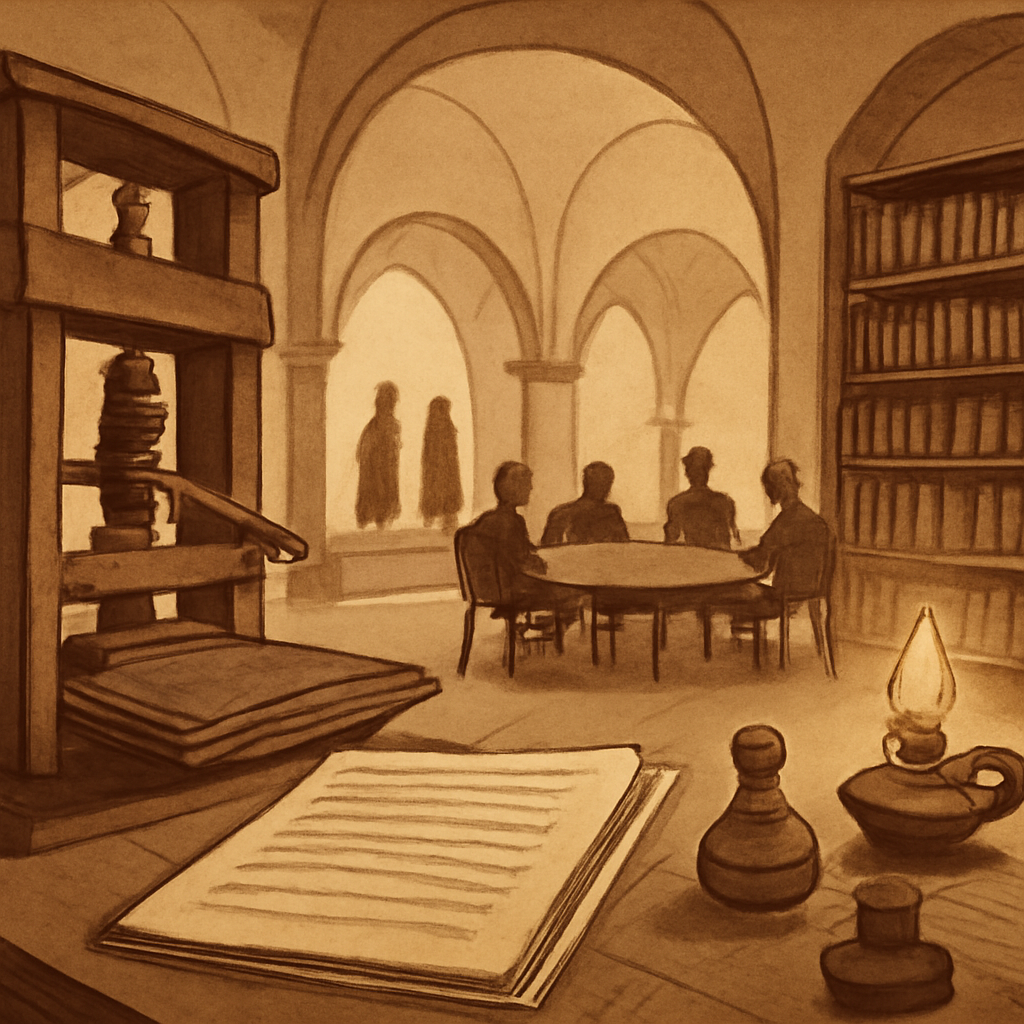
Visual material matters because belief and ideas become tangible. Manuscripts, inscriptions, pamphlets, icons, mosques, churches, temples, classrooms, printing presses, protest placards, and court records show authority being copied, displayed, contested, and enforced. The current print-and-authority visual fits the route because it makes the reader see reform as a public communication system rather than only a private conviction.
A final reading path follows authority as it changes hands. Ashoka's inscriptions, Milan's law, Nicaea's council, the Hijra's community memory, the Reformation's printed argument, and modern rights movements all ask who can define obligation in public. The answer can be ruler, text, scholar, assembly, conscience, court, school, family, or movement. That shifting answer is what makes religion and ideas a historical route rather than a category of beliefs.
The route is strongest when the next click keeps that authority question alive across regions instead of ending with one tradition, one famous reformer, or one familiar European crisis as the sole endpoint.
The reader payoff is a route that answers searches such as Protestant Reformation summary, spread of Islam, Council of Nicaea significance, or religion in world history without flattening belief into either inspiration or conflict. The better answer is that ideas become historical when communities give them institutions, rituals, texts, laws, buildings, arguments, and memories strong enough to survive beyond the first moment of reform.
This hub becomes more compelling when religion is treated as lived authority and public argument, not only doctrine. Councils, manuscripts, translations, sermons, print, pilgrimage, law, education, reform movements, and everyday practice all shaped how communities understood truth and power. The route connects Nicaea, Islamic scholarship, Reformation print, Akbar's debates, Enlightenment ideas, Darwin, and secular political language because ideas moved through institutions and people, not through abstract influence alone.
Reform is not one European story. Christian councils and Reformation pamphlets matter, but so do Islamic legal and scholarly networks, South Asian court debates, Buddhist patronage, scientific controversy, and arguments over public reason. The same questions travel across cases: who had authority to interpret, which language reached ordinary people, what institutions protected or punished disagreement, and how new media changed the audience.
The route also needs a source-aware lens. Sacred texts, commentaries, inscriptions, court debates, trial records, printed pamphlets, letters, scientific papers, and later memory all preserve different kinds of claims. Some sources argue for belief, some police boundaries, some translate, some attack, and some describe communities from outside. The hub becomes richer when readers learn to ask what kind of source is speaking before deciding what it proves.
Read the events in order first; the page is built to reveal change over time.
Ask which pressures existed before the visible turning point and which actors had room to choose.
Follow what changed afterward in institutions, borders, law, belief, or everyday life.
Notice which events became symbols and why later generations kept returning to them.
Ask who can define truth, law, ritual, doctrine, reform, or community: rulers, councils, scholars, texts, clergy, prophets, or lay believers.
Follow monasteries, mosques, churches, schools, courts, printing shops, councils, missions, and reform associations.
Read reform as both critique and institution-building, with supporters, opponents, risks, and unintended consequences.
Notice which religious events become origin stories, warnings, holidays, monuments, controversies, or arguments about identity.
Follow manuscripts, translations, print, schools, sermons, songs, and pamphlets as the channels that carry ideas into public life.
Look for households, teachers, converts, women, dissenters, migrants, workers, and local communities beside rulers and councils.
Follow who could interpret truth, which media carried ideas, and how institutions turned belief or argument into public power.
Choose a Reading Path
Start With the Timeline
Use the related timeline first when you want a chronological route through the topic.
Start with 313 CE: Edict of MilanOpen a Person Page
Use people pages when the topic is easier to understand through leadership, resistance, reform, or memory.
Start with 325 CE: Council of NicaeaUse Year Pages
Use year pages when you need a fast answer to what changed in a specific year.
Start with c. 610 CE: Beginning of Muhammad's RevelationsReturn to the Map
Use the map to keep geography visible while moving between events and regions.
Start with 622 CE: Hijra to MedinaStart With Empire and Belief
Use Ashoka, Milan, Nicaea, and early Islam to see how rulers and communities turned belief into public structures.
Start with 1095 CE: First Crusade BeginsStart With Reform
Read the Reformation and later movements when the question is how criticism becomes new institutions.
Start with 1545-1563: Council of TrentStart With Travel
Follow pilgrimage, missions, trade, printing, and scholarship when the question is how ideas cross distance.
Start with 1648 CE: Peace of WestphaliaStart With Conflict
Use religious conflict and rights movements to see how ideas can legitimize power, resistance, violence, or solidarity.
Start With Media
Open manuscript, council, print, sermon, school, and protest examples when the question is how an idea gained an audience.
How the Story Builds
Begin with Edict of Milan. The opening event usually shows the pressure that made the route necessary: a crisis of authority, an expanding exchange system, a new technology, a contested idea, or a conflict that older institutions could no longer contain.
First Crusade Begins works as a checkpoint because it lets readers ask what had become irreversible, which actors still had choices, and how the route changed scale between the opening event and the later consequences.
The later edge of the route includes Council of Trent, Peace of Westphalia, and Scientific Revolution Begins. These pages help readers see what survived beyond the first shock: institutions, borders, laws, memories, technologies, movements, or arguments that kept shaping later history.
The route is easier to remember through people and places. Watch figures such as Constantine the Great, Licinius, Early bishops, and Muhammad move through settings such as Milan, Nicaea, Mecca, Medina, and Constantinople and Rome; that is where large structures become visible as choices, risks, costs, and memories.
Ancient and late antique cases show rulers using religious language, inscriptions, councils, and patronage to shape public order.
Early Islam and other traditions show belief organizing migration, law, ritual, leadership, and durable community memory.
The Reformation reveals how printing and vernacular debate changed the scale of religious argument and institutional crisis.
Religious and secular reform movements move into schools, courts, empires, rights campaigns, nationalism, and public memory.
Modern societies keep negotiating religion through secular law, migration, identity politics, rights language, and media.
Ideas endure through homes, schools, songs, rituals, translations, charities, courts, and local memory after public controversy fades.
- Which event in Religion, Reform, and Ideas feels like the true point of no return, and why might another reader choose a different event?
- What changes if the route is read from the perspective of ordinary people rather than rulers, armies, inventors, reformers, or institutions?
- Which consequence was immediate, and which consequence only became clear decades later?
- Where does the map change the interpretation by showing distance, borders, routes, ports, capitals, or frontiers?
- When does a religious idea become an institution rather than only a belief?
- How do texts, councils, teachers, rulers, and ordinary communities compete over authority?
- Why do reform movements so often create new institutions after challenging old ones?
- Where did religious change produce violence, and where did it produce care, education, rights, or solidarity?
- Which future pages are needed to make this route less centered on Europe and the Mediterranean?
- How did translation change who could argue about sacred or political authority?
- Which source type best reveals lived religion: law, text, object, sermon, architecture, song, or oral memory?
- When does reform change belief, and when does it change the institutions that control belief?
- How do manuscripts, print, translation, councils, courts, and schools alter who can join an argument?
Interactive Timeline
Follow Religion, Reform, and Ideas by sequence
Edict of Milan
The Edict of Milan recognized religious toleration for Christians within the Roman Empire, changing the relationship between imperial power and Christianity.
Read the full event pageMap Layer
Religion, Reform, and Ideas geography
Gold pins mark the approximate locations of published event pages. This is a schematic locator map, not a historical border map.
Coordinates are approximate and are used to help readers orient themselves before opening a full event page.
Route Events
Events in This Topic
Edict of Milan
The Edict of Milan recognized religious toleration for Christians within the Roman Empire, changing the relationship between imperial power and Christianity.
Council of Nicaea
Bishops gathered at Nicaea under Constantine to address doctrinal disputes and define shared Christian teaching within an imperial setting.
Beginning of Muhammad's Revelations
Islamic tradition places the first revelations to Muhammad near Mecca, beginning a religious movement that would transform Arabia and much of the wider world.
Hijra to Medina
Muhammad and his followers migrated from Mecca to Medina, creating a new community that linked religious authority with social and political organization.
Great Schism of 1054
Mutual excommunications between representatives of Rome and Constantinople became a later marker of division between western and eastern Christianity.
First Crusade Begins
Pope Urban II called for armed pilgrimage to the eastern Mediterranean, launching the First Crusade and a new phase of Latin Christian warfare.
Protestant Reformation Begins
Martin Luther's challenge to indulgences became a wider dispute over authority, salvation, scripture, and church power in western Christianity.
Scientific Revolution Begins
Publications by Copernicus and Vesalius helped mark a new phase in European inquiry about astronomy, anatomy, evidence, and method.
Council of Trent
The Council of Trent clarified Catholic doctrine and reform measures in response to Protestant challenges and internal pressures.
Peace of Westphalia
The Peace of Westphalia ended major phases of the Thirty Years' War and adjusted political and religious arrangements in Europe.
References
Where to Check the Facts
- Encyclopaedia Britannica: ReligionBroad reference for religion as social practice, belief, institution, ritual, and cultural system.
- Fordham University Internet History SourcebooksUniversity sourcebook reference for primary and teaching texts across religious, reform, medieval, and modern history.