Historical Role
Augustus is the biography where Roman civil war becomes imperial government. His importance does not rest only on being the first emperor. It rests on the political settlement that let monarchy operate through republican language, offices, honors, army loyalty, provincial administration, public building, legal reform, and controlled memory after decades of violence.
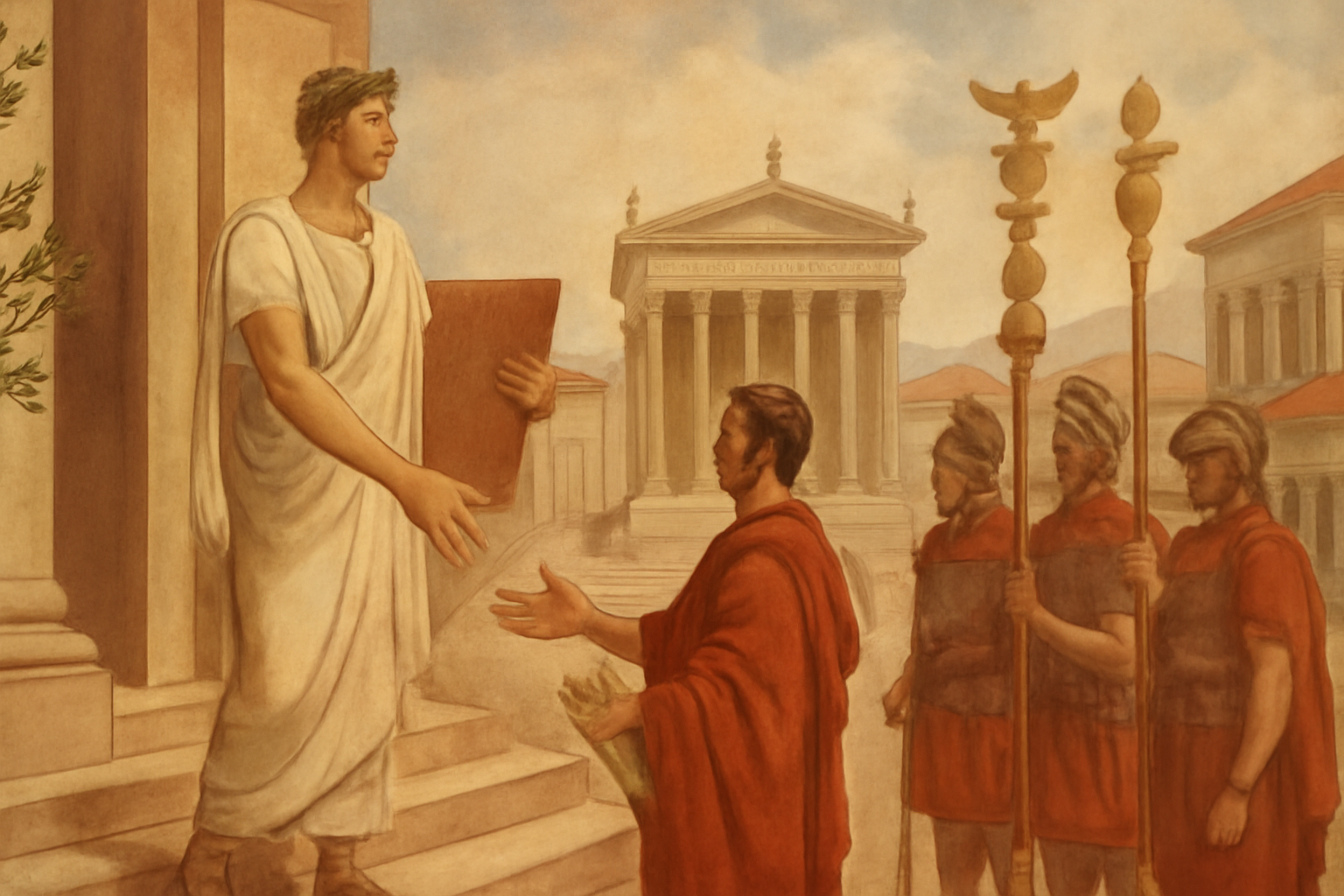
The founding of the Roman Empire in 27 BCE worked as a performance of restraint as much as a seizure of power. Augustus presented himself as restoring order, respecting Senate traditions, and ending civil conflict, while the real distribution of authority gave him command, prestige, patronage, and military leverage that no rival could easily match.
The settlement also depended on practical administration. Veterans needed land or pay, provincial governors needed supervision, tax collection needed regularity, and the army needed loyalty to the new order rather than to competing generals. Roads, colonies, censuses, frontier commands, and elite bargains made the regime visible far beyond Rome.
Public building turned power into memory. The Forum of Augustus, restored temples, the Ara Pacis, inscriptions, coins, and ceremonies made civil-war victory look like peace, piety, and renewal. Those images did not merely decorate the regime. They taught Romans how to read the new political order without saying that the republic had openly become monarchy.
Augustan moral and family legislation shows another side of the project. The princeps claimed to repair Roman discipline, marriage, hierarchy, and public virtue, yet his own household was full of succession anxiety, exile, scandal, and dynastic calculation. The gap between moral language and political reality helps readers see why Augustan order was both durable and carefully staged.
The biography also needs succession and propaganda. The Augustan settlement depended on images of peace, moral renewal, family, empire, and divine favor, but it remained vulnerable because personal authority had to become durable rule. The problem of succession shows that the new system was stable enough to survive Augustus yet unstable enough to keep producing court conflict, adoption politics, and anxiety about legitimacy.
Augustus helps connect individual action with wider historical change in Roman Empire. The biography works best when it keeps the surrounding world visible: authority, conflict, belief, reform, or discovery moved through decisions made under pressure.
The related events show how roles such as Roman emperor, Political founder can be read through dates, places, institutions, and consequences rather than through reputation alone. The biography explains why this person matters, while the linked events explain what changed around them.
A richer reading starts with the limits around the person. Some figures acted through offices, armies, courts, laboratories, churches, parties, ships, trade networks, or protest movements; others became important because later communities turned their lives into symbols. The page therefore asks what this person could actually change, what was already moving before them, and which consequences later readers attached to the name.
Read the biography against absence as well. Many lives around Augustus are less visible in the record: opponents, collaborators, family members, workers, soldiers, students, subjects, victims, translators, scribes, or local communities. Keeping those surrounding people in view makes the page less like a name card and more like an entry point into historical systems.
Augustus also works as a navigation point. Open the linked event pages to see where the biography becomes chronology, then use the topic routes to test whether the same pattern appears beyond one life. That extra step matters because historical importance is rarely contained inside a single decision; it usually spreads through institutions, witnesses, opponents, imitators, and later arguments over memory.
Sources and Method
Source method: read Augustus through the 27 BCE founding page, Roman Empire route, and primary-style claims such as the Res Gestae where represented by source material, then compare public restoration language with actual control over armies and provinces.
Evidence Notes
How Sensitive Claims Are Sourced
- 1
Settlement after civil war
The biography treats 27 BCE as a political arrangement, not a simple coronation: republican titles, senatorial ritual, military command, and personal prestige worked together.
- 2
Memory, moral order, and succession
The page keeps monuments, law, family politics, adoption, and imperial memory visible because Augustus had to make personal victory look like public restoration.
Why This Person Matters
Augustus matters because the connected events make a larger historical pattern easier to follow. The page links biography to consequences so readers can move from a life story into the wider atlas, compare the person with contemporaries, and understand why later memory kept returning to this figure. Augustus matters because his career shows how a republic can become an empire without announcing a clean break. The page helps readers see institutions as political design: titles, armies, roads, laws, monuments, families, and memory all helped make Roman one-man rule durable.
How did Augustus make personal dominance look like restored republican order, and what did that settlement hide about power, violence, and hierarchy?
How to Read This Life
Augustus is easiest to understand when the biography is read beside Founding of the Roman Empire. Those events show the historical setting in motion: dates, places, institutions, conflict, and consequences give the life a structure that a short biography alone cannot provide.
The surrounding route crosses Classical Antiquity and locations such as Rome. That matters because influence rarely stays inside one person. It moves through offices, armies, movements, laws, texts, speeches, institutions, and later memory.
A useful reading path starts with the role labels, then opens the event pages to see what changed, and finally compares this person with other actors facing similar pressures.
For readers who arrive on a biography first, this page is meant to become a doorway rather than a stop. Read one paragraph for the answer, then use the turning points, topic routes, and event links to test whether the person's reputation matches the wider evidence.
Read Augustus beside the founding of the Roman Empire, Julius Caesar, the Roman Republic, Roman law, provincial administration, and the Roman Empire timeline. That path turns biography into a study of institutional transformation.
Then compare him with Qin Shi Huang, Ashoka, Constantine, Abd al-Malik, and Napoleon where available. The comparison asks how rulers turn conquest or crisis into a repeatable political order.
Read Augustus through the roles of Roman emperor, Political founder rather than as reputation alone.
Place the biography inside Roman Empire and the wider events linked below.
Ask which choices were personal and which were constrained by institutions or crisis.
Follow how later memory simplified, contested, or reused this person's role.
Separate titles and ceremonies from the real levers of army command, provinces, patronage, and prestige.
Read monuments, moral reform, family imagery, and public peace language as political tools.
Ask why a system built around one exceptional victor needed adoption, dynastic planning, and managed legitimacy.
Legacy, Limits, and Memory
A useful biography keeps scale in view. Augustus mattered because individual choices met a wider structure: institutions, enemies, allies, audiences, technologies, beliefs, and inherited conflicts. The related event pages help separate personal agency from conditions that no single person controlled.
Memory is part of the biography too. Later readers often simplify a figure into a hero, villain, founder, reformer, conqueror, prophet, scientist, or symbol. Those labels can be helpful, but they become misleading when they hide conflict, compromise, exclusion, uncertainty, or the experiences of people outside the main biography.
For the next step, compare this life with a topic route rather than stopping at the name. If the same pattern appears across several figures, the reader has found a historical structure; if this person breaks the pattern, the contrast is usually where the most interesting question begins.
The main risk is calling Augustus simply an emperor in the later sense and missing how carefully the settlement used republican forms. The mask was part of the mechanism.
A second risk is treating the Pax Romana as peaceful in every direction. Order at the center could coexist with provincial extraction, military coercion, frontier violence, slavery, and hierarchy.
Turning Points to Read Next
Founding of the Roman Empire
Octavian accepted the title Augustus and reorganized Roman power around a new imperial settlement that preserved republican language while concentrating authority.
Related Timeline
- 27 BCEFounding of the Roman Empire
Octavian accepted the title Augustus and reorganized Roman power around a new imperial settlement that preserved republican language while concentrating authority.
References
Where to Check the Facts
- Encyclopaedia Britannica: AugustusBiographical reference for Augustus's life dates, roles, institutions, and historical setting.
- Encyclopaedia BritannicaBackground reference for chronology, names, and historical context.
- WikidataStructured reference for dates, places, alternate names, and entity links.