Fast Answer
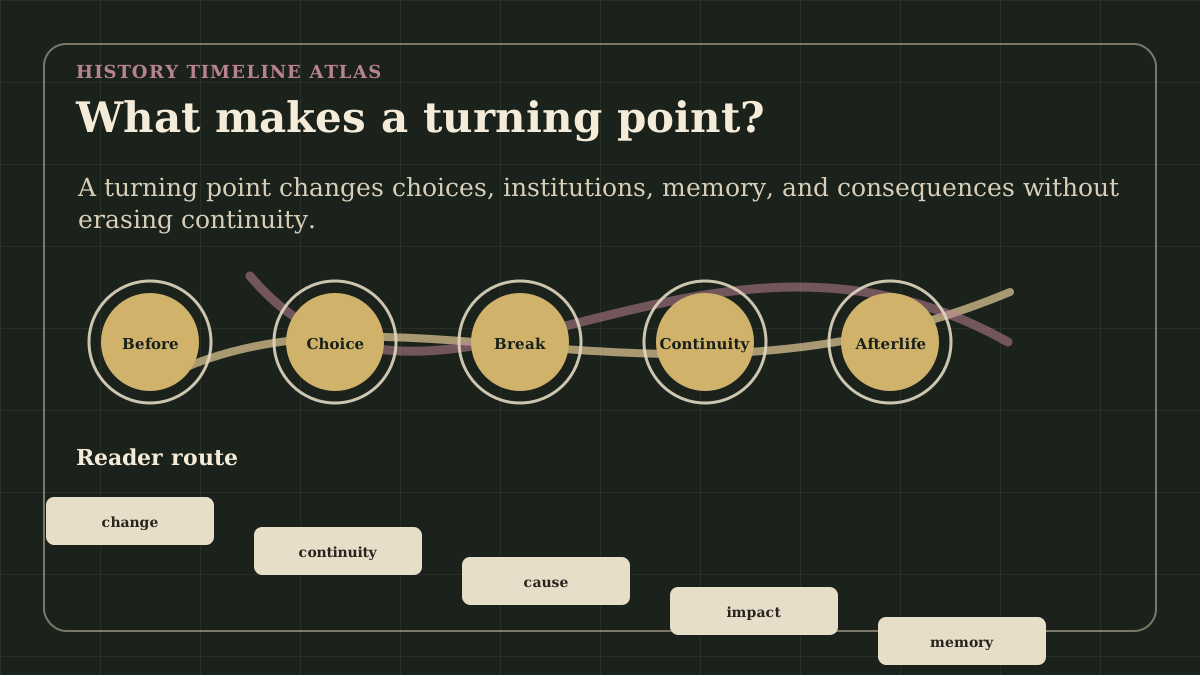
Test a turning point by asking what options existed before it, what options disappeared after it, who experienced the change, and how long the effects lasted.
A turning point is not just a famous moment; it is a moment after which the range of possible futures changed.
Reading Paths
Choose a reading path
What Makes a Historical Turning Point? becomes clearer when the broad answer stays tied to sequence, place, and concrete next pages.
Start with a concrete event, then return to the fast answer with evidence in view.
Fall of Constantinople, 1453: Siege Timeline, Causes, Aftermath
The Fall of Constantinople happened on May 29, 1453, when Mehmed II's Ottoman forces captured the city after a 55-day siege. Read the event through a four-step sequence: Ottoman artillery and blockade pressure on the Bosporus map, Byzantine wall defense, the final assault before dawn, and the aftermath in which Constantinople became an Ottoman imperial capital.
Industrial Revolution Begins
Mechanized production, coal energy, factory organization, and new transport systems began transforming work and wealth in Britain before spreading globally.
Hong Kong Handover
Britain transferred Hong Kong to China under the one country, two systems framework, linking treaty-port history, decolonization, capitalism, sovereignty, and civic memory.
How to Think About It
Read events in order before drawing a cause-and-effect conclusion.
Check where the events happened and which borders or paths are anachronistic.
Distinguish source-backed claims from later memory and simplified textbook labels.
Ask how the event was reused by later states, movements, classrooms, or public memory.
Why the Question Matters
A turning point is not just a famous moment; it is a moment after which the range of possible futures changed. The path works best as a guided path rather than a detached essay, because the answer changes when it is tested against dates, places, institutions, and memory.
What Makes a Historical Turning Point? is a method path: it turns a broad historical habit into a sequence of questions that can be tested against real cases. The point is not to force every example into one pattern. The point is to keep the main claim visible while giving the evidence enough room to complicate it.
A quick answer can orient the reader, but a quick answer alone leaves too much hidden. The first question gives the path a purpose: it turns a broad label into a historical problem with evidence behind it.
Fast Answer With Boundaries
The compact answer names the main mechanism, but the body of the path tests that mechanism rather than repeating it.
The boundary is important. A useful answer names what the phrase explains, but it also names what the phrase cannot explain by itself.
The compressed answer at the top gives orientation; the rest of the path tests it against examples. That keeps the page from becoming either a glossary entry or a loose essay with no next step.
Evidence Path
The event path starts with Fall OF Constantinople 1453, Industrial Revolution Begins 1760, and Hong Kong Handover 1997. These examples keep the path concrete. They show where causes become decisions, where decisions become institutions, and where later memory simplifies the story.
The timeline path runs through Roman Empire Timeline, Industrial Revolution Timeline, and East Asia Dynasties Modern Timeline. Timelines matter because sequence changes interpretation: a cause before the crisis is not the same as a trigger during the crisis, and an afterlife decades later is not the same as an immediate result.
The topic path opens into Turning Points and Historical Method. Topic hubs widen the frame when an event is too narrow to carry the whole answer. They also show whether the same pattern appears across regions, periods, or political systems.
Map and Scale
A map changes the answer because power never moves through empty space. Roads, ports, rivers, frontiers, islands, capitals, battlefields, schools, courts, and archives shape what people can do and what later historians can see.
The path begins with a method question, then tests that method against linked events instead of leaving it as abstract advice. The comparison or method becomes stronger when it moves between local scenes and large systems rather than choosing one scale forever.
Scale also changes moral language. A policy may look orderly from a capital and coercive from a village. A turning point may look sudden in a timeline and slow inside a household, workplace, school, or port.
People and Institutions
The strongest path names both formal decision-makers and the people who lived with the outcome. Rulers, officials, generals, reformers, merchants, teachers, soldiers, families, workers, migrants, and local communities all leave different traces.
Institutions make the traces durable. A treaty, court, army, school, company, archive, church, bureaucracy, newspaper, map, or parliament can preserve one version of events while making another harder to hear.
That is why the path asks more than who won. It asks who had leverage, who carried costs, who recorded the result, who remembered it differently, and who used the memory later.
How to Avoid a Thin Answer
A thin answer repeats the title in different words. A stronger answer separates pressure, trigger, institution, consequence, and memory. Those layers stop the page from sounding certain before the evidence has done any work.
Another thin answer treats famous names as if they explain systems. Leaders matter, but leaders act through armies, parties, courts, households, markets, clerks, ships, teachers, witnesses, and opponents. The surrounding structure gives individual choices their force.
The third thin answer ignores counterexamples. If one linked event resists the main claim, the path becomes more interesting, not weaker. The exception may reveal a regional difference, a missing source, or a hidden assumption.
Source and Uncertainty
Sources do not preserve every voice equally. Official documents often show what institutions wanted to record. Memoirs, oral history, material culture, maps, newspapers, photographs, court records, and archaeology may reveal different layers of experience.
Uncertainty belongs inside the explanation. Dates can be approximate, motives can be debated, and later memory can change the meaning of an event. Naming uncertainty helps the reader trust the path because it shows where confidence is strong and where the record is uneven.
The best source habit is comparison. Read a reference source for chronology, then follow a linked event for context, then ask whose voice is still missing. That habit turns source notes into part of the historical argument.
Case Study Pass
A useful case-study pass chooses one linked event and reads it slowly. Start with the title, then ask what pressure was already present before the event began, which actor made the pressure visible, and which institution carried the consequence afterward.
For this path, Fall OF Constantinople 1453 gives the first anchor. It does not have to explain the whole subject. Its job is to make the abstract question visible in a specific place, with a specific sequence, and with people who faced limits on what they could choose.
The second anchor, Industrial Revolution Begins 1760, lets the reader test whether the same pattern repeats. If it repeats, the path has found a structure. If it changes, the difference is usually where the best historical explanation begins.
Comparison Method
Method pages work best when they are tested against cases. A definition becomes historical only when it can explain why one event followed one path while another event followed a different one.
The method is to hold one question steady and change the evidence. Keep asking about pressure, trigger, institution, affected group, and memory. Then watch which category carries the most weight in each linked example.
This prevents a common error: matching events by surface similarity. Two events can share a date range, battlefield, treaty, or reform language while meaning very different things because the institutions and communities around them were different.
Memory Layer
Later memory is part of the history, not a decorative afterword. States, movements, schools, museums, families, and political parties often reuse the past to explain identity or authority. That reuse can preserve evidence, but it can also simplify conflict.
The memory layer asks which story became easiest to repeat. A clean victory, tragic fall, heroic reform, inevitable revolution, or simple cause may survive because it is memorable, not because it is complete.
A stronger reading keeps official memory beside quieter evidence. If the famous story celebrates a ruler, ask about workers and households. If it celebrates a law, ask about enforcement. If it celebrates independence, ask who still lacked power afterward.
Essay Shape
A clear essay or study note can follow five moves: define the question, name the main pressure, show the trigger, explain the institution that carried the result, and end with memory or afterlife.
For What Makes a Historical Turning Point?, the first paragraph can use the quick answer as orientation. The middle paragraphs belong to cases: one event for sequence, one timeline for longer causation, one topic hub for the wider system, and one source note for uncertainty.
The conclusion becomes stronger when it does not repeat the introduction. It can return to how long did the change last? and show how the evidence changed the first answer. That gives the path a sense of discovery rather than summary alone.
What to Check
Check the chronology first. If the order of events is wrong, the cause-and-effect argument will usually be wrong too. Then check the map, because distance and paths often explain why one choice was possible and another was not.
Check the actors next. A state, empire, party, church, company, court, army, or movement can sound unified even when it contained factions. Named groups make the answer more precise and less dependent on broad labels.
Finally, check the source family. A legal text, a diplomatic note, a monument, a newspaper, a memory project, and an archaeological object do not answer the same question. The path becomes more reliable when those differences stay visible.
Where the Path Opens
The path opens backward into causes and forward into consequences. It also opens sideways into related topics when the same pressure appears in another region or period. That is why the linked hub matters as much as the first event.
If the reader wants a short answer, the opening sections are enough. If the reader wants depth, the path moves from Fall OF Constantinople 1453, Industrial Revolution Begins 1760, and Hong Kong Handover 1997 to Roman Empire Timeline, Industrial Revolution Timeline, and East Asia Dynasties Modern Timeline, then into Turning Points and Historical Method. Each step adds a different kind of evidence.
The path also opens by changing the reader's scale. A single event gives a scene, a timeline gives duration, a topic gives structure, and a source note gives limits. Moving among those scales keeps the answer useful without pretending every detail has the same weight.
The path ends by making the next question sharper. Instead of asking whether what makes a historical turning point? matters, the reader can ask which mechanism mattered most: chronology, geography, institution, source, affected group, or memory.
Worked Reading Drill
A practical drill starts with Fall OF Constantinople 1453. Write one sentence about what happened, then add one sentence about what had to be true beforehand for the event to matter. That second sentence is usually where the historical explanation begins.
Next, place Industrial Revolution Begins 1760 beside it. Ask whether the same institution, path, class, border, technology, or memory appears again. If it does, the path is showing a pattern. If it does not, the contrast may be more important than the similarity.
Finally, use Roman Empire Timeline to test timing. A timeline can show whether two examples are close enough to be part of one process or separated by a long afterlife. The drill keeps the reader from treating examples as decoration.
Counterexamples and Limits
Every strong path needs a limit. For What Makes a Historical Turning Point?, the limit may appear when one linked example fits the question too neatly and another one refuses to fit. That friction is useful because it reveals where vocabulary, geography, or source survival changes the answer.
A counterexample does not cancel the path. It marks the edge of the claim. If Hong Kong Handover 1997 points toward a different explanation, the reader can ask whether the first answer was too broad, too regional, too leader-centered, or too dependent on one source family.
The safest conclusion names both the pattern and the boundary. It says what the path explains, where it becomes less certain, and which linked event or topic needs another pass before the claim becomes persuasive.
What a Strong Answer Sounds Like
A strong answer to What Makes a Historical Turning Point? does not sound like a list. It has a claim, evidence, and a test. The claim names the main mechanism; the evidence names events and places; the test asks whether a different source or region would change the answer.
The answer also avoids empty balance. It does not say that everything was complicated and stop there. It identifies which complication matters most: sequence, scale, map, institution, affected group, or memory. That choice gives the reader something to carry into the next page.
The strongest version ends with a next move. It might send the reader to Turning Points for the wider structure, to Roman Empire Timeline for order, or to Fall OF Constantinople 1453 for a concrete case where the argument becomes visible.
Source Check in Practice
Source checking begins by naming the kind of evidence in front of the reader. A chronology, treaty, map, speech, artifact, court record, government archive, and later textbook each answer a different question. The path becomes stronger when it refuses to treat them as interchangeable.
For this path, the useful source question is not only whether a fact is correct. It is whether the source can support the kind of claim being made. A date source can anchor sequence; it cannot alone explain motive. A map can reveal paths; it cannot alone prove consent. A speech can reveal public language; it cannot alone show everyday experience.
That practice keeps what makes a historical turning point? readable and honest. Readers get a usable answer, but they also see how to keep checking it: follow the event, inspect the timeline, open the topic hub, and ask which voices are still difficult to hear.
Memory Hook
The most useful thing to remember is not a phrase but a habit: start with the claim, follow one event, check the map, and return to the claim with a sharper limit. That habit works whether the path is a comparison, a causation question, a map-reading guide, or a source-literacy problem.
For What Makes a Historical Turning Point?, the memory hook is the movement from Fall OF Constantinople 1453 to Industrial Revolution Begins 1760. The first example opens the question; the second tests it; the topic path keeps the answer from shrinking into one place or one date.
That memory hook also gives the page a practical use: it helps a reader prepare an essay, choose a next path, or notice when a quick answer has become too confident for the evidence behind it.
It also keeps source limits visible, because a memorable answer still needs to say which record, witness, map, archive, or later memory makes the claim possible.
A reader who remembers only one sentence can keep this one: the path is strongest when evidence changes the first answer. That sentence leaves room for chronology, source disagreement, geography, agency, uncertainty, and the next page in the atlas.
Questions to Carry Forward
The opening question tests whether the path has identified the right problem before it starts collecting examples.
The second question forces the answer to name people, places, and institutions instead of floating above the evidence.
The afterlife question keeps memory visible. A crisis, comparison, or method matters most when later people reuse it, argue with it, or inherit its consequences.
Next Reading Path
Start with the linked events when the question needs concrete detail. Move to the timelines when sequence becomes confusing. Open the topic hubs when the same pressure appears across more than one region or period.
Then return to the original question and revise the quick answer. A good path changes the reader's first sentence: it adds a place, an affected group, an institution, or a source limit that was not visible at the beginning.
The final pass is comparative even on explainer pages. Place two linked examples side by side and ask what changes: the geography, the available choices, the language of legitimacy, the people affected, the source record, or the memory afterward.
Map Layer
What Makes a Historical Turning Point? map examples
Gold pins mark the approximate locations of published event pages. This is a schematic locator map, not a historical border map.
Coordinates are approximate and are used to help readers orient themselves before opening a full event page.
Examples
Events That Make the Pattern Visible
Fall of Constantinople, 1453: Siege Timeline, Causes, Aftermath
The Fall of Constantinople happened on May 29, 1453, when Mehmed II's Ottoman forces captured the city after a 55-day siege. Read the event through a four-step sequence: Ottoman artillery and blockade pressure on the Bosporus map, Byzantine wall defense, the final assault before dawn, and the aftermath in which Constantinople became an Ottoman imperial capital.
Industrial Revolution Begins
Mechanized production, coal energy, factory organization, and new transport systems began transforming work and wealth in Britain before spreading globally.
Hong Kong Handover
Britain transferred Hong Kong to China under the one country, two systems framework, linking treaty-port history, decolonization, capitalism, sovereignty, and civic memory.
References
Where to Check the Facts
- Encyclopaedia Britannica: World HistoryReference for chronology, major events, regions, and historical periods.
- World History EncyclopediaReference for event summaries, civilizations, empires, and interpretive context.
- Library of Congress: Digital CollectionsReference for primary-source collections, maps, images, and public-history context.