At a Glance
The shape of the event
- Date
- 1398 CE
- Place
- Delhi
- Type
- Invasion and sack
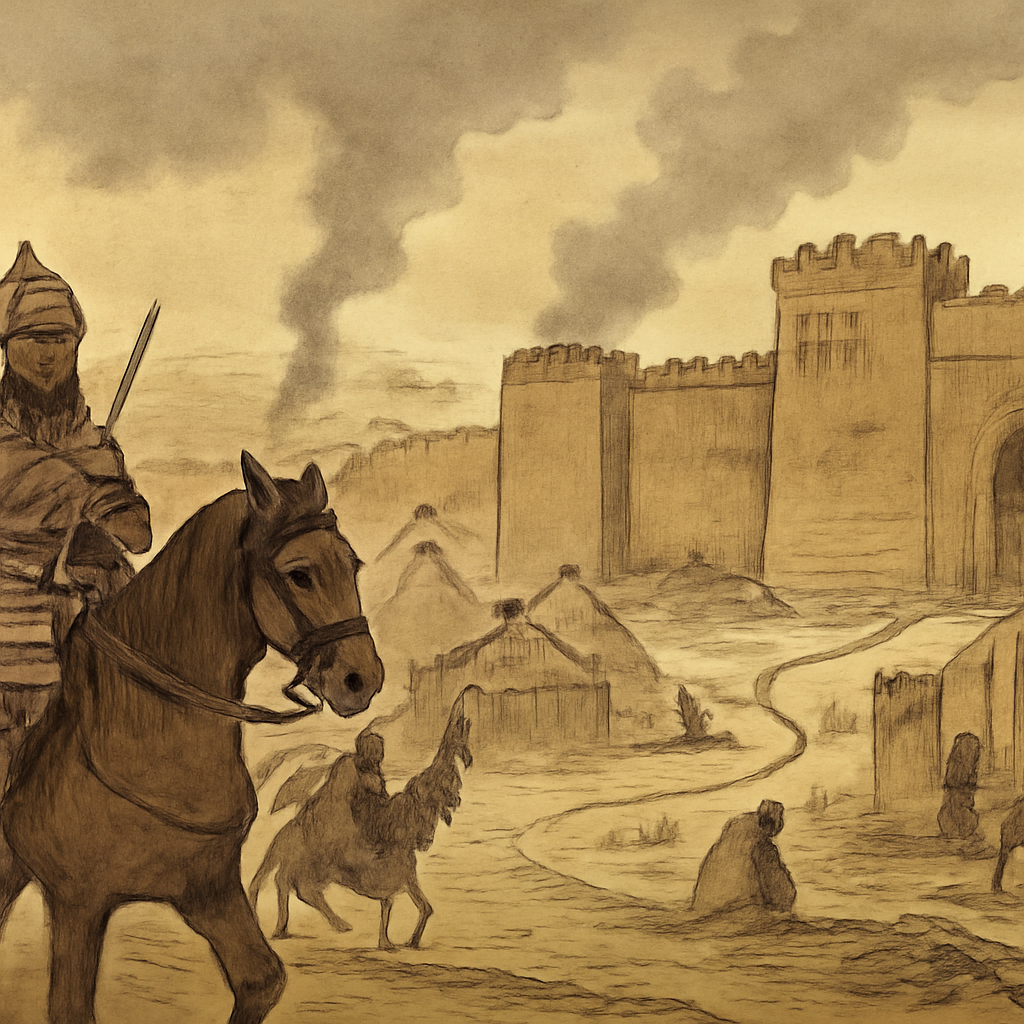
Timur invaded north India and sacked Delhi, exposing the vulnerability of the late Delhi Sultanate and linking South Asian politics to Central Asian imperial violence.
1398 CE; place the event in Delhi before comparing causes or consequences.
The event became a marker of late medieval crisis and a bridge into later Timurid-Mughal connections in South Asia.
Timur / Delhi Sultanate rulers are the first names or groups to compare before widening the story.
Delhi suffered heavy destruction, and the sultanate's authority weakened further.
Delhi suffered heavy destruction, and the sultanate's authority weakened further.
The event became a marker of late medieval crisis and a bridge into later Timurid-Mughal connections in South Asia.
This episode connects to broader shifts you can trace next: how Central Asian dynasties projected power into South Asia, how the Delhi Sultanate navigated successive crises, and how later Timurid and Mughal movements...
Background
The late fourteenth century was a season of overlapping pressures across South Asia and Central Asia. The Delhi Sultanate, once expansive, confronted internal strains: contested succession, local governors asserting autonomy, and the constant challenge of extracting revenue and loyalty across diverse territories. Beyond internal fault lines, long-distance connections mattered: trade routes and diplomatic ties linked Delhi to regions stretching into Central Asia, where new powers and movements were reshaping politics. Timur, a conqueror rooted in the steppes and deserts of Central Asia, led an imperial project that combined military mobility with a claim to regional supremacy. His campaigns were part of a wider pattern of Central Asian rulers projecting force into neighboring lands.
For Delhi’s rulers, this was now a strategic problem they had not fully anticipated—an external engine of violence arriving at a moment when the Sultanate’s internal cohesion was frayed. Contemporary chroniclers wrote from different vantage points; some emphasized divine judgment, others military failure, and later retellings sometimes magnified the carnage. This page uses the episode less as spectacle and more as evidence—evidence of political fragility, of how transregional power could upend local orders, and of the cautions needed when reading sources shaped by aftermath. Timur's sack of Delhi needs to be read through the fragility of the late Delhi Sultanate and the political culture of conquest.
The campaign combined mobile military force, claims to legitimacy, plunder, terror, and the symbolic value of taking a major capital. Delhi was not merely a prize; it was a stage on which power could be displayed. The event also forces readers to hold military success beside civilian catastrophe. Urban residents, captives, artisans, soldiers, religious communities, and local elites experienced conquest as violence, displacement, extraction, and uncertainty. The shock mattered because cities are social systems as well as political symbols.
The Turning Point
In 1398, Timur’s decision to move into north India and the subsequent sack of Delhi constituted a decisive rupture. The primary actors were clear: Timur as the invading commander, and the rulers of the Delhi Sultanate attempting to marshal defense from a court already weakened by faction and fatigue. Timur’s campaign did not occur in a vacuum; it resulted from choices about routing, timing, and objectives that favored a swift, punitive strike rather than prolonged occupation. The defenders faced hard choices: to engage in pitched battle, shelter within the city walls, or negotiate under duress. Contemporary accounts stress the collapse of coordinated resistance and the speed with which authority disintegrated in the wake of the assault.
Physically, the city suffered heavy destruction; politically, the sack broadcast a message about the Sultanate’s vulnerability. The event reoriented regional calculations: neighboring rulers and governors updated their expectations about Delhi’s ability to project power, while Central Asian observers recorded how a Timurid army could impose its will far from its home base. Crucially, the sack did not simply end with military victory; it opened lines of contact—violent, diplomatic, and migratory—between Central Asia and the Indian subcontinent that would have repercussions in the decades and centuries to follow. The turning point was the conversion of a raiding campaign into a devastating blow against an already weakened sultanate.
Timur did not remain to govern Delhi directly, but the attack exposed how vulnerable the political order had become.
Consequences
The immediate consequence was the heavy destruction of Delhi and a perceptible weakening of the Sultanate’s authority. Administratively and symbolically, the sack undermined claims to order: local notables recalibrated loyalties, military commanders tested limits of obedience, and the court’s capacity to enforce taxation and justice was diminished for a time. For ordinary inhabitants, the event meant displacement, loss of property, and disruption of markets and patronage networks—effects that could last for years even when institutions formally persisted. In the longer sweep, historians see the 1398 sack as a marker of late medieval crisis: it crystallized existing vulnerabilities within the Delhi Sultanate and reminded contemporaries that power could be contested from outside as well as within.
At the same time, the episode served as a bridge—practical and conceptual—linking Central Asian imperial dynamics and the later Timurid-Mughal presence in South Asia. Traders, migrants, and military professionals moved along the same corridors that armies had used, carrying skills, claims, and memories that shaped later encounters. Finally, this account calls attention to source perspective: descriptions of violence were often amplified in later retellings, so using the sack to explain political fragility rather than as an endpoint gives a more useful historical frame. The consequences include economic disruption, weakened authority in North India, memory of terror, and a longer regional environment in which new powers would compete before the rise of the Mughals.
The sack matters because destruction can reshape politics even without permanent occupation.
Interpretation Notes
Accounts of violence can become sensationalized; the page uses the event to explain political fragility and source perspective, not to reduce South Asian history to catastrophe.
Why Keep Reading
This episode connects to broader shifts you can trace next: how Central Asian dynasties projected power into South Asia, how the Delhi Sultanate navigated successive crises, and how later Timurid and Mughal movements remade political and cultural landscapes. Follow the story to see what happened to regional governors after the sack, how trade and migration altered city life, and how memory of 1398 shaped political rhetoric in the fifteenth and sixteenth centuries. Readers interested in military logistics, diplomatic exchange, or the uses of historical narrative will find the next pages useful. The timeline ahead emphasizes choices—of rulers, commanders, and civilians—that turned rupture into longer-term change.
Continue to the Delhi Sultanate, Central Asian conquest, Babur, Mughal founding, and South Asian empire routes to follow how violence, memory, and legitimacy traveled across regions.
Reading Path
Follow the story without losing the thread
Before This
- Delhi Sultanate Founded1206 CE
- Battle of Talas751 CE
- Zhang Qian's Western Mission138 BCE
After This
- First Battle of Panipat1526 CE
- Akbar Founds the Ibadat Khana1575 CE
- Bangladesh Liberation War1971 CE
Same Period
- Battle of Talas751 CE
- Zhang Qian's Western Mission138 BCE
- Delhi Sultanate Founded1206 CE
Wider Timeline
Mind Map
How to think about Timur Sacks Delhi
fragmented authority
local governors and court factions weakened centralized control, making coordinated defense difficult
Map Layer
Where this event sits geographically
Gold pins mark the approximate locations of published event pages. This is a schematic locator map, not a historical border map.
Coordinates are approximate and are used to help readers orient themselves before opening a full event page.
References
Where to Check the Facts
- Encyclopaedia Britannica: Delhi sultanateReference for Delhi Sultanate decline, Timurid invasion context, and later Mughal transition.
- Encyclopaedia Britannica: TimurBiographical reference for Timur's campaigns, Central Asian imperial power, and military reputation.