At a Glance
The shape of the event
- Date
- September 1980
- Place
- Iran-Iraq border
- Type
- War outbreak
Iraq invaded Iran in 1980, beginning an eight-year war shaped by revolutionary upheaval, border disputes, oil regions, regional rivalry, and outside support.
September 1980; place the event in Iran-Iraq border before comparing causes or consequences.
The conflict scarred both societies and shaped later Gulf politics, militarization, debt, and regional insecurity.
Saddam Hussein / Ruhollah Khomeini are the first names or groups to compare before widening the story.
The war became a prolonged and costly conflict before ending without a decisive territorial settlement.
The war became a prolonged and costly conflict before ending without a decisive territorial settlement.
The conflict scarred both societies and shaped later Gulf politics, militarization, debt, and regional insecurity.
This episode sits where revolution, oil, and regional rivalry intersect.
Background
The late 1970s left the Gulf unsettled. Iran’s revolution upended a monarchy and reconfigured politics, security institutions, and the economy; the country was adjusting to new religious leadership and a turbulent domestic scene. Iraq, under Saddam Hussein, faced its own pressures: regime consolidation, territorial anxieties, and a desire to assert regional standing in the face of a transformed neighbor. Between them lay disputed frontier lands and zones of economic importance—fertile plains, ports, and fields linked to oil production—where sovereignty and access carried real stakes for revenue and prestige. Revolutionary rhetoric, fears of instability crossing borders, and competition for energy and infrastructure sharpened old grievances.
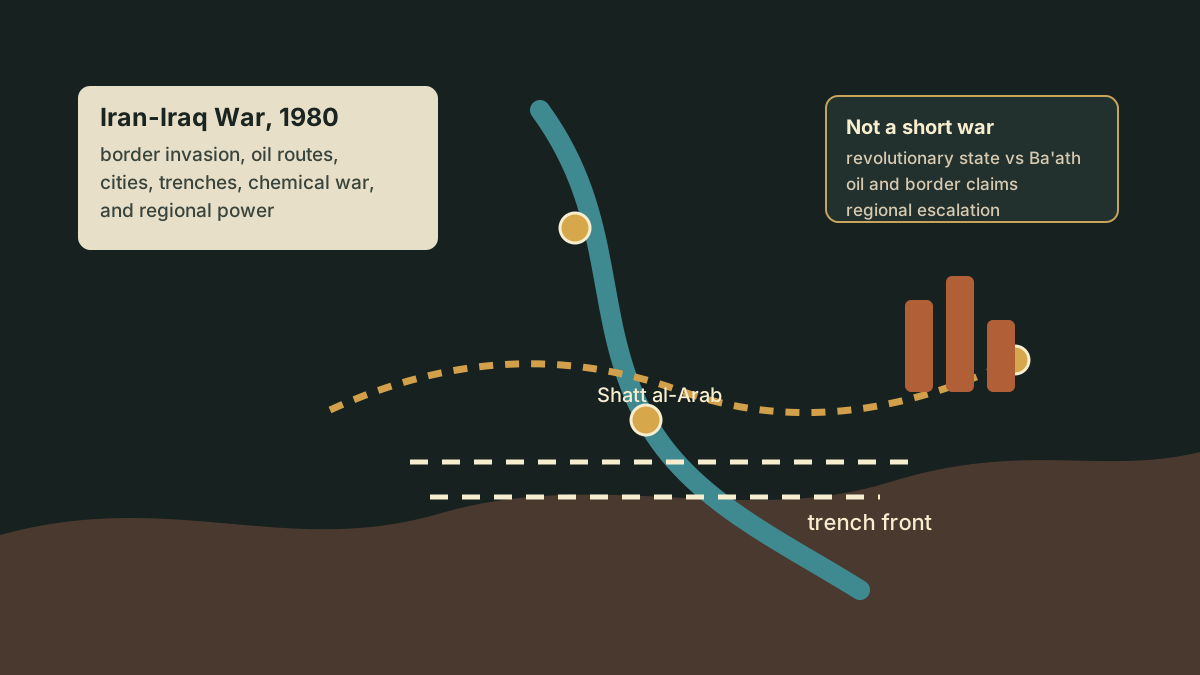
External powers observed and engaged in differing ways, shaping diplomatic and material balances without resolving core disputes. Border towns, tribal networks, and workers found themselves caught between national strategies and international maneuvers. In short, September 1980 was not an isolated spectacle but a flashpoint born of accumulated political, economic, and social pressures that made armed conflict a plausible, if catastrophic, option. The Iran-Iraq War began after the Iranian Revolution unsettled regional politics and Saddam Hussein's Iraq saw both danger and opportunity. Border disputes around the Shatt al-Arab, oil infrastructure, Arab and Persian nationalist language, revolutionary ideology, military ambition, and Gulf security all shaped the decision to invade.
The war was never only bilateral; outside powers watched oil routes, arms markets, and revolutionary contagion anxiously.
The Turning Point
In September 1980 a calculated choice converted accumulated tensions into open warfare. Iraqi forces crossed the frontier and launched an invasion that compelled Tehran’s revolutionary leadership under Ruhollah Khomeini to shift from sorting internal politics to defending territorial integrity. Saddam Hussein’s regime framed the offensive as a means to press long-standing claims and to capitalize on Iran’s post-revolutionary disarray; for Iran, the attack forced the rapid mobilization of a state still reorganizing itself. The immediate effect was to change political tempo and priorities: emergency economies replaced peacetime plans, recruitment and military production surged, and local populations near the border faced evacuation and disruption.
Militias and volunteers spawned in the revolution’s wake met professional units, while command structures on both sides were reshaped by the necessities of sustained combat. Diplomacy hardened and regional actors reassessed security—choices that broadened the confrontation beyond a bilateral dispute. More than the moment troops crossed the line, the turning point lay in the cascade of policy decisions that followed: to contest control of territory and resources by force, to mobilize societies for long-term conflict, and to involve wider regional and international calculations. The invasion in 1980 did not produce the quick Iraqi victory that planners expected. Iranian resistance, revolutionary mobilization, urban defense, and the symbolic power of defending the revolution changed the tempo of war.
The conflict hardened into trench lines, missile attacks, tanker warfare, chemical weapons use, and repeated offensives. The opening gamble became a prolonged war of exhaustion.
Consequences
The war that followed became a protracted contest that outlasted the expectations of leaders and planners. Rather than a swift settlement, the conflict entrenched a war of attrition that drained resources, redirected state priorities, and devastated border provinces. Economies bore the weight of elevated military spending, reconstruction needs, and mounting public and private debt; livelihoods in affected regions were disrupted, prompting displacement and contributing to new diasporas. The human consequences—families broken, communities uprooted, and a generation shaped by conflict—entered national memories and political narratives. Regionally, the fighting altered alignments and deepened insecurity: neighbors and distant powers adjusted policies and arms relationships in response, and energy-exporting states adopted new security postures toward infrastructure and shipping.
Over the long term the war fed cycles of militarization, hardened narratives of sacrifice and sovereignty used by regimes and movements, and complicated efforts at reconciliation and rebuilding. When hostilities ended, there was no decisive territorial reordering—only societies and states marked by economic, social, and political scars that influenced later crises and strategic choices across the Gulf. The consequences were devastating: mass casualties, damaged cities, militarized politics, debt, trauma, and a regional security order defined by fear. The war strengthened some state institutions while exhausting societies. It also shaped later Gulf politics, including Iraq's financial crisis, relations with Kuwait, and the road toward the 1990 invasion of Kuwait.
The event matters because it links revolution, oil, borders, and modern total war. The war's opening also shows how leaders can misread revolutionary disorder, assuming a neighbor is weak when mobilization and nationalism can instead harden resistance.
Interpretation Notes
Iran-Iraq War Begins is easy to flatten into one dramatic date. A stronger reading separates immediate action from deeper causes, affected communities, and the memory later states or movements built around the event.
Why Keep Reading
This episode sits where revolution, oil, and regional rivalry intersect. Follow the war’s aftermath to see how military mobilization reconfigured economies, how border communities rebuilt or scattered, and how memory and commemoration shaped public life. Tracing subsequent timelines explains why later Gulf crises often repeated familiar patterns—militarization, contested sovereignty, and acute concern over energy routes. If you want to move from a headline date to the lived consequences that shaped the region’s political landscape for decades, the war’s long shadow offers essential context. Read next into the Iranian Revolution, Gulf War, oil politics, chemical warfare, and Cold War regional alignments. The route explains why 1980 became a hinge for the modern Middle East.
It also explains why later diplomacy around the Gulf treated borders, tankers, missiles, and oil terminals as parts of the same security problem.
Reading Path
Follow the story without losing the thread
Before This
- Iranian Revolution1978-1979 CE
- Arab Oil Embargo1973-1974 CE
- Opening of the Suez CanalNovember 17, 1869
After This
- Iraq War BeginsMarch 2003
- Syrian Civil War Begins2011 CE
Same Period
- Arab Oil Embargo1973-1974 CE
- Iranian Revolution1978-1979 CE
- Mongol Sack of BaghdadFebruary 1258
Wider Timeline
Mind Map
How to think about Iran-Iraq War Begins
Border dispute
Longstanding claims over frontier lands and access to waterways and oil-linked zones intensified rivalries
Map Layer
Where this event sits geographically
Gold pins mark the approximate locations of published event pages. This is a schematic locator map, not a historical border map.
Coordinates are approximate and are used to help readers orient themselves before opening a full event page.
References
Where to Check the Facts
- Encyclopaedia Britannica: Iran-Iraq WarReference for the war's outbreak, duration, casualties, and ceasefire.
- Encyclopaedia Britannica: Iraq, the Iran-Iraq WarReference for Iraq's war context and regional setting.
- U.S. National Archives: The Cold WarArchive reference hub for Cold War records, federal documentation, and research guidance.
- Office of the Historian: The Early Cold War, 1945-1952Official diplomatic history reference for early Cold War foreign-policy context.