How to Read the Year
Why does 1969 connect the Moon, networked computing, Cold War prestige, and modern technological imagination?
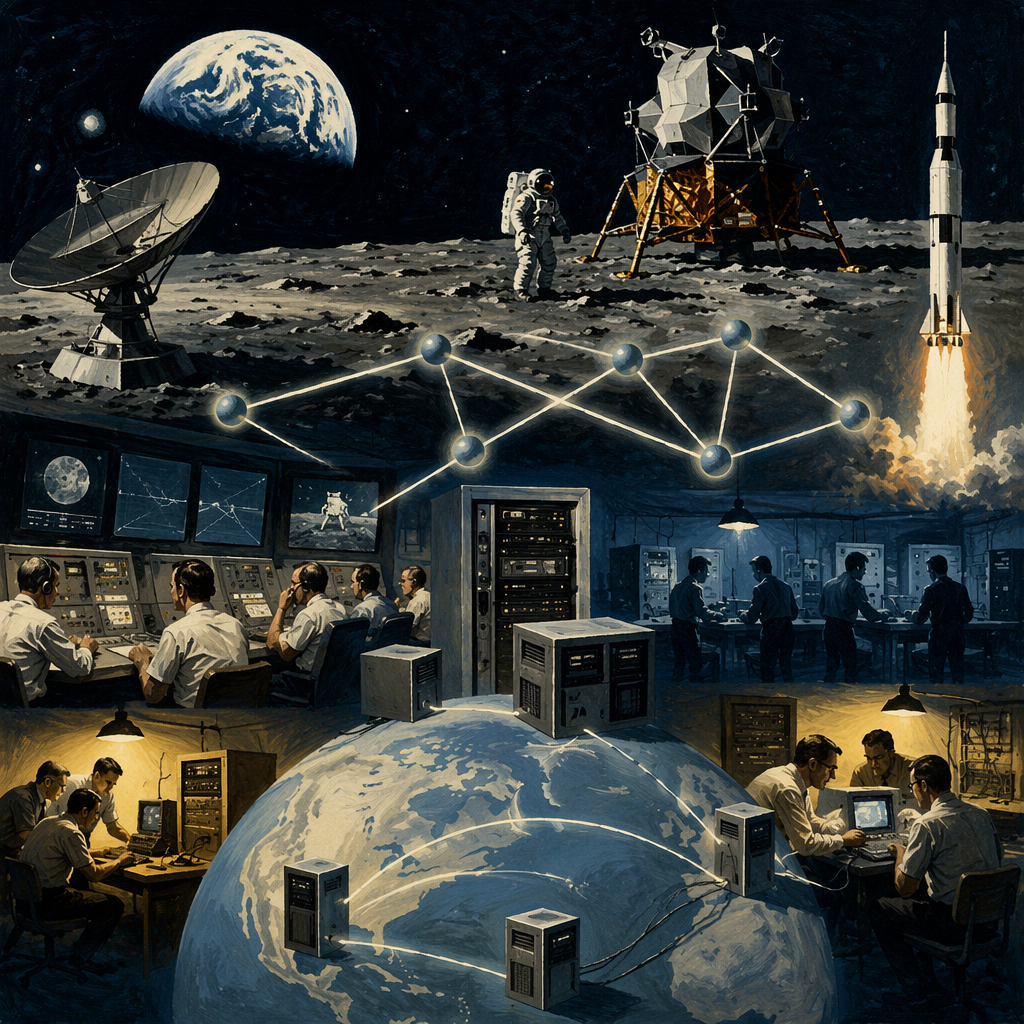
1969 is anchored by the Apollo 11 Moon landing and the first ARPANET connection. Those events are different in scale and public drama, but together they make the year a doorway into Cold War science, systems engineering, state funding, universities, military research, media spectacle, and the long history of digital connection.
Apollo 11 made technological achievement visible to a global audience. It depended on astronauts, engineers, mathematicians, contractors, launch workers, computers, guidance systems, public budgets, presidential promises, and Cold War competition. The footprint on the Moon was memorable because an enormous institutional system had made it possible.
ARPANET was quieter but just as consequential for later readers. A small networked-computing experiment linked research institutions and tested packet switching, remote communication, protocols, and the idea that computers could communicate across distance. The internet was not born fully formed in 1969, but the year marks an early practical step in that direction.
The comparison helps readers avoid a hero-machine story. Neil Armstrong, Buzz Aldrin, Michael Collins, programmers, network researchers, technicians, women mathematicians, university labs, NASA centers, defense funding, and public institutions all belong in the same technological ecosystem. In both spaceflight and networking, achievement came from systems rather than isolated genius.
1969 also invites a political reading. Cold War rivalry made funding and urgency possible, but those investments produced legacies that outlived the rivalry: satellite culture, Earth imagery, environmental imagination, computing infrastructure, communication networks, and a public expectation that science could reorganize daily life.
The year should stay honest about exclusion and cost. Space and computing were celebrated as universal futures, yet access, race, gender, military sponsorship, public spending, and global inequality shaped who built, used, and benefited from those systems. A rich 1969 page keeps wonder and critique together. The future was public, but access was uneven.
The media layer explains why the Moon landing and networking feel so different in memory. Apollo was televised as a shared spectacle, while ARPANET grew through technical communities, documents, protocols, and institutional trust. Comparing those paths helps readers see that some technologies become famous instantly while others become world-changing before most people notice.
1969 CE in History gathers events that help readers move from a single date into wider historical patterns. A useful year entry does more than answer what happened; it shows why people keep using the year as a marker for change.
The connected events show how decisions, institutions, conflicts, ideas, and consequences crossed beyond one location or one person. The event links explain the immediate story, while the topic routes and timelines show what came before and after.
The year also helps organize broad questions. It gives readers a concise answer and a direct path into deeper event pages where causes, turning points, consequences, maps, and references are easier to inspect.
Read the date in three passes. First ask what happened inside the year itself. Then ask which older pressures made the event possible. Finally ask which later pages reuse the same vocabulary, institutions, borders, technologies, or memories. That sequence keeps the page from becoming a trivia answer.
Even when only one event is currently attached, the year still has a job: it gives students and curious visitors a stable chronological doorway into the atlas. The page makes the doorway useful by pointing to the event, the topic route, the timeline, the map, and the evidence trail that can turn a date into a broader explanation.
This year matters because it connects Apollo 11 Moon Landing, ARPANET Connection to a wider sequence of causes and consequences. It gives the reader a chronological anchor while still pointing outward to people, places, institutions, and later effects. A thin year page would only name the event; a useful year page explains why this date is a handle for a larger route through history. 1969 matters because it shows twentieth-century technology at two scales: spectacular space achievement and quiet network infrastructure. Apollo 11 and ARPANET connect Cold War rivalry, public science, computing, media, systems engineering, and the later digital world. The year helps readers see that modern technology is built from institutions, money, labor, politics, imagination, and maintenance.
Reader Lenses
Look for the pressures that made change possible.
Identify who acted and what options were available.
Follow what changed after the event.
Ask why this date still appears in historical summaries.
Look for institutions, budgets, contractors, labs, programmers, engineers, and maintenance behind famous milestones.
Ask how rivalry funded science while leaving legacies beyond the rivalry itself.
Compare the Moon landing's spectacle with ARPANET's quieter path toward networked life.
How This Year Connects
1969 CE in History is anchored by Apollo 11 Moon Landing and ARPANET Connection. Read those pages together and the year stops being a date label; it becomes a crossroads where immediate choices met older pressures and opened later consequences.
The setting matters as much as the date. The year moves through Mare Tranquillitatis and California and belongs to Cold War. That combination helps readers avoid treating the year as isolated; geography, institutions, conflict, belief, economy, and communication all shape what a date can mean.
The year also opens into people and themes. Figures such as Neil Armstrong, Buzz Aldrin, Michael Collins, and ARPANET researchers appear because their choices made the year visible, while themes such as Space Race, Science, Technology, Internet, and Cold War explain why the consequences outlived the moment. A useful next step is usually an event page, then a topic route, then a timeline.
Evidence changes the way a date reads. A treaty, battle report, inscription, newspaper, census, court record, memoir, photograph, or archaeological trace does not answer the same question. Looking at source type helps separate what happened in the year from how later people remembered it.
A year page is most useful when it keeps two scales open at once. The first scale is immediate: what happened, where, and who was involved. The second scale is interpretive: why later readers use this date to organize a wider story. Holding both scales together makes the page a starting point for deeper reading rather than a dead-end answer.
The before-and-after frame matters too. A date rarely begins the forces it reveals. Earlier pressures made the linked event possible, while later pages show which effects were temporary, which became institutions, and which turned into memory. Reading the year this way helps students avoid the false impression that history changes only when the calendar flips.
Use this page as a junction. If the event feels too brief, follow the topic route for background; if the cause feels too abstract, open the event page for sequence; if the consequence feels larger than the date, move into the timeline. The value of a year page is that it lets readers change scale without losing their place.
Read 1969 beside Apollo 11, ARPANET, Sputnik, the Cold War timeline, science and technology routes, and globalization pages. That path connects rockets, computers, networks, and public imagination.
Then compare 1969 with 1957, 1945, 1989, 2003, and 2020. The comparison asks how scientific systems move from military rivalry into everyday infrastructure.
Events in This Year
- July 20, 1969Apollo 11 Moon Landing
Apollo 11 landed humans on the Moon, fulfilling a U.S. Cold War space goal and creating a global symbol of technological ambition.
- 1969 CEARPANET Connection
Researchers connected early ARPANET nodes, helping create the packet-switching network that later influenced the development of the internet.
Map Layer
1969 CE in History geography
Gold pins mark the approximate locations of published event pages. This is a schematic locator map, not a historical border map.
Coordinates are approximate and are used to help readers orient themselves before opening a full event page.
References
Where to Check the Facts
- Encyclopaedia Britannica: Apollo 11Specific reference for the 1969 CE anchor event, chronology, and historical setting.
- Encyclopaedia BritannicaBackground reference for chronology, names, and historical context.
- WikidataStructured reference for dates, places, alternate names, and entity links.