How to Read the Year
Why does 1959 CE in History deserve a focused year page?
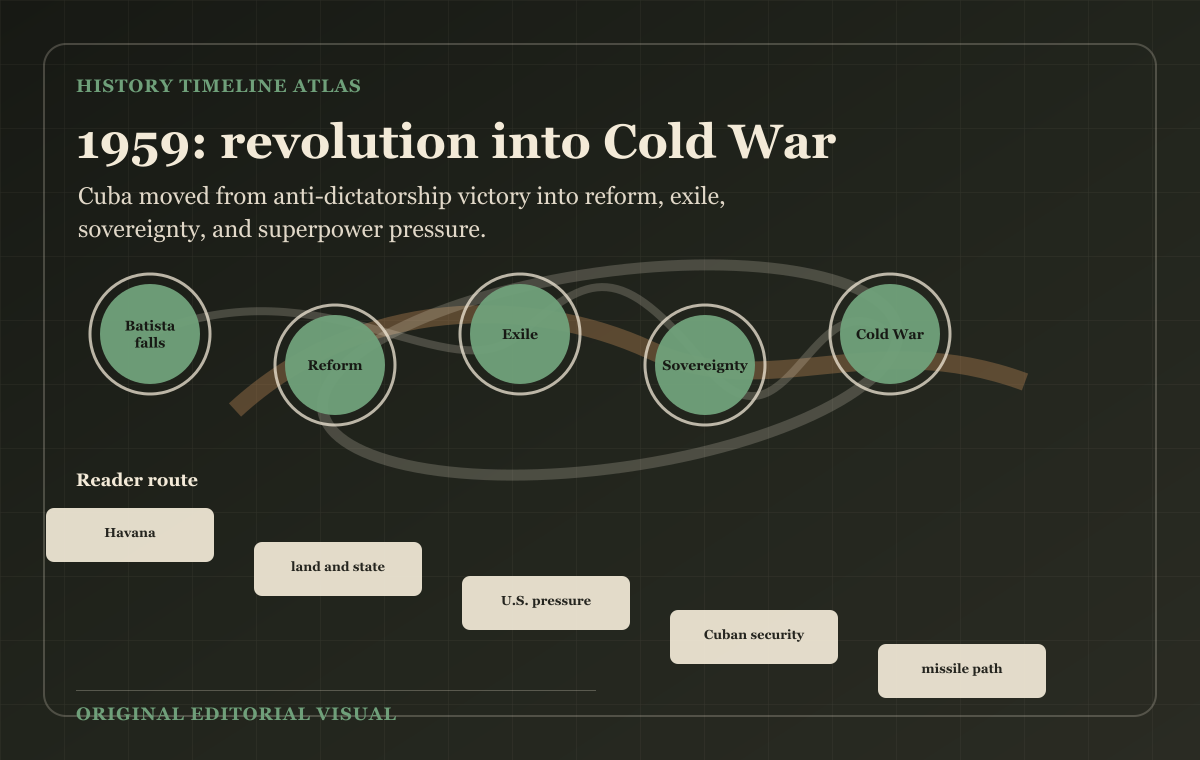
The Cuban Revolution makes 1959 a year about national liberation, dictatorship, social reform, exile, and Cold War alignment. Batista's fall did not settle the revolution's meaning; it opened a struggle over land, sovereignty, class, political opposition, U.S. influence, and the kind of state Cuba would become.
The year should be read through Havana streets, rural insurgency, public trials, reform promises, business anxiety, U.S. policy debates, and the hopes of Cubans who expected a break from corruption and repression. The revolution was not yet reducible to a later Cold War symbol, even though Cold War pressure quickly shaped its path.
1959 also belongs to the wider decolonizing world. Across Asia, Africa, Latin America, and the Caribbean, movements were challenging old hierarchies and asking whether formal sovereignty could produce social justice. Cuba became unusually visible because it sat close to the United States and soon aligned with the Soviet bloc.
A richer page keeps disagreement visible. For supporters, 1959 represented dignity, reform, and resistance to domination. For critics and exiles, it led to repression, one-party rule, confiscations, imprisonment, and lost homes. The date remains powerful because both memory streams are historically real.
The year should also slow down around state formation. A guerrilla victory had to become ministries, courts, land reform, security agencies, schools, health campaigns, media control, and foreign policy. That conversion from movement to government is where many revolutions become harder to read. The hopes of justice and dignity met the tools of command, surveillance, party discipline, and international bargaining.
U.S.-Cuban relations changed through decisions as well as ideology. Property seizures, exile organizing, diplomatic pressure, economic retaliation, and Cuban searches for security pushed both governments toward confrontation. A searcher asking what happened in 1959 should therefore see more than Castro entering Havana. The useful answer follows how a national revolution became a hemispheric and then global problem.
Readers should also meet the revolution through uneven social expectations. Rural supporters, urban students, workers, professionals, landowners, Catholic institutions, Afro-Cuban communities, and political opponents did not all imagine the same future. Some expected democracy after dictatorship, some expected land and dignity, some feared communist direction, and others watched the new government decide who counted as loyal. That diversity keeps the page from flattening Cuba into one revolutionary crowd.
The strongest next route moves from 1959 to the Bay of Pigs, Cuban Missile Crisis, Cold War, Latin American revolutions, exile politics, and decolonization. The sequence shows why a single year can become a permanent reference point: it started as a national break with Batista, then became a test case for sovereignty, socialism, intervention, and memory across the Americas.
The date also prepares readers for the missile crisis without making that later event inevitable. Revolution, U.S. hostility, Soviet support, exile politics, and Cuban security fears created a path toward confrontation, but each step still involved choices by governments and movements.
1959 CE in History gathers events that help readers move from a single date into wider historical patterns. A useful year entry does more than answer what happened; it shows why people keep using the year as a marker for change.
The connected events show how decisions, institutions, conflicts, ideas, and consequences crossed beyond one location or one person. The event links explain the immediate story, while the topic routes and timelines show what came before and after.
The year also helps organize broad questions. It gives readers a concise answer and a direct path into deeper event pages where causes, turning points, consequences, maps, and references are easier to inspect.
Read the date in three passes. First ask what happened inside the year itself. Then ask which older pressures made the event possible. Finally ask which later pages reuse the same vocabulary, institutions, borders, technologies, or memories. That sequence keeps the page from becoming a trivia answer.
Even when only one event is currently attached, the year still has a job: it gives students and curious visitors a stable chronological doorway into the atlas. The page makes the doorway useful by pointing to the event, the topic route, the timeline, the map, and the evidence trail that can turn a date into a broader explanation.
This year matters because it connects Cuban Revolution Triumphs to a wider sequence of causes and consequences. It gives the reader a chronological anchor while still pointing outward to people, places, institutions, and later effects. A thin year page would only name the event; a useful year page explains why this date is a handle for a larger route through history. 1959 matters because it turned a Caribbean revolution into a global Cold War problem. The year links dictatorship, guerrilla war, social reform, U.S.-Cuban relations, exile politics, and later missile crisis danger. It helps readers ask how revolutions change when they must govern, defend themselves, and survive inside a polarized international system.
Reader Lenses
Look for the pressures that made change possible.
Identify who acted and what options were available.
Follow what changed after the event.
Ask why this date still appears in historical summaries.
Ask how anti-dictatorship politics became a claim against foreign domination.
Follow the shift from insurgency to state power, reform, coercion, and institutions.
Hold revolutionary pride, exile grief, repression, and social reform in the same frame.
How This Year Connects
1959 CE in History is anchored by Cuban Revolution Triumphs. Read those pages together and the year stops being a date label; it becomes a crossroads where immediate choices met older pressures and opened later consequences.
The setting matters as much as the date. The year moves through Havana and belongs to Cold War Latin America. That combination helps readers avoid treating the year as isolated; geography, institutions, conflict, belief, economy, and communication all shape what a date can mean.
The year also opens into people and themes. Figures such as Fidel Castro and Cuban revolutionaries appear because their choices made the year visible, while themes such as Cuba, Revolution, and Cold War explain why the consequences outlived the moment. A useful next step is usually an event page, then a topic route, then a timeline.
Evidence changes the way a date reads. A treaty, battle report, inscription, newspaper, census, court record, memoir, photograph, or archaeological trace does not answer the same question. Looking at source type helps separate what happened in the year from how later people remembered it.
A year page is most useful when it keeps two scales open at once. The first scale is immediate: what happened, where, and who was involved. The second scale is interpretive: why later readers use this date to organize a wider story. Holding both scales together makes the page a starting point for deeper reading rather than a dead-end answer.
The before-and-after frame matters too. A date rarely begins the forces it reveals. Earlier pressures made the linked event possible, while later pages show which effects were temporary, which became institutions, and which turned into memory. Reading the year this way helps students avoid the false impression that history changes only when the calendar flips.
Use this page as a junction. If the event feels too brief, follow the topic route for background; if the cause feels too abstract, open the event page for sequence; if the consequence feels larger than the date, move into the timeline. The value of a year page is that it lets readers change scale without losing their place.
Events in This Year
- 1959Cuban Revolution Triumphs
Cuban revolutionaries overthrew Fulgencio Batista, creating a revolutionary government that soon became central to Cold War politics.
Map Layer
1959 CE in History geography
Gold pins mark the approximate locations of published event pages. This is a schematic locator map, not a historical border map.
Coordinates are approximate and are used to help readers orient themselves before opening a full event page.
References
Where to Check the Facts
- Encyclopaedia Britannica: Cuban RevolutionReference for the Cuban Revolution, Batista's overthrow, revolutionary government, and Cold War significance.
- Encyclopaedia Britannica: Fidel CastroBiographical reference for Castro's revolutionary leadership, Cuban government, and Cold War role.
- U.S. National Archives: The Cold WarArchive reference hub for Cold War records, federal documentation, and research guidance.
- Office of the Historian: The Early Cold War, 1945-1952Official diplomatic history reference for early Cold War foreign-policy context.