How to Read the Year
Why did 1919 turn peace-making into protest and disappointment?
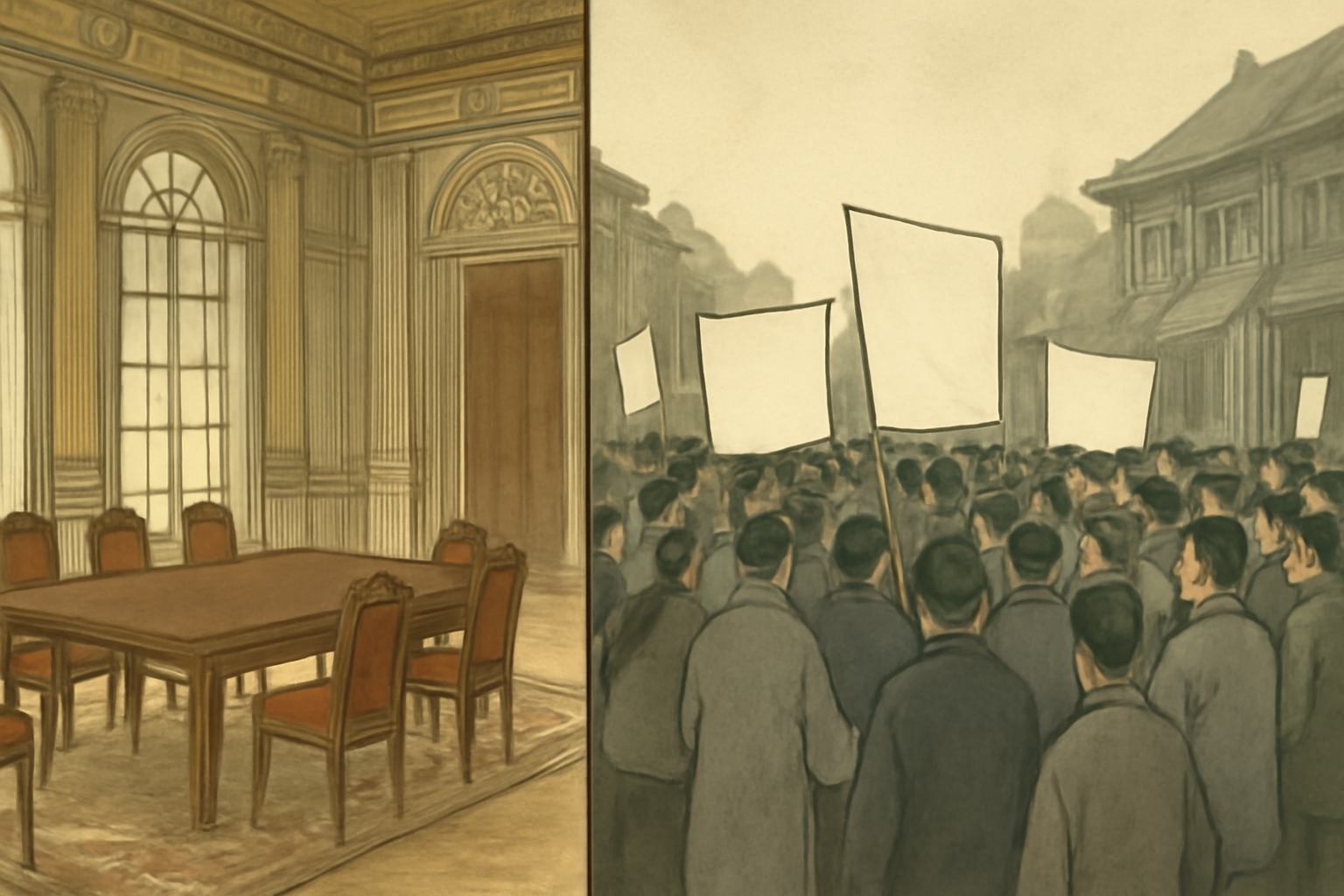
1919 is anchored by the Treaty of Versailles and the May Fourth Movement, a pairing that makes the year a study in the limits of postwar promise. In Paris, diplomats tried to turn victory into a settlement over borders, reparations, security, mandates, and international organization. In China, students and citizens protested when postwar diplomacy failed to return Shandong in the way many Chinese expected, turning disappointment into a new political and cultural moment.
The Treaty of Versailles was not only a document. It was an attempt to assign responsibility, contain Germany, satisfy Allied publics, redraw parts of Europe, and build a League of Nations. The settlement carried contradictions from the start: self-determination was uneven, colonial mandates continued hierarchy, reparations became politically charged, and security fears competed with reconciliation.
May Fourth makes the year global rather than merely European. Chinese activists connected diplomacy to sovereignty, language, education, science, anti-imperialism, youth politics, and cultural reform. The movement shows how people outside the main treaty rooms interpreted the peace settlement and turned international disappointment into domestic mobilization.
1919 also helps readers understand why interwar history cannot be told as a straight line from treaty to war. Versailles mattered, but so did revolutions, colonial demands, economic instability, nationalist movements, and the uneven credibility of liberal internationalism. The year is strongest when it shows hope and exclusion together.
The reading path moves from 1919 to Versailles, May Fourth, Wilson, the League of Nations, anti-colonial nationalism, interwar Europe, and East Asian modern politics. The sharp question is who got to define peace after a world war, and who was asked to accept someone else's settlement?
The answer was argued in more places than conference rooms. Newspapers, student meetings, diplomatic cables, colonial offices, labor movements, veteran organizations, and street protests all interpreted the peace. A treaty became history only when publics decided whether it felt like justice, humiliation, compromise, or another form of domination.
The year also helps readers understand why the language of self-determination traveled farther than its official application. People in colonized and semi-colonized societies heard a promise, compared it with mandates and unequal treaties, and built new political arguments from the gap between ideals and outcomes.
1919 CE in History gathers events that help readers move from a single date into wider historical patterns. A useful year entry does more than answer what happened; it shows why people keep using the year as a marker for change.
The connected events show how decisions, institutions, conflicts, ideas, and consequences crossed beyond one location or one person. The event links explain the immediate story, while the topic routes and timelines show what came before and after.
The year also helps organize broad questions. It gives readers a concise answer and a direct path into deeper event pages where causes, turning points, consequences, maps, and references are easier to inspect.
Read the date in three passes. First ask what happened inside the year itself. Then ask which older pressures made the event possible. Finally ask which later pages reuse the same vocabulary, institutions, borders, technologies, or memories. That sequence keeps the page from becoming a trivia answer.
Even when only one event is currently attached, the year still has a job: it gives students and curious visitors a stable chronological doorway into the atlas. The page makes the doorway useful by pointing to the event, the topic route, the timeline, the map, and the evidence trail that can turn a date into a broader explanation.
This year matters because it connects Treaty of Versailles, May Fourth Movement to a wider sequence of causes and consequences. It gives the reader a chronological anchor while still pointing outward to people, places, institutions, and later effects. A thin year page would only name the event; a useful year page explains why this date is a handle for a larger route through history. 1919 matters because it exposes the gap between the language of a new world order and the unequal politics of making one. Versailles tried to build peace through treaties and institutions; May Fourth showed how excluded or disappointed publics could read that peace as a new reason to organize.
Reader Lenses
Look for the pressures that made change possible.
Identify who acted and what options were available.
Follow what changed after the event.
Ask why this date still appears in historical summaries.
Ask what treaties can settle and what they leave unresolved in borders, debt, security, and public memory.
Use May Fourth to track how international diplomacy became a domestic cultural and political crisis.
Notice whose claims were recognized, postponed, ignored, or translated into mandates and unequal arrangements.
How This Year Connects
1919 CE in History is anchored by Treaty of Versailles and May Fourth Movement. Read those pages together and the year stops being a date label; it becomes a crossroads where immediate choices met older pressures and opened later consequences.
The setting matters as much as the date. The year moves through Versailles and Beijing and belongs to Twentieth Century and Modern China. That combination helps readers avoid treating the year as isolated; geography, institutions, conflict, belief, economy, and communication all shape what a date can mean.
The year also opens into people and themes. Figures such as Woodrow Wilson, Georges Clemenceau, David Lloyd George, Chinese students, and New Culture intellectuals appear because their choices made the year visible, while themes such as World War I, Diplomacy, Germany, China, Nationalism, and Culture explain why the consequences outlived the moment. A useful next step is usually an event page, then a topic route, then a timeline.
Evidence changes the way a date reads. A treaty, battle report, inscription, newspaper, census, court record, memoir, photograph, or archaeological trace does not answer the same question. Looking at source type helps separate what happened in the year from how later people remembered it.
A year page is most useful when it keeps two scales open at once. The first scale is immediate: what happened, where, and who was involved. The second scale is interpretive: why later readers use this date to organize a wider story. Holding both scales together makes the page a starting point for deeper reading rather than a dead-end answer.
The before-and-after frame matters too. A date rarely begins the forces it reveals. Earlier pressures made the linked event possible, while later pages show which effects were temporary, which became institutions, and which turned into memory. Reading the year this way helps students avoid the false impression that history changes only when the calendar flips.
Use this page as a junction. If the event feels too brief, follow the topic route for background; if the cause feels too abstract, open the event page for sequence; if the consequence feels larger than the date, move into the timeline. The value of a year page is that it lets readers change scale without losing their place.
Read 1919 beside the Treaty of Versailles, May Fourth Movement, Woodrow Wilson, League of Nations, World War I, Chinese nationalism, and anti-colonial routes.
Then compare 1919 with 1815, 1945, 1955, 1960, and 1989. The comparison asks when settlements create legitimacy and when they create protest.
Events in This Year
- June 28, 1919Treaty of Versailles
The Treaty of Versailles ended formal war between Germany and the Allied powers while assigning responsibility, reparations, and territorial changes.
- 1919May Fourth Movement
Chinese students and intellectuals protested the Versailles settlement and broader political weakness, linking nationalism to cultural and political critique.
Map Layer
1919 CE in History geography
Gold pins mark the approximate locations of published event pages. This is a schematic locator map, not a historical border map.
Coordinates are approximate and are used to help readers orient themselves before opening a full event page.
References
Where to Check the Facts
- National WWI Museum and Memorial: All About WWIMuseum reference hub for World War I chronology, maps, articles, and educational context.
- U.S. National Archives: World War I CentennialArchive reference hub for World War I records, photographs, documents, and educational resources.
- Cambridge University Press: The Cambridge History of ChinaSpecialist scholarly synthesis for Chinese dynastic, imperial, revolutionary, and Mao-era historical interpretation.
- Cambridge University Press: The Cambridge History of JapanSpecialist scholarly synthesis for Japanese state formation, Meiji transformation, imperial expansion, and modern political change.