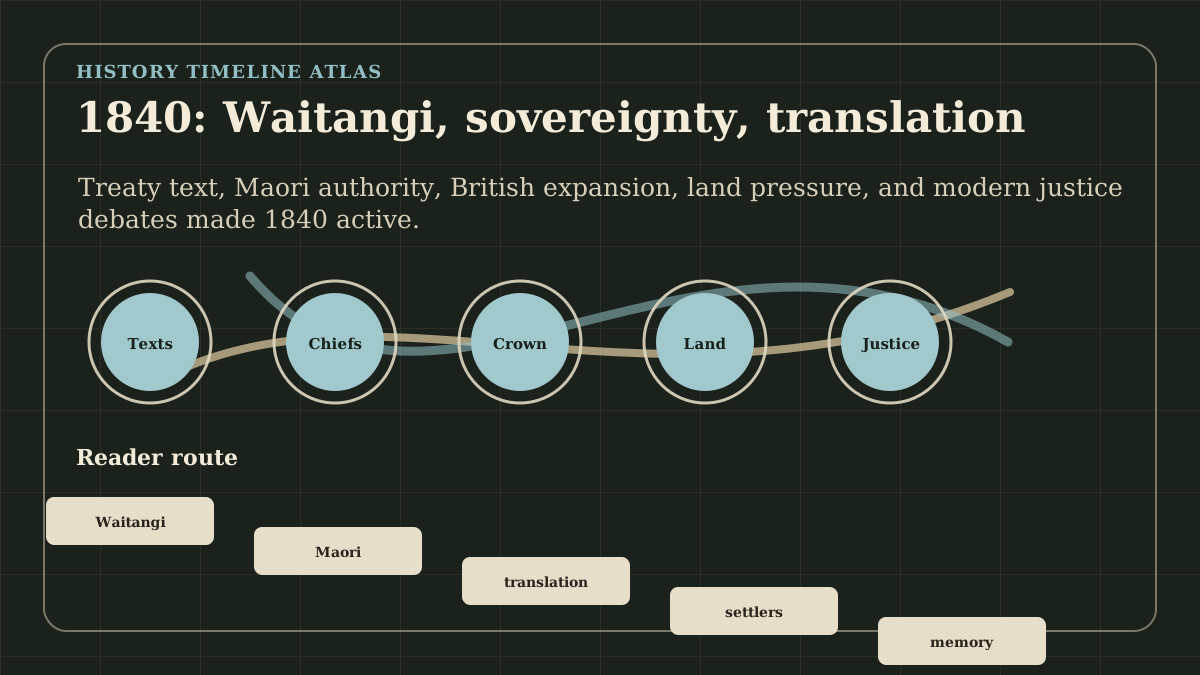
How to Read the Year
Why does 1840 force readers to compare treaty text, sovereignty, and empire?
1840 is anchored by the Treaty of Waitangi in New Zealand, a document that became central to arguments over sovereignty, land, translation, and the relationship between Maori communities and the British Crown. The year matters because the treaty's meaning was contested from the start and remains politically important.
The text problem is not a technical detail. English and Maori versions carried different implications about sovereignty and governance. Chiefs, missionaries, British officials, settlers, and later courts did not all read the agreement in the same way. That difference shaped land claims, authority, and memory.
1840 also belongs to a wider imperial age. British expansion used treaties, settlement, law, purchase, military force, and administrative language to turn relationships into rule. In New Zealand, Maori agency and negotiation were real, but so were asymmetries of power and later settler pressure.
A strong year page keeps the treaty alive as a historical problem rather than a closed founding moment. Waitangi is about what was said, what was understood, what was later enforced, and how communities argue over justice when a document becomes the basis of a state.
1840 should not be read as a simple scene of British officials imposing rule on silent recipients. Maori chiefs debated, calculated, rejected, signed, negotiated, and interpreted the agreement through their own political worlds. That agency matters, but it does not cancel the later imbalance created by settler migration, land hunger, colonial courts, and military force.
The page is also a strong SEO doorway because readers often search for the Treaty of Waitangi as both a date and a meaning question. The answer has to include language, sovereignty, land, Crown authority, Maori rangatiratanga, and modern legal memory. Otherwise the year becomes a thin founding-date card rather than a guide to why the treaty remains contested.
1840 also teaches readers how translation can become power. Words that seem close in one language can carry different legal expectations in another, and those differences become more consequential when settlers, courts, officials, and Indigenous communities argue over land and authority for generations.
A good next comparison is with other treaty frontiers where agreement, coercion, and memory overlap. Waitangi shows why readers should ask who translated the words, who explained the obligations, who enforced the result, and who later gained the institutional power to define what the document meant.
1840 CE in History gathers events that help readers move from a single date into wider historical patterns. A useful year entry does more than answer what happened; it shows why people keep using the year as a marker for change.
The connected events show how decisions, institutions, conflicts, ideas, and consequences crossed beyond one location or one person. The event links explain the immediate story, while the topic routes and timelines show what came before and after.
The year also helps organize broad questions. It gives readers a concise answer and a direct path into deeper event pages where causes, turning points, consequences, maps, and references are easier to inspect.
Read the date in three passes. First ask what happened inside the year itself. Then ask which older pressures made the event possible. Finally ask which later pages reuse the same vocabulary, institutions, borders, technologies, or memories. That sequence keeps the page from becoming a trivia answer.
Even when only one event is currently attached, the year still has a job: it gives students and curious visitors a stable chronological doorway into the atlas. The page makes the doorway useful by pointing to the event, the topic route, the timeline, the map, and the evidence trail that can turn a date into a broader explanation.
This year matters because it connects Treaty of Waitangi to a wider sequence of causes and consequences. It gives the reader a chronological anchor while still pointing outward to people, places, institutions, and later effects. A thin year page would only name the event; a useful year page explains why this date is a handle for a larger route through history. 1840 matters because it teaches readers that founding documents can be agreements, misunderstandings, tools of empire, and resources for justice all at once. The Treaty of Waitangi links language, sovereignty, land, settler colonialism, Indigenous rights, and modern legal memory.
Reader Lenses
Look for the pressures that made change possible.
Identify who acted and what options were available.
Follow what changed after the event.
Ask why this date still appears in historical summaries.
Ask how different treaty texts changed the meaning of sovereignty.
Track how law, land, settlers, and administration turned agreement into conflict.
Follow why Waitangi remains active in modern political and legal memory.
How This Year Connects
1840 CE in History is anchored by Treaty of Waitangi. Read those pages together and the year stops being a date label; it becomes a crossroads where immediate choices met older pressures and opened later consequences.
The setting matters as much as the date. The year moves through Waitangi and belongs to Colonial New Zealand. That combination helps readers avoid treating the year as isolated; geography, institutions, conflict, belief, economy, and communication all shape what a date can mean.
The year also opens into people and themes. Figures such as Maori rangatira and British representatives appear because their choices made the year visible, while themes such as Maori, New Zealand, and Treaty explain why the consequences outlived the moment. A useful next step is usually an event page, then a topic route, then a timeline.
Evidence changes the way a date reads. A treaty, battle report, inscription, newspaper, census, court record, memoir, photograph, or archaeological trace does not answer the same question. Looking at source type helps separate what happened in the year from how later people remembered it.
A year page is most useful when it keeps two scales open at once. The first scale is immediate: what happened, where, and who was involved. The second scale is interpretive: why later readers use this date to organize a wider story. Holding both scales together makes the page a starting point for deeper reading rather than a dead-end answer.
The before-and-after frame matters too. A date rarely begins the forces it reveals. Earlier pressures made the linked event possible, while later pages show which effects were temporary, which became institutions, and which turned into memory. Reading the year this way helps students avoid the false impression that history changes only when the calendar flips.
Use this page as a junction. If the event feels too brief, follow the topic route for background; if the cause feels too abstract, open the event page for sequence; if the consequence feels larger than the date, move into the timeline. The value of a year page is that it lets readers change scale without losing their place.
Read 1840 beside the Treaty of Waitangi and Pacific / Oceania sovereignty route. That sequence keeps Maori agency and British imperial pressure in the same frame.
Then compare with the Indian Removal Act, Latin American independence treaties, and African partition agreements. The comparison asks how paper documents can transform land and authority.
A useful reading path then moves forward to Hawaiian overthrow, Pacific sovereignty, and Indigenous rights pages. That route keeps 1840 from sounding like a closed colonial beginning and instead shows treaty memory as an active political resource.
Events in This Year
- 1840Treaty of Waitangi
Maori rangatira and British representatives signed Te Tiriti o Waitangi, a treaty whose texts and meanings remain central to New Zealand history.
Map Layer
1840 CE in History geography
Gold pins mark the approximate locations of published event pages. This is a schematic locator map, not a historical border map.
Coordinates are approximate and are used to help readers orient themselves before opening a full event page.
References
Where to Check the Facts
- Te Ara: Pacific migrationsReference for Pacific voyaging, settlement paths, Polynesian migration, and Aotearoa context.
- Te Ara: TupaiaPacific-based biographical reference for Tupaia's navigation, mediation, and role during Cook's voyage.
- University of Hawaii ScholarSpace: Epeli Hau'ofa, Our Sea of IslandsPacific scholar's argument for reading Oceania as a connected sea of islands rather than scattered small places.
- Waitangi Tribunal: Treaty claims and Te TiritiPacific-based institutional reference for Te Tiriti, Maori claims, Crown obligations, and treaty interpretation.