How to Read the Year
Why does 1796 CE in History deserve a focused year page?
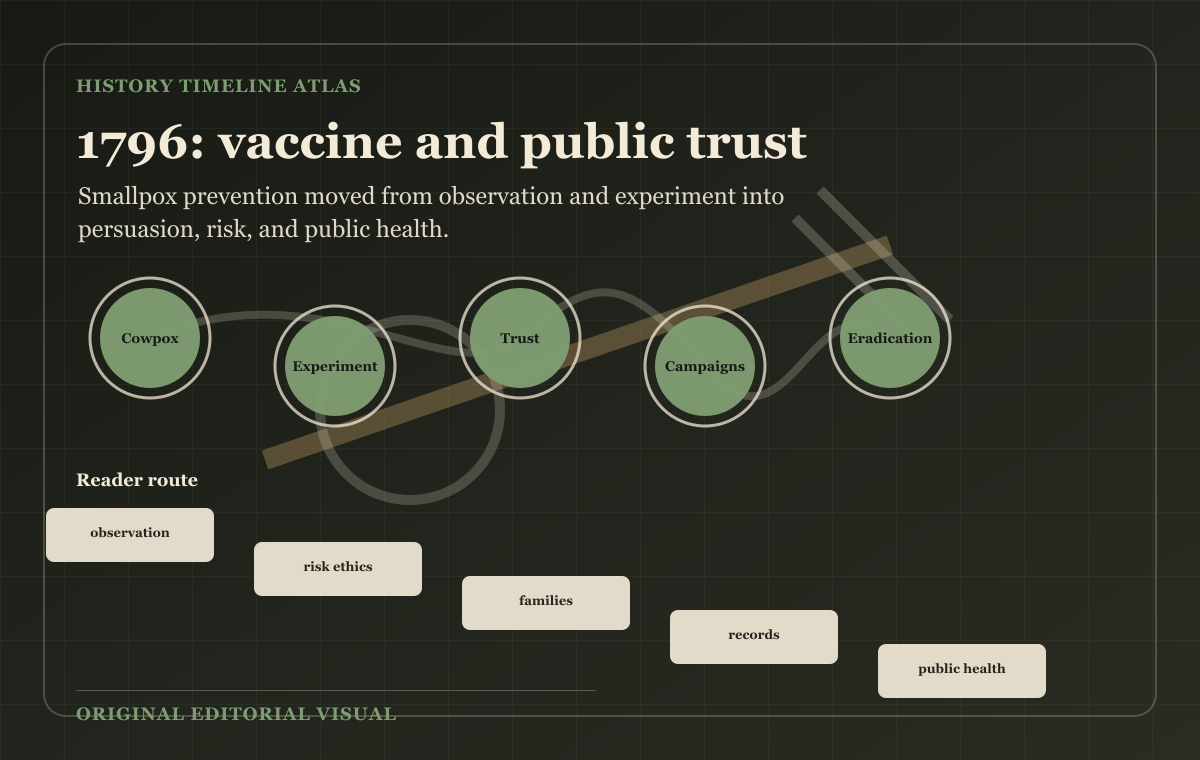
The smallpox vaccine makes 1796 a year about experiment, risk, trust, and public health before modern medicine had its later institutions. Edward Jenner's work did not instantly end smallpox, but it gave vaccination a public form that could be tested, debated, copied, resisted, and eventually organized.
The story begins with observation as well as laboratory action. Claims about cowpox protection, rural knowledge, medical correspondence, and case reporting shaped what Jenner thought could be tried. The year is therefore useful for showing how formal medicine sometimes drew on practical knowledge before turning it into scientific claim.
The vaccine also opened social questions. Who had authority to test a procedure? How should risk be explained? Why would families trust or refuse it? How could a local experiment become a public campaign across cities, empires, armies, and colonies?
Smallpox itself keeps the stakes visible. The disease killed, scarred, blinded, and frightened communities across regions. Vaccination mattered because it promised prevention before exposure rather than treatment after suffering had begun.
A strong route from 1796 moves to nineteenth-century public health, empire, statistics, compulsory vaccination debates, germ theory, and the twentieth-century eradication campaign. The year is the doorway, not the finish line.
A careful reading avoids making medical progress look automatic. Vaccination required persuasion, recordkeeping, repeated procedures, supply chains, and institutions that could reach people beyond one physician's circle. It also generated fear and resistance. That tension between evidence and acceptance is why the year still speaks to public-health history.
The public-health angle becomes clearer when the page follows the path after Jenner. Vaccination moved through physicians, charitable societies, armies, colonial administrations, printed case reports, family decisions, and later state programs. Each step required people to believe that a controlled exposure could prevent a worse disease. Evidence had to become routine before it could become infrastructure.
The year also raises an ethics question that modern readers recognize. Early vaccination experiments involved children, social trust, uneven consent standards, and risk in a world without modern clinical regulation. A useful page does not judge the past with a single modern sentence; it shows how prevention, vulnerability, authority, and public benefit became tangled from the beginning.
That makes 1796 a strong gateway for readers asking why vaccines are trusted, resisted, mandated, or remembered. The page can connect discovery to communication, and communication to public legitimacy.
The next route should move from 1796 to germ theory, public health, epidemiology, eradication, colonial medicine, and modern vaccine debates. That reading path makes the page more than a Jenner biography. It turns the year into a doorway into how societies decide which risks are acceptable in order to prevent larger harm.
1796 CE in History gathers events that help readers move from a single date into wider historical patterns. A useful year entry does more than answer what happened; it shows why people keep using the year as a marker for change.
The connected events show how decisions, institutions, conflicts, ideas, and consequences crossed beyond one location or one person. The event links explain the immediate story, while the topic routes and timelines show what came before and after.
The year also helps organize broad questions. It gives readers a concise answer and a direct path into deeper event pages where causes, turning points, consequences, maps, and references are easier to inspect.
Read the date in three passes. First ask what happened inside the year itself. Then ask which older pressures made the event possible. Finally ask which later pages reuse the same vocabulary, institutions, borders, technologies, or memories. That sequence keeps the page from becoming a trivia answer.
Even when only one event is currently attached, the year still has a job: it gives students and curious visitors a stable chronological doorway into the atlas. The page makes the doorway useful by pointing to the event, the topic route, the timeline, the map, and the evidence trail that can turn a date into a broader explanation.
This year matters because it connects Smallpox Vaccine to a wider sequence of causes and consequences. It gives the reader a chronological anchor while still pointing outward to people, places, institutions, and later effects. A thin year page would only name the event; a useful year page explains why this date is a handle for a larger route through history. 1796 matters because it shows medical history at the point where observation, experiment, public trust, and state capacity begin to meet. Jenner's vaccine did not create modern public health by itself, but it made a preventive intervention imaginable at scale. The date helps readers ask how evidence becomes policy and why trust is as important as discovery.
Reader Lenses
Look for the pressures that made change possible.
Identify who acted and what options were available.
Follow what changed after the event.
Ask why this date still appears in historical summaries.
Ask how observation, cases, correspondence, and experiment turned into a medical claim.
Follow why families, doctors, officials, and critics accepted or resisted vaccination.
Track the path from local test to public health campaigns and eventual eradication.
How This Year Connects
1796 CE in History is anchored by Smallpox Vaccine. Read those pages together and the year stops being a date label; it becomes a crossroads where immediate choices met older pressures and opened later consequences.
The setting matters as much as the date. The year moves through Berkeley and belongs to Age of Revolutions. That combination helps readers avoid treating the year as isolated; geography, institutions, conflict, belief, economy, and communication all shape what a date can mean.
The year also opens into people and themes. Figures such as Edward Jenner appear because their choices made the year visible, while themes such as Medicine, Disease, and Science explain why the consequences outlived the moment. A useful next step is usually an event page, then a topic route, then a timeline.
Evidence changes the way a date reads. A treaty, battle report, inscription, newspaper, census, court record, memoir, photograph, or archaeological trace does not answer the same question. Looking at source type helps separate what happened in the year from how later people remembered it.
A year page is most useful when it keeps two scales open at once. The first scale is immediate: what happened, where, and who was involved. The second scale is interpretive: why later readers use this date to organize a wider story. Holding both scales together makes the page a starting point for deeper reading rather than a dead-end answer.
The before-and-after frame matters too. A date rarely begins the forces it reveals. Earlier pressures made the linked event possible, while later pages show which effects were temporary, which became institutions, and which turned into memory. Reading the year this way helps students avoid the false impression that history changes only when the calendar flips.
Use this page as a junction. If the event feels too brief, follow the topic route for background; if the cause feels too abstract, open the event page for sequence; if the consequence feels larger than the date, move into the timeline. The value of a year page is that it lets readers change scale without losing their place.
Events in This Year
- 1796 CESmallpox Vaccine
Edward Jenner tested vaccination against smallpox, helping establish a new method for preventing one of history's deadliest diseases.
Map Layer
1796 CE in History geography
Gold pins mark the approximate locations of published event pages. This is a schematic locator map, not a historical border map.
Coordinates are approximate and are used to help readers orient themselves before opening a full event page.
References
Where to Check the Facts
- Encyclopaedia Britannica: Edward JennerSpecific reference for the 1796 CE anchor event, chronology, and historical setting.
- Encyclopaedia BritannicaBackground reference for chronology, names, and historical context.
- WikidataStructured reference for dates, places, alternate names, and entity links.