Historical Role
Edward Jenner matters because his 1796 vaccination experiment made a new public-health future imaginable, but the story was not a clean heroic breakthrough. Smallpox was already a feared disease, variolation had already circulated as a risky preventive practice, and communities already faced hard choices about danger, trust, evidence, and bodily intervention.
The famous scene involving cowpox, James Phipps, and later exposure to smallpox belongs inside an eighteenth-century world with different ethical norms. A modern reader should not erase the problem of consent or risk. The historical point is that Jenner's work helped move prevention from observation and local practice toward a method that could be tested, repeated, promoted, criticized, and eventually organized by public institutions.
Vaccination changed the scale of medicine. A disease that once seemed like fate could become a target for coordinated prevention. That required more than a doctor and a discovery. It required supply of vaccine material, record keeping, public trust, government action, medical networks, and a language for explaining why an intervention in the present could prevent catastrophe later.
Jenner's legacy also shows that evidence does not spread by itself. Fear, religious objection, satire, class mistrust, empire, military needs, and state power shaped vaccination campaigns. The history of vaccination is therefore a history of science, persuasion, administration, and public legitimacy.
The biography leads forward to smallpox eradication. Jenner did not eradicate smallpox alone, and the global campaign came much later. But his work helped create a pathway from local experiment to one of the most important public-health achievements in modern history.
The reader should also see how rural observation became scientific argument. Jenner noticed patterns around cowpox and smallpox, but observation had to be converted into claims other practitioners could inspect, repeat, dispute, and circulate. That movement from local knowledge to public evidence is the core of the biography.
The ethics layer makes the page more honest. James Phipps appears in the famous story, but modern readers need to ask about risk, consent, class, and childhood in eighteenth-century medicine. That question does not erase the historical importance of vaccination; it makes the history less like a heroic poster and more like real public health.
Vaccination also required infrastructure. Vaccine material had to be preserved, transported, trusted, and administered by people working through military, colonial, charitable, and government networks. The method became world-changing only when institutions could carry it beyond Jenner's own hands.
Resistance to vaccination belongs in the biography because trust is part of evidence. Some people feared bodily harm, religious violation, elite control, or state coercion. Those objections do not make vaccination ineffective, but they show why public health has always required persuasion, records, accountability, and visible benefit.
Jenner's page should therefore connect science to governance. A vaccine could protect individuals, but population protection required policy, distribution, training, and public legitimacy. That is why the biography links a doctor to institutions instead of ending with a single experiment.
Edward Jenner helps connect individual action with wider historical change in United Kingdom. The biography works best when it keeps the surrounding world visible: authority, conflict, belief, reform, or discovery moved through decisions made under pressure.
The related events show how roles such as Physician, Vaccine pioneer can be read through dates, places, institutions, and consequences rather than through reputation alone. The biography explains why this person matters, while the linked events explain what changed around them.
A richer reading starts with the limits around the person. Some figures acted through offices, armies, courts, laboratories, churches, parties, ships, trade networks, or protest movements; others became important because later communities turned their lives into symbols. The page therefore asks what this person could actually change, what was already moving before them, and which consequences later readers attached to the name.
Read the biography against absence as well. Many lives around Edward Jenner are less visible in the record: opponents, collaborators, family members, workers, soldiers, students, subjects, victims, translators, scribes, or local communities. Keeping those surrounding people in view makes the page less like a name card and more like an entry point into historical systems.
Edward Jenner also works as a navigation point. Open the linked event pages to see where the biography becomes chronology, then use the topic routes to test whether the same pattern appears beyond one life. That extra step matters because historical importance is rarely contained inside a single decision; it usually spreads through institutions, witnesses, opponents, imitators, and later arguments over memory.
Sources and Method
Source trail: the page uses Jenner biography references, smallpox vaccination event sources, and public-health route material.
Method note: the page separates discovery, ethical context, public trust, institutional delivery, and later eradication.
Evidence Notes
How Sensitive Claims Are Sourced
- 1
Vaccination before modern public health
Jenner's 1796 work is placed after variolation and before later public-health institutions so the page explains both breakthrough and system-building.
Why This Person Matters
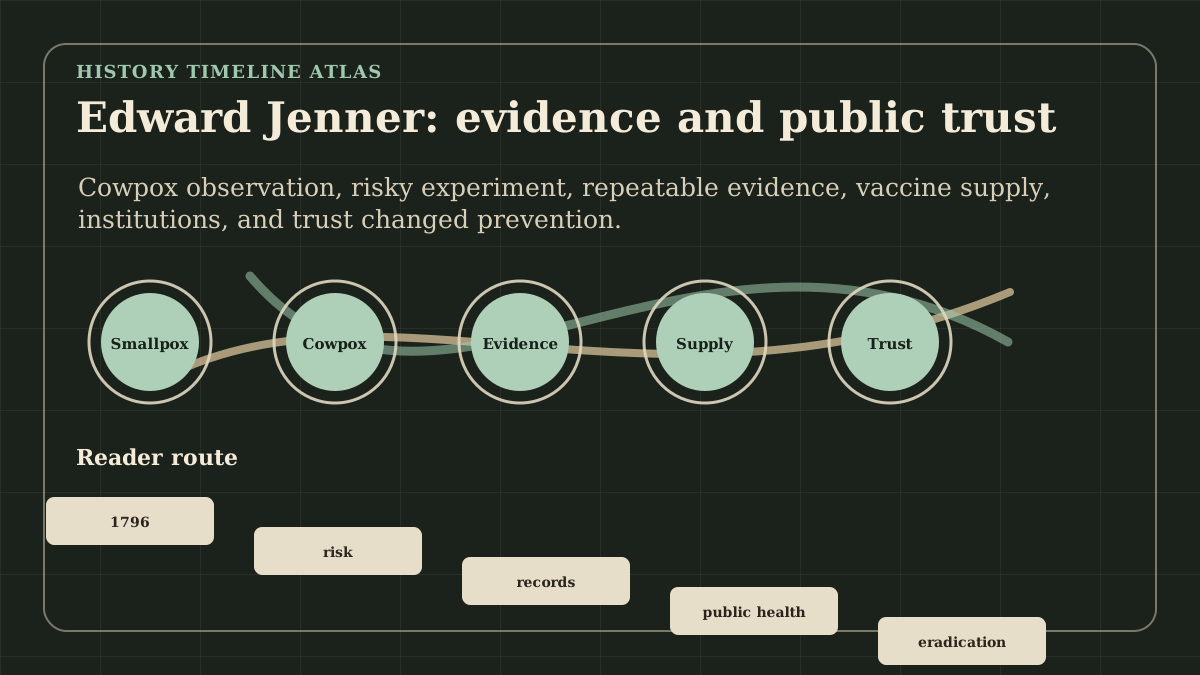
Edward Jenner matters because the connected events make a larger historical pattern easier to follow. The page links biography to consequences so readers can move from a life story into the wider atlas, compare the person with contemporaries, and understand why later memory kept returning to this figure. Jenner matters because his page turns a famous experiment into a longer story about observation, risk, ethics, evidence, public trust, and institutional delivery. Readers can follow the route from cowpox observation to vaccination campaigns and smallpox eradication without mistaking the first experiment for the whole system.
What has to happen after a medical insight before it becomes public health?
How to Read This Life
Edward Jenner is easiest to understand when the biography is read beside Smallpox Vaccine. Those events show the historical setting in motion: dates, places, institutions, conflict, and consequences give the life a structure that a short biography alone cannot provide.
The surrounding route crosses Age of Revolutions and locations such as Berkeley. That matters because influence rarely stays inside one person. It moves through offices, armies, movements, laws, texts, speeches, institutions, and later memory.
A useful reading path starts with the role labels, then opens the event pages to see what changed, and finally compares this person with other actors facing similar pressures.
For readers who arrive on a biography first, this page is meant to become a doorway rather than a stop. Read one paragraph for the answer, then use the turning points, topic routes, and event links to test whether the person's reputation matches the wider evidence.
Read Jenner beside smallpox vaccination, the Industrial Revolution, and modern public-health pages. That path shows how science becomes social infrastructure.
Then compare with Pasteur, germ theory, cholera, and COVID-era public trust if those pages are added later. The common question is how evidence becomes accepted practice.
Read Edward Jenner through the roles of Physician, Vaccine pioneer rather than as reputation alone.
Place the biography inside United Kingdom and the wider events linked below.
Ask which choices were personal and which were constrained by institutions or crisis.
Follow how later memory simplified, contested, or reused this person's role.
Ask how observation, experiment, repetition, and criticism shaped confidence.
Keep historical context visible without hiding risk, consent, and power.
Follow the institutions, records, supply chains, and trust needed to scale prevention.
Legacy, Limits, and Memory
A useful biography keeps scale in view. Edward Jenner mattered because individual choices met a wider structure: institutions, enemies, allies, audiences, technologies, beliefs, and inherited conflicts. The related event pages help separate personal agency from conditions that no single person controlled.
Memory is part of the biography too. Later readers often simplify a figure into a hero, villain, founder, reformer, conqueror, prophet, scientist, or symbol. Those labels can be helpful, but they become misleading when they hide conflict, compromise, exclusion, uncertainty, or the experiences of people outside the main biography.
For the next step, compare this life with a topic route rather than stopping at the name. If the same pattern appears across several figures, the reader has found a historical structure; if this person breaks the pattern, the contrast is usually where the most interesting question begins.
A careful reading avoids both celebration without ethics and ethics without historical context. Eighteenth-century experimentation needs clear distance from modern standards.
Vaccination history is partly about trust. A medical method changes society only when people, institutions, and records can carry it.
Smallpox eradication should be treated as a later collective achievement, not as a single-person victory.
The page works best when discovery, delivery, and public confidence are treated as separate historical problems, each with its own actors, risks, institutions, and evidence trail.
Turning Points to Read Next
Smallpox Vaccine
Edward Jenner tested vaccination against smallpox, helping establish a new method for preventing one of history's deadliest diseases.
Related Timeline
- 1796 CESmallpox Vaccine
Edward Jenner tested vaccination against smallpox, helping establish a new method for preventing one of history's deadliest diseases.
References
Where to Check the Facts
- Encyclopaedia Britannica: Edward JennerBiographical reference for Edward Jenner's life dates, roles, institutions, and historical setting.
- Encyclopaedia BritannicaBackground reference for chronology, names, and historical context.
- WikidataStructured reference for dates, places, alternate names, and entity links.