How to Read the Year
Why does 1543 CE in History deserve a focused year page?
1543 makes science history concrete because books entered public argument. Copernicus's De revolutionibus and Vesalius's De humani corporis fabrica did not create modern science in one year, but they showed how print, mathematics, anatomy, observation, and criticism could unsettle inherited authorities.
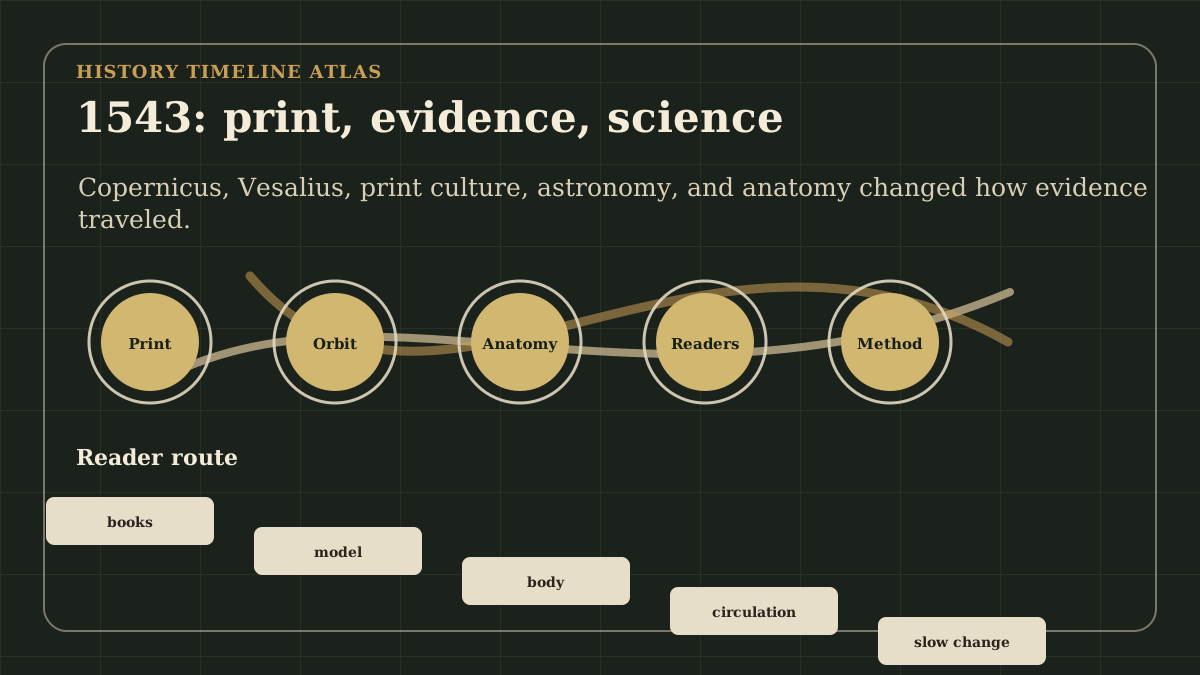
The date should be read through media as much as genius. Diagrams, tables, Latin prose, patronage, university medicine, astronomical calculation, and learned correspondence allowed arguments to travel. Scientific change needed readers, printers, instruments, bodies, data, and institutions.
Copernicus and Vesalius also changed different kinds of evidence. Astronomy asked readers to imagine planetary order through mathematical models; anatomy asked them to compare texts with dissected bodies and visual plates. Together they make 1543 a useful doorway into method.
The year remains a marker because later readers organized the Scientific Revolution around such publications. That is useful if handled carefully: the revolution was long, uneven, and collective, but 1543 helps readers see how questioning authority became visible in printed form.
The date also helps readers compare knowledge fields. Astronomy moved through calculation and model-building, while anatomy moved through bodies, images, and correction of inherited texts. Both cases show that evidence becomes persuasive only when a community can inspect, repeat, teach, dispute, preserve, revise, and transmit it across generations.
The human setting keeps 1543 from turning into a slogan. Printers took risks, patrons lent authority, students and physicians read with professional interests, and religious or university readers interpreted new claims through older habits. Knowledge changed through argument among communities, not by replacing one worldview overnight.
Copernicus also shows that a publication can be radical without causing instant revolution. His mathematical model challenged inherited cosmology, yet it required later readers, observations, instruments, debates, and reinterpretations before heliocentrism became a new consensus. The book's importance grew through argument after publication.
Vesalius gives a different kind of reader experience. Anatomical plates, corrected descriptions, and the authority of dissection asked students to compare inherited texts with visible bodies. The next route moves from 1543 to Galileo, Newton, medicine, printing, universities, and the wider question of how evidence becomes trustworthy.
The year also teaches patience about intellectual change. A printed claim can disturb authority long before it reorganizes schools, instruments, professions, curricula, and public common sense across Europe and beyond. That delay is part of the story, not a sign that the publications were unimportant.
1543 CE in History gathers events that help readers move from a single date into wider historical patterns. A useful year entry does more than answer what happened; it shows why people keep using the year as a marker for change.
The connected events show how decisions, institutions, conflicts, ideas, and consequences crossed beyond one location or one person. The event links explain the immediate story, while the topic routes and timelines show what came before and after.
The year also helps organize broad questions. It gives readers a concise answer and a direct path into deeper event pages where causes, turning points, consequences, maps, and references are easier to inspect.
Read the date in three passes. First ask what happened inside the year itself. Then ask which older pressures made the event possible. Finally ask which later pages reuse the same vocabulary, institutions, borders, technologies, or memories. That sequence keeps the page from becoming a trivia answer.
Even when only one event is currently attached, the year still has a job: it gives students and curious visitors a stable chronological doorway into the atlas. The page makes the doorway useful by pointing to the event, the topic route, the timeline, the map, and the evidence trail that can turn a date into a broader explanation.
This year matters because it connects Scientific Revolution Begins to a wider sequence of causes and consequences. It gives the reader a chronological anchor while still pointing outward to people, places, institutions, and later effects. A thin year page would only name the event; a useful year page explains why this date is a handle for a larger route through history. 1543 matters because it connects discovery with publication. The year shows that knowledge changes when claims can be printed, diagrammed, criticized, taught, and compared with observation. It also helps readers avoid a lone-genius story by placing Copernicus and Vesalius inside universities, presses, patrons, instruments, and inherited problems. The date gives students a concrete way to ask how evidence travels from a specialist claim into a wider intellectual world.
Reader Lenses
Look for the pressures that made change possible.
Identify who acted and what options were available.
Follow what changed after the event.
Ask why this date still appears in historical summaries.
Ask how books, diagrams, and tables made technical arguments portable.
Compare mathematical astronomy with anatomical observation and illustration.
Watch how older texts were challenged without disappearing overnight.
Follow readers, printers, patrons, physicians, mathematicians, and teachers around the books.
How This Year Connects
1543 CE in History is anchored by Scientific Revolution Begins. Read those pages together and the year stops being a date label; it becomes a crossroads where immediate choices met older pressures and opened later consequences.
The setting matters as much as the date. The year moves through Europe and belongs to Early Modern World. That combination helps readers avoid treating the year as isolated; geography, institutions, conflict, belief, economy, and communication all shape what a date can mean.
The year also opens into people and themes. Figures such as Nicolaus Copernicus and Andreas Vesalius appear because their choices made the year visible, while themes such as Science, Astronomy, and Ideas explain why the consequences outlived the moment. A useful next step is usually an event page, then a topic route, then a timeline.
Evidence changes the way a date reads. A treaty, battle report, inscription, newspaper, census, court record, memoir, photograph, or archaeological trace does not answer the same question. Looking at source type helps separate what happened in the year from how later people remembered it.
A year page is most useful when it keeps two scales open at once. The first scale is immediate: what happened, where, and who was involved. The second scale is interpretive: why later readers use this date to organize a wider story. Holding both scales together makes the page a starting point for deeper reading rather than a dead-end answer.
The before-and-after frame matters too. A date rarely begins the forces it reveals. Earlier pressures made the linked event possible, while later pages show which effects were temporary, which became institutions, and which turned into memory. Reading the year this way helps students avoid the false impression that history changes only when the calendar flips.
Use this page as a junction. If the event feels too brief, follow the topic route for background; if the cause feels too abstract, open the event page for sequence; if the consequence feels larger than the date, move into the timeline. The value of a year page is that it lets readers change scale without losing their place.
Read 1543 beside Copernicus, Vesalius, Newton, Darwin, the Scientific Revolution, printing, Renaissance learning, medicine, and astronomy routes.
Then compare 1543 with 1517, 1687, 1796, 1859, and 1969 where available. The comparison asks when publication, instruments, institutions, and public trust make knowledge durable.
Events in This Year
- 1543 CEScientific Revolution Begins
Publications by Copernicus and Vesalius helped mark a new phase in European inquiry about astronomy, anatomy, evidence, and method.
Map Layer
1543 CE in History geography
Gold pins mark the approximate locations of published event pages. This is a schematic locator map, not a historical border map.
Coordinates are approximate and are used to help readers orient themselves before opening a full event page.
References
Where to Check the Facts
- Encyclopaedia Britannica: Nicolaus CopernicusSpecific reference for the 1543 CE anchor event, chronology, and historical setting.
- Encyclopaedia BritannicaBackground reference for chronology, names, and historical context.
- WikidataStructured reference for dates, places, alternate names, and entity links.