How to Read the Year
Why does 1050 CE in History deserve a focused year page?
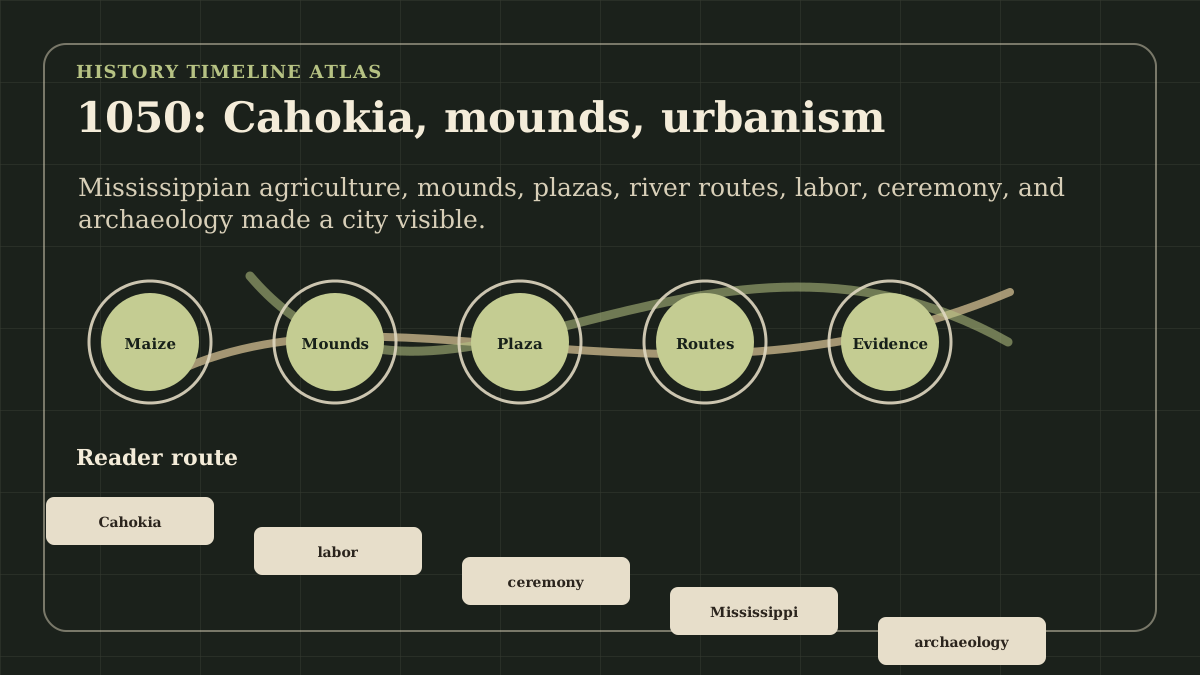
Cahokia makes 1050 a year about urban growth, regional influence, and Indigenous North American complexity before European contact. The date should not be used as a sudden founding myth. It marks an expansion phase in a much longer Mississippian world of mounds, plazas, agriculture, trade, ceremony, migration, and political authority.
The scale matters. Cahokia was not a small village with a few monuments; it became a major urban and ceremonial center with neighborhoods, public works, and connections reaching across river routes. A reader who pictures only scattered settlements misses the labor, food systems, planning, and ritual authority required to build and maintain such a place.
1050 also asks readers to think through evidence. Archaeology, mound landscapes, material culture, settlement patterns, diet evidence, and later Indigenous histories do not work like a written royal chronicle. The page becomes stronger when it teaches readers how historians reconstruct urban life from landscape and objects.
The wider meaning is comparative. Cahokia belongs beside Tenochtitlan, Cusco, Great Zimbabwe, Angkor, and other centers that challenge narrow assumptions about where cities, sacred landscapes, and regional power could form.
The date also gives readers a better search answer than a list of mound facts. It explains why a settlement could become a regional magnet, why ceremonial space mattered, and why North American history needs urban and political vocabulary before colonial contact appears.
Monks Mound should be treated as labor, planning, and sacred landscape rather than as a tourist landmark. Building and maintaining large earthworks required organized work, food production, social authority, and shared meaning. That makes the mound a political clue as well as an archaeological feature.
Cahokia's river setting gives the year a regional map. The Mississippi and nearby waterways connected movement, exchange, food, diplomacy, and influence. The city was powerful partly because it sat inside a landscape where people, goods, and ritual practices could travel.
A strong page also avoids making Cahokia mysterious in a lazy way. Some questions remain open, but uncertainty should invite evidence rather than exoticism. Archaeology gives readers real ways to ask about population, diet, migration, hierarchy, ritual, and change.
The route points forward to decline without treating decline as the only question. Cahokia matters because of what people built, organized, fed, and remembered, not only because later population changed. Rise, life, and afterlife all deserve attention.
A classroom-friendly reading also asks what urbanism means when there is no written city charter. Population estimates, mound phases, craft production, food remains, burials, soil, and regional exchange all become evidence. The year teaches readers to treat archaeology as argument, not as a substitute for missing text.
1050 CE in History gathers events that help readers move from a single date into wider historical patterns. A useful year entry does more than answer what happened; it shows why people keep using the year as a marker for change.
The connected events show how decisions, institutions, conflicts, ideas, and consequences crossed beyond one location or one person. The event links explain the immediate story, while the topic routes and timelines show what came before and after.
The year also helps organize broad questions. It gives readers a concise answer and a direct path into deeper event pages where causes, turning points, consequences, maps, and references are easier to inspect.
Read the date in three passes. First ask what happened inside the year itself. Then ask which older pressures made the event possible. Finally ask which later pages reuse the same vocabulary, institutions, borders, technologies, or memories. That sequence keeps the page from becoming a trivia answer.
Even when only one event is currently attached, the year still has a job: it gives students and curious visitors a stable chronological doorway into the atlas. The page makes the doorway useful by pointing to the event, the topic route, the timeline, the map, and the evidence trail that can turn a date into a broader explanation.
This year matters because it connects Cahokia Rises to a wider sequence of causes and consequences. It gives the reader a chronological anchor while still pointing outward to people, places, institutions, and later effects. A thin year page would only name the event; a useful year page explains why this date is a handle for a larger route through history. 1050 matters because it gives readers a concrete entry into Indigenous North American urban history. The year helps replace a thin pre-contact story with one about cities, agriculture, ceremony, exchange, labor, and regional authority. It also teaches that historical evidence can be spatial and material: mounds, plazas, houses, fields, routes, artifacts, and landscapes can carry arguments about power, belief, and memory.
Reader Lenses
Look for the pressures that made change possible.
Identify who acted and what options were available.
Follow what changed after the event.
Ask why this date still appears in historical summaries.
Ask what food, labor, ceremony, and authority were needed to sustain a large center.
Read mounds, plazas, neighborhoods, and river routes as historical evidence.
Compare Cahokia with other world cities without forcing it into European categories.
How This Year Connects
1050 CE in History is anchored by Cahokia Rises. Read those pages together and the year stops being a date label; it becomes a crossroads where immediate choices met older pressures and opened later consequences.
The setting matters as much as the date. The year moves through Cahokia and belongs to Mississippian World. That combination helps readers avoid treating the year as isolated; geography, institutions, conflict, belief, economy, and communication all shape what a date can mean.
The year also opens into people and themes. Figures such as Mississippian builders and Cahokia residents appear because their choices made the year visible, while themes such as Cahokia, Mississippian Culture, and Urbanism explain why the consequences outlived the moment. A useful next step is usually an event page, then a topic route, then a timeline.
Evidence changes the way a date reads. A treaty, battle report, inscription, newspaper, census, court record, memoir, photograph, or archaeological trace does not answer the same question. Looking at source type helps separate what happened in the year from how later people remembered it.
A year page is most useful when it keeps two scales open at once. The first scale is immediate: what happened, where, and who was involved. The second scale is interpretive: why later readers use this date to organize a wider story. Holding both scales together makes the page a starting point for deeper reading rather than a dead-end answer.
The before-and-after frame matters too. A date rarely begins the forces it reveals. Earlier pressures made the linked event possible, while later pages show which effects were temporary, which became institutions, and which turned into memory. Reading the year this way helps students avoid the false impression that history changes only when the calendar flips.
Use this page as a junction. If the event feels too brief, follow the topic route for background; if the cause feels too abstract, open the event page for sequence; if the consequence feels larger than the date, move into the timeline. The value of a year page is that it lets readers change scale without losing their place.
Events in This Year
- c. 1050 CECahokia Rises
Cahokia expanded into the largest pre-Columbian urban center north of Mexico, with mounds, plazas, neighborhoods, and regional influence.
Map Layer
1050 CE in History geography
Gold pins mark the approximate locations of published event pages. This is a schematic locator map, not a historical border map.
Coordinates are approximate and are used to help readers orient themselves before opening a full event page.
References
Where to Check the Facts
- Smithsonian National Museum of the American Indian: Native Knowledge 360Indigenous-centered educational reference for Native history, sovereignty, community knowledge, and public interpretation.
- Smithsonian NMAI: Haudenosaunee Guide for EducatorsCommunity-consulted educational reference for Haudenosaunee culture, history, continuity, and interpretation.
- Yale History: Ned Blackhawk, The Rediscovery of AmericaIndigenous historian's synthesis for centering Native peoples in broader American historical interpretation.
- Indigenous ChicagoCommunity-partnered public-history project for place-based Native history, maps, memory, and continuity.