How to Read the Year
Why does 508 BCE in History deserve a focused year page?
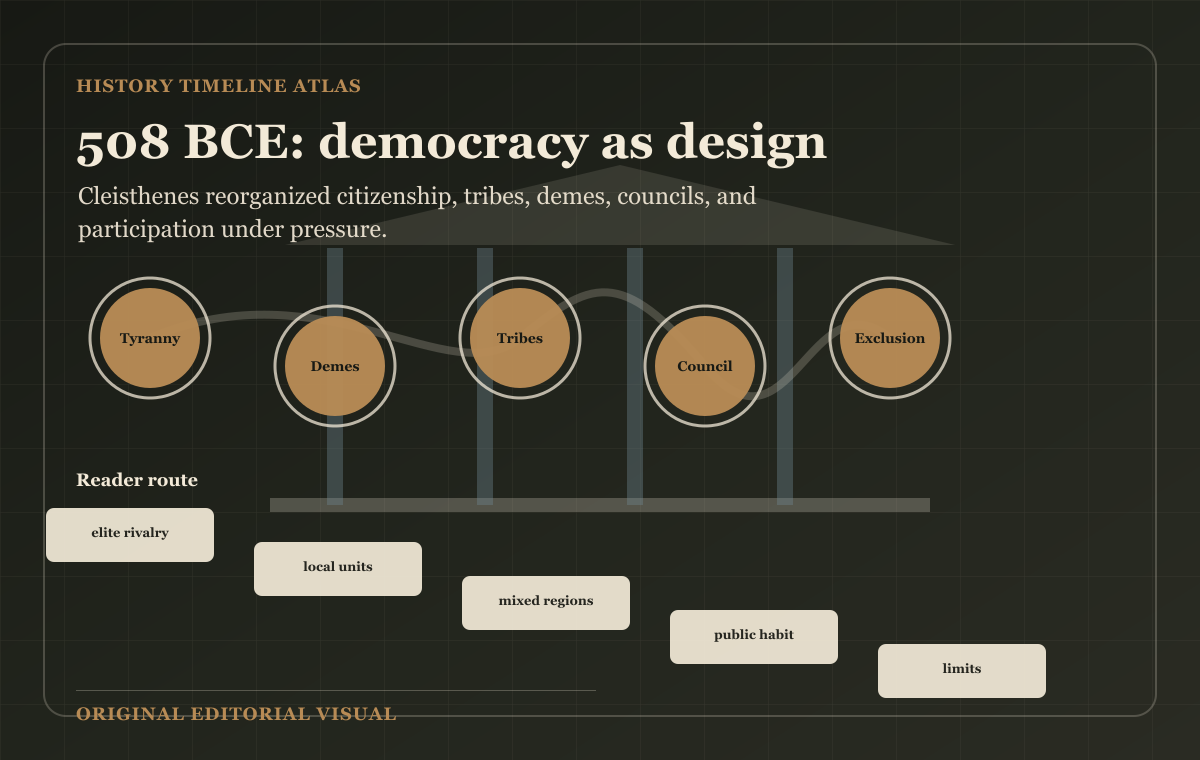
The reforms of Cleisthenes make 508 BCE a year about political design rather than a simple birth certificate for democracy. Athens did not suddenly become modern democracy. It reorganized citizenship, tribes, local units, councils, and participation in ways that changed who could act politically inside the polis.
The date matters because institutions were used to weaken older aristocratic and regional power. New tribal organization mixed populations across local divisions, while the Council of Five Hundred gave broader civic participation a working structure. Political equality was built through arrangements, not only ideals.
The exclusions are just as important. Women, enslaved people, resident foreigners, and many others were outside the citizen body. Calling the reforms democratic without naming those limits would make the page flatter and less honest.
508 BCE also belongs inside a Greek world of tyranny, aristocratic rivalry, Persian pressure, and civic experimentation. Athens was not inventing politics in isolation. Its institutions developed through conflict and competition with other Greek and imperial models.
The best reading path moves from Cleisthenes to Marathon, Pericles, Athenian empire, and later debates over citizenship. The year is valuable because it lets readers see democracy as a designed and contested practice.
The city scale matters. Political reform changed how citizens identified themselves, where they met, who counted in public decision-making, and how local belonging could be reorganized into civic order. That makes the year useful for readers who want democracy to feel like institutions and habits, not only an abstract ideal.
The causes should stay political rather than mythical. Cleisthenes acted in a world of elite rivalry, memories of tyranny, Spartan intervention, family competition, and pressure from ordinary Athenians who had already shown that public mobilization mattered. Democracy did not arrive as a pure idea. It emerged from conflict over who could organize the city after old power arrangements became unstable.
The reforms also help readers understand why maps matter. Demes tied citizens to local units; tribes mixed regions; the council made participation more regular; public offices and assemblies gave citizens repeated habits of decision. That design weakened older patronage geography and made the polis easier to imagine as a shared civic body.
For modern readers, the value of 508 BCE is not that Athens was morally complete. Its value is that it shows political equality being built through procedures, boundaries, offices, and repeated civic practice.
That distinction makes the page useful for searches about the origins of democracy without pretending ancient citizenship matches modern democratic ideals.
The next route moves from 508 BCE to Marathon, the Persian Wars, Athenian empire, ostracism, Pericles, slavery, women, and later democratic memory. That path keeps innovation and exclusion together. The year is important not because Athens solved politics, but because it built a durable model for asking who gets to participate.
508 BCE in History gathers events that help readers move from a single date into wider historical patterns. A useful year entry does more than answer what happened; it shows why people keep using the year as a marker for change.
The connected events show how decisions, institutions, conflicts, ideas, and consequences crossed beyond one location or one person. The event links explain the immediate story, while the topic routes and timelines show what came before and after.
The year also helps organize broad questions. It gives readers a concise answer and a direct path into deeper event pages where causes, turning points, consequences, maps, and references are easier to inspect.
Read the date in three passes. First ask what happened inside the year itself. Then ask which older pressures made the event possible. Finally ask which later pages reuse the same vocabulary, institutions, borders, technologies, or memories. That sequence keeps the page from becoming a trivia answer.
Even when only one event is currently attached, the year still has a job: it gives students and curious visitors a stable chronological doorway into the atlas. The page makes the doorway useful by pointing to the event, the topic route, the timeline, the map, and the evidence trail that can turn a date into a broader explanation.
This year matters because it connects Cleisthenes Reforms Athens to a wider sequence of causes and consequences. It gives the reader a chronological anchor while still pointing outward to people, places, institutions, and later effects. A thin year page would only name the event; a useful year page explains why this date is a handle for a larger route through history. 508 BCE matters because it gives readers a concrete entry into how political participation can be engineered through institutions. The reforms show that democracy is not only a word for values; it is a set of rules about membership, voting, councils, local identity, and public authority. The date also warns readers to study exclusion alongside innovation.
Reader Lenses
Look for the pressures that made change possible.
Identify who acted and what options were available.
Follow what changed after the event.
Ask why this date still appears in historical summaries.
Read tribes, demes, councils, and citizenship as political technology.
Name who was outside the citizen body while studying participation inside it.
Place Athens beside tyranny, aristocratic rivalry, other poleis, and Persian power.
How This Year Connects
508 BCE in History is anchored by Cleisthenes Reforms Athens. Read those pages together and the year stops being a date label; it becomes a crossroads where immediate choices met older pressures and opened later consequences.
The setting matters as much as the date. The year moves through Athens and belongs to Classical Antiquity. That combination helps readers avoid treating the year as isolated; geography, institutions, conflict, belief, economy, and communication all shape what a date can mean.
The year also opens into people and themes. Figures such as Cleisthenes appear because their choices made the year visible, while themes such as Athens, Democracy, and City-States explain why the consequences outlived the moment. A useful next step is usually an event page, then a topic route, then a timeline.
Evidence changes the way a date reads. A treaty, battle report, inscription, newspaper, census, court record, memoir, photograph, or archaeological trace does not answer the same question. Looking at source type helps separate what happened in the year from how later people remembered it.
A year page is most useful when it keeps two scales open at once. The first scale is immediate: what happened, where, and who was involved. The second scale is interpretive: why later readers use this date to organize a wider story. Holding both scales together makes the page a starting point for deeper reading rather than a dead-end answer.
The before-and-after frame matters too. A date rarely begins the forces it reveals. Earlier pressures made the linked event possible, while later pages show which effects were temporary, which became institutions, and which turned into memory. Reading the year this way helps students avoid the false impression that history changes only when the calendar flips.
Use this page as a junction. If the event feels too brief, follow the topic route for background; if the cause feels too abstract, open the event page for sequence; if the consequence feels larger than the date, move into the timeline. The value of a year page is that it lets readers change scale without losing their place.
Events in This Year
- 508 BCECleisthenes Reforms Athens
Cleisthenes reorganized Athenian political participation around new tribes and demes, helping create the institutional foundations of Athenian democracy.
Map Layer
508 BCE in History geography
Gold pins mark the approximate locations of published event pages. This is a schematic locator map, not a historical border map.
Coordinates are approximate and are used to help readers orient themselves before opening a full event page.
References
Where to Check the Facts
- Encyclopaedia Britannica: The reforms of CleisthenesSpecific reference for Cleisthenes' reforms and the 508 BCE Athenian political transition.
- World History Encyclopedia: CleisthenesNarrative reference for Cleisthenes, Athens, and the political reforms associated with democracy.