Historical Role
Micaela Bastidas should not be introduced only as the wife of Tupac Amaru II. She was a strategist, organizer, and political actor in the Andean rebellion that challenged Spanish colonial rule in the early 1780s. Her importance appears in logistics, intelligence, provisions, recruitment, correspondence, and the difficult work of turning grievance into coordinated action.
The rebellion's world was not abstract empire. It included tribute demands, forced labor memories, corregidores, local officials, kinship networks, market towns, Indigenous communities, mixed-status households, roads, mule routes, and the racial hierarchy of the Spanish colonial Andes. Bastidas worked inside that social geography.
Her role also changes how readers understand gender in revolutionary history. Women were not only symbols, mourners, or victims. They could move information, manage supplies, command loyalty, and shape decisions. Bastidas's presence makes the rebellion less like a single male leader's uprising and more like a networked political movement.
The execution of Bastidas and Tupac Amaru II gave the rebellion a brutal memory. Spanish punishment was meant to restore authority through terror, but it also preserved the rebels as later symbols of anti-colonial resistance. The page keeps both facts visible: repression worked in the short term, and memory escaped its intended limits.
A careful biography avoids making Bastidas a modern nationalist before her time while still recognizing why later Latin American and Indigenous movements found her powerful. She links domestic labor, political command, colonial violence, and Andean resistance in a way that broadens the atlas beyond presidents, generals, and declarations.
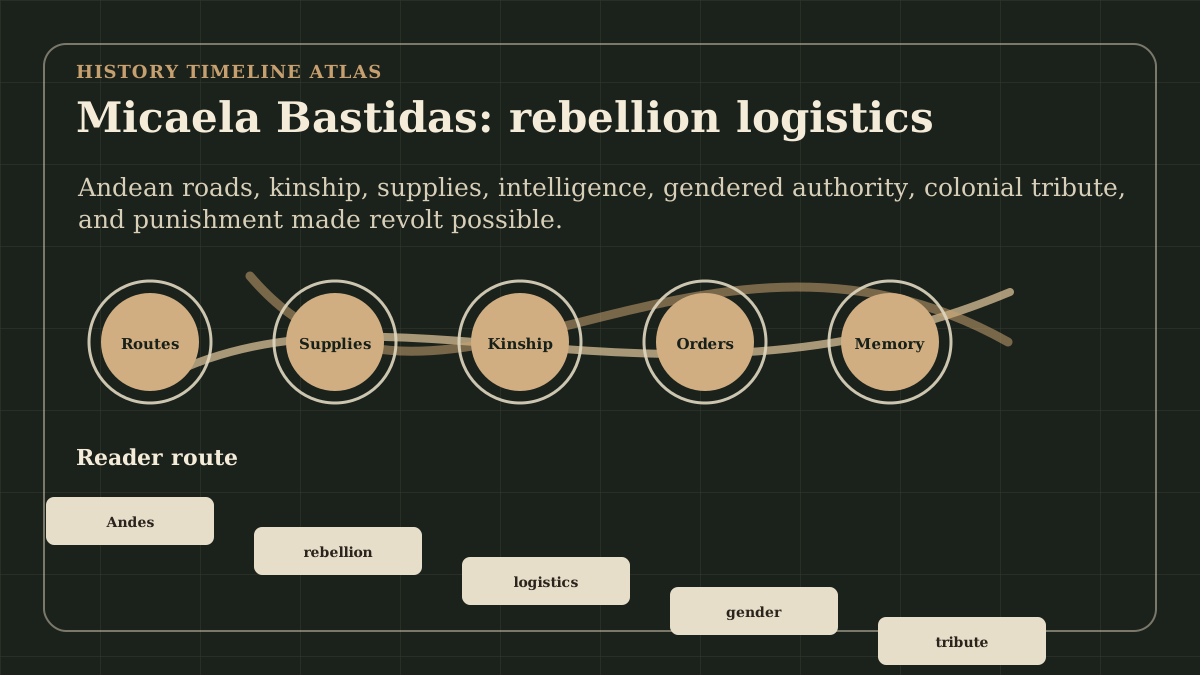
Logistics make the rebellion vivid. Food, animals, letters, safe passage, intelligence, road knowledge, and pressure on wavering allies could decide whether anger became action. Bastidas's authority appears in that practical layer, where political possibility depended on moving people and supplies through difficult terrain.
The Andean setting also forces readers to think beyond capital cities. Valleys, highland routes, markets, parish networks, and Indigenous authorities shaped the speed and limits of mobilization. The rebellion was not a speech spreading in empty space; it was a social geography under colonial strain.
Bastidas's gendered memory carries a second tension. Later commemoration can turn her into a martyr or symbol of heroic motherhood, but the historical page keeps her strategic decisions visible. Symbolic power matters, yet it becomes stronger when readers see the organizing labor beneath it.
The rebellion's defeat does not make it historically small. Its violence, fear, and memory helped later generations ask what colonial justice, Indigenous authority, taxation, and sovereignty meant in the Andes. Bastidas gives that question a human and operational scale.
Her biography also invites readers to notice the archive's imbalance. Colonial punishment records can make rebels visible at the moment of defeat, while the quieter work of planning, persuading, feeding, warning, and sustaining trust is harder to recover. Reading against that imbalance helps treat survival work as evidence of political intelligence.
Micaela Bastidas helps connect individual action with wider historical change in Colonial Andes. The biography works best when it keeps the surrounding world visible: authority, conflict, belief, reform, or discovery moved through decisions made under pressure.
The related events show how roles such as Andean rebel leader, Strategist can be read through dates, places, institutions, and consequences rather than through reputation alone. The biography explains why this person matters, while the linked events explain what changed around them.
A richer reading starts with the limits around the person. Some figures acted through offices, armies, courts, laboratories, churches, parties, ships, trade networks, or protest movements; others became important because later communities turned their lives into symbols. The page therefore asks what this person could actually change, what was already moving before them, and which consequences later readers attached to the name.
Read the biography against absence as well. Many lives around Micaela Bastidas are less visible in the record: opponents, collaborators, family members, workers, soldiers, students, subjects, victims, translators, scribes, or local communities. Keeping those surrounding people in view makes the page less like a name card and more like an entry point into historical systems.
Micaela Bastidas also works as a navigation point. Open the linked event pages to see where the biography becomes chronology, then use the topic routes to test whether the same pattern appears beyond one life. That extra step matters because historical importance is rarely contained inside a single decision; it usually spreads through institutions, witnesses, opponents, imitators, and later arguments over memory.
Sources and Method
Source trail: the page uses the Tupac Amaru II rebellion event, Latin American revolution route sources, and Andean colonial context rather than relying on a generic revolution summary.
Method note: Bastidas is treated as an organizer and strategist. The page avoids reducing her to relationship status or martyrdom.
Evidence Notes
How Sensitive Claims Are Sourced
- 1
Logistics and leadership in rebellion
The biography emphasizes communication, supplies, recruitment, and Andean networks so Micaela Bastidas appears as an actor in rebellion, not as a footnote to Tupac Amaru II.
Why This Person Matters
Micaela Bastidas matters because the connected events make a larger historical pattern easier to follow. The page links biography to consequences so readers can move from a life story into the wider atlas, compare the person with contemporaries, and understand why later memory kept returning to this figure. Micaela Bastidas matters because her biography makes logistics, gendered authority, kinship, and Andean geography visible inside anti-colonial rebellion. The page helps readers understand that revolts are built from food, messages, trust, routes, fear, and memory as much as from famous proclamations.
That makes her a guide to the hidden labor that lets resistance move across mountains, households, markets, and colonial checkpoints, where decisions became survival and memory became political inheritance across generations afterward.
What does a rebellion look like when logistics, kinship, and local knowledge are treated as leadership?
How to Read This Life
Micaela Bastidas is easiest to understand when the biography is read beside Tupac Amaru II Rebellion. Those events show the historical setting in motion: dates, places, institutions, conflict, and consequences give the life a structure that a short biography alone cannot provide.
The surrounding route crosses Colonial Latin America and locations such as Cusco region. That matters because influence rarely stays inside one person. It moves through offices, armies, movements, laws, texts, speeches, institutions, and later memory.
A useful reading path starts with the role labels, then opens the event pages to see what changed, and finally compares this person with other actors facing similar pressures.
For readers who arrive on a biography first, this page is meant to become a doorway rather than a stop. Read one paragraph for the answer, then use the turning points, topic routes, and event links to test whether the person's reputation matches the wider evidence.
Read Bastidas beside the Tupac Amaru II rebellion, the Haitian Revolution, and Latin American independence pages. That path shows how anti-colonial action differed across Indigenous, enslaved, creole, and mixed social worlds.
Then follow the Rights / Independence route to compare memory. Some figures became state heroes, some movement ancestors, and some symbols of unfinished justice.
Read Micaela Bastidas through the roles of Andean rebel leader, Strategist rather than as reputation alone.
Place the biography inside Colonial Andes and the wider events linked below.
Ask which choices were personal and which were constrained by institutions or crisis.
Follow how later memory simplified, contested, or reused this person's role.
Follow supplies, messages, routes, and coordination as the nervous system of rebellion.
Ask which forms of authority are easier to miss because they do not look like officeholding.
Connect tribute, labor, officials, and racial hierarchy to political mobilization.
Legacy, Limits, and Memory
A useful biography keeps scale in view. Micaela Bastidas mattered because individual choices met a wider structure: institutions, enemies, allies, audiences, technologies, beliefs, and inherited conflicts. The related event pages help separate personal agency from conditions that no single person controlled.
Memory is part of the biography too. Later readers often simplify a figure into a hero, villain, founder, reformer, conqueror, prophet, scientist, or symbol. Those labels can be helpful, but they become misleading when they hide conflict, compromise, exclusion, uncertainty, or the experiences of people outside the main biography.
For the next step, compare this life with a topic route rather than stopping at the name. If the same pattern appears across several figures, the reader has found a historical structure; if this person breaks the pattern, the contrast is usually where the most interesting question begins.
The page corrects a common imbalance: revolutionary logistics are historical action, not background support.
Gender matters because the record of rebellion often hides organizational work when it does not look like formal command.
The Andean setting remains visible. Tribute, labor, local officials, kinship, and road networks explain how revolt moved.
Turning Points to Read Next
Tupac Amaru II Rebellion
Tupac Amaru II led a major Andean rebellion against Spanish colonial taxation, labor demands, and administrative pressure.
Related Timeline
- 1780-1781Tupac Amaru II Rebellion
Tupac Amaru II led a major Andean rebellion against Spanish colonial taxation, labor demands, and administrative pressure.
References
Where to Check the Facts
- Primary Source Set: Latin American RevolutionariesPrimary-source set reference for Latin American revolutionary leaders, documents, and independence politics.
- Library of Congress: Hispanic Reading Room CollectionsArchive and collection reference for Latin America, the Caribbean, Iberian worlds, and related primary materials.
- Cambridge University Press: The Cambridge History of Latin AmericaSpecialist scholarly synthesis for colonial society, independence, republic-building, regional variation, and modern Latin American historiography.
- Oxford Research Encyclopedia of Latin American HistoryPeer-reviewed reference for Latin American history themes, regional debates, social history, and competing interpretations.
- John Carter Brown Library: Spanish America collectionPrimary-source collection reference for Spanish American independence, printed political culture, maps, and early republican debate.
- Encyclopaedia Britannica: Latin America independenceReference for Spanish American and Portuguese American independence movements.
- Encyclopaedia Britannica: History of Latin AmericaReference for Latin American colonial, independence, national, and modern history.
- Official UNESCO World Heritage Centre: City of PotosiInstitutional reference for Potosi's mining city, colonial extraction, and global silver economy.