How to Read the Year
Why does 1687 CE in History deserve a focused year page?
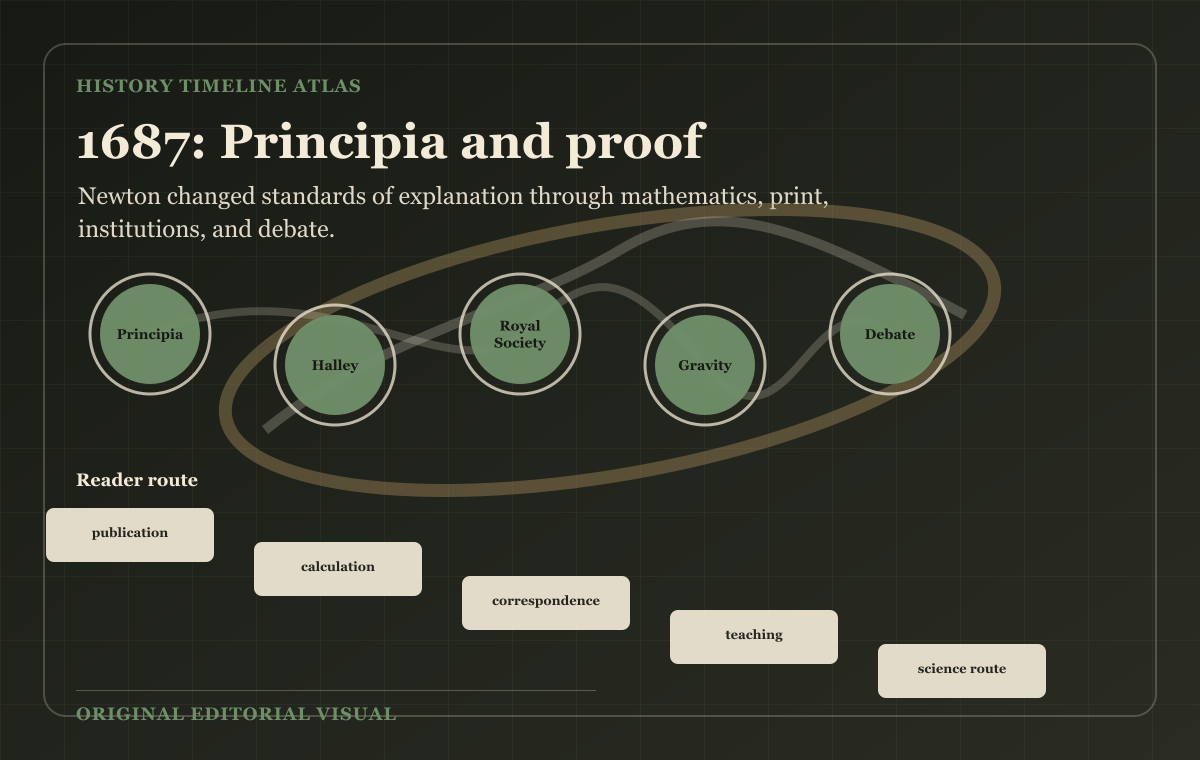
Newton's Principia makes 1687 a year about publication, mathematics, and a new standard for explaining nature. The book did not appear from nowhere. It followed earlier work by Copernicus, Galileo, Kepler, Descartes, Huygens, Hooke, Halley, and many others who had changed the questions natural philosophers could ask.
The year is concrete because a book entered public argument. Laws of motion and universal gravitation gave readers a framework for linking falling bodies, planetary motion, tides, comets, and force. Mathematical demonstration became a route to authority.
Institutional context matters. Edmond Halley's encouragement, the Royal Society, print culture, correspondence, and priority disputes shaped how Newton's work was completed and received. Scientific change depended on people, money, presses, and credibility as well as ideas.
1687 also helps readers avoid a lonely-genius story. Newton's achievement was extraordinary, but it belonged to a network of instruments, observations, inherited problems, rivals, editors, and later teachers who made the work usable.
The reading path should move from Principia to the Enlightenment, navigation, engineering, astronomy, and later physics. The date matters because it changed the relationship between nature, mathematics, and public knowledge.
The year is also about persuasion. A difficult Latin book full of geometry did not become influential simply by existing. Readers, translators, teachers, correspondents, and institutions had to make its methods teachable and authoritative. That process helps students see scientific revolution as communication and training, not only as discovery.
1687 should keep disagreement visible too. Newton's work entered a world of rival mechanical philosophies, debates over action at a distance, theological assumptions, and questions about what counted as a legitimate cause. The Principia became durable partly because later readers could use its mathematics even while continuing to argue over metaphysics.
The date also belongs to global history rather than only to English intellectual life. Navigation, astronomy, artillery, surveying, calendars, engineering, and later industrial technology all depended on increasingly precise relationships between observation, calculation, and prediction. The route from a learned book to practical authority was long, but 1687 became one of the dates later readers use to mark that shift.
A good next path moves from 1687 to Galileo, Kepler, Newton, the Enlightenment, the Industrial Revolution, and modern science. The comparison with Darwin is especially useful: Newton helps readers see mathematical law and prediction, while Darwin helps them see historical evidence, variation, and deep time. Together they show that science changes not only answers, but standards for explanation.
The book's limits also matter. The Principia did not give modern physics in finished form, and it did not end disputes about force, matter, God, or method. Its importance lies in resetting the standard of argument so powerfully that later thinkers had to answer it.
1687 CE in History gathers events that help readers move from a single date into wider historical patterns. A useful year entry does more than answer what happened; it shows why people keep using the year as a marker for change.
The connected events show how decisions, institutions, conflicts, ideas, and consequences crossed beyond one location or one person. The event links explain the immediate story, while the topic routes and timelines show what came before and after.
The year also helps organize broad questions. It gives readers a concise answer and a direct path into deeper event pages where causes, turning points, consequences, maps, and references are easier to inspect.
Read the date in three passes. First ask what happened inside the year itself. Then ask which older pressures made the event possible. Finally ask which later pages reuse the same vocabulary, institutions, borders, technologies, or memories. That sequence keeps the page from becoming a trivia answer.
Even when only one event is currently attached, the year still has a job: it gives students and curious visitors a stable chronological doorway into the atlas. The page makes the doorway useful by pointing to the event, the topic route, the timeline, the map, and the evidence trail that can turn a date into a broader explanation.
This year matters because it connects Newton Publishes Principia to a wider sequence of causes and consequences. It gives the reader a chronological anchor while still pointing outward to people, places, institutions, and later effects. A thin year page would only name the event; a useful year page explains why this date is a handle for a larger route through history. 1687 matters because it marks a moment when mathematical physics became a durable language for explaining the natural world. The Principia did not end debate, but it reset expectations: a strong explanation could be expressed through laws, calculation, and prediction. The year belongs to science history and to the wider history of institutions that make knowledge credible.
Reader Lenses
Look for the pressures that made change possible.
Identify who acted and what options were available.
Follow what changed after the event.
Ask why this date still appears in historical summaries.
Treat the book as a public event shaped by editing, funding, print, and learned societies.
Ask how calculation changed the authority of natural philosophy.
Look for predecessors, rivals, correspondents, instruments, and later teachers.
How This Year Connects
1687 CE in History is anchored by Newton Publishes Principia. Read those pages together and the year stops being a date label; it becomes a crossroads where immediate choices met older pressures and opened later consequences.
The setting matters as much as the date. The year moves through London and belongs to Early Modern World. That combination helps readers avoid treating the year as isolated; geography, institutions, conflict, belief, economy, and communication all shape what a date can mean.
The year also opens into people and themes. Figures such as Isaac Newton appear because their choices made the year visible, while themes such as Science, Physics, and Ideas explain why the consequences outlived the moment. A useful next step is usually an event page, then a topic route, then a timeline.
Evidence changes the way a date reads. A treaty, battle report, inscription, newspaper, census, court record, memoir, photograph, or archaeological trace does not answer the same question. Looking at source type helps separate what happened in the year from how later people remembered it.
A year page is most useful when it keeps two scales open at once. The first scale is immediate: what happened, where, and who was involved. The second scale is interpretive: why later readers use this date to organize a wider story. Holding both scales together makes the page a starting point for deeper reading rather than a dead-end answer.
The before-and-after frame matters too. A date rarely begins the forces it reveals. Earlier pressures made the linked event possible, while later pages show which effects were temporary, which became institutions, and which turned into memory. Reading the year this way helps students avoid the false impression that history changes only when the calendar flips.
Use this page as a junction. If the event feels too brief, follow the topic route for background; if the cause feels too abstract, open the event page for sequence; if the consequence feels larger than the date, move into the timeline. The value of a year page is that it lets readers change scale without losing their place.
Events in This Year
- 1687 CENewton Publishes Principia
Isaac Newton published the Principia, presenting laws of motion and universal gravitation in a mathematical framework.
Map Layer
1687 CE in History geography
Gold pins mark the approximate locations of published event pages. This is a schematic locator map, not a historical border map.
Coordinates are approximate and are used to help readers orient themselves before opening a full event page.
References
Where to Check the Facts
- Encyclopaedia Britannica: Isaac NewtonSpecific reference for the 1687 CE anchor event, chronology, and historical setting.
- Encyclopaedia BritannicaBackground reference for chronology, names, and historical context.
- WikidataStructured reference for dates, places, alternate names, and entity links.