How to Read the Year
Why does 202 BCE mark both the end of civil war and the beginning of Han rule?
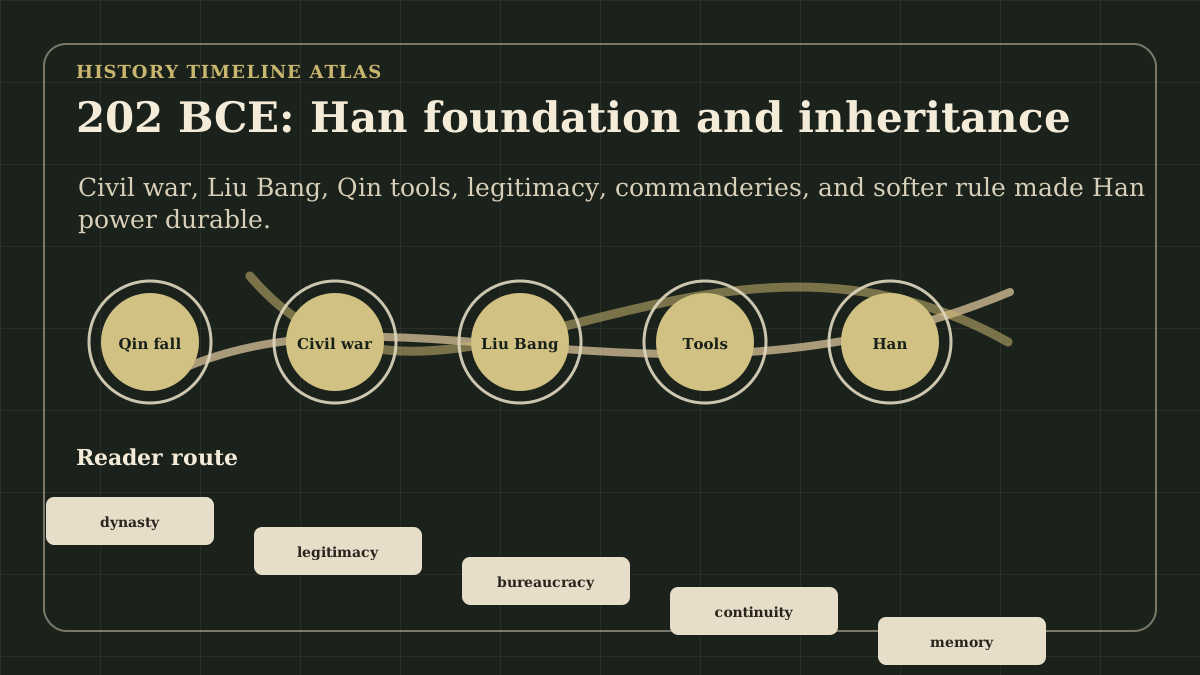
202 BCE is remembered because Liu Bang defeated Xiang Yu and founded the Han dynasty after the collapse of Qin. The year matters as a state-formation moment: a harsh unifying empire had fallen, civil war had tested rival leaders, and a new dynasty had to decide what to keep from Qin and what to soften.
The Chu-Han struggle was not only a duel between personalities. It involved armies, regional loyalties, supply, elite alliances, political reputation, and the problem of ruling a formerly unified realm. Liu Bang's victory mattered because he could translate military success into dynastic legitimacy.
Han rule did not simply reject Qin. It inherited centralized administration, commanderies, legal habits, roads, weights, and imperial ambition while presenting itself as less brutal and more sustainable. That mixture explains why the Han became a long-lasting model in Chinese history.
The year also helps readers compare dynasty and institution. Qin as a ruling house failed quickly, but many tools of imperial governance survived. Han success came from adapting those tools to a different political language and a broader coalition of support.
Liu Bang's social background makes the year more readable. He was not an old aristocratic conqueror in the same mold as many rivals, and later memory used that fact to tell a story about practical rule, flexibility, and the ability to recruit talent. The biography of a founder and the institution of a dynasty reinforce one another here.
The year points forward to Emperor Wu, Silk Road connections, Confucian statecraft, frontier policy, and the long use of Han identity in Chinese history. The date is an opening chapter, not the whole explanation.
Xiang Yu remains visible because Liu Bang's victory makes sense only beside a rival whose military charisma, regional base, and political choices shaped the civil war. Dynastic beginnings are usually made against alternatives that almost won.
The everyday stakes were administrative as well as military. Farmers, conscripted workers, local officials, surrendered soldiers, and regional elites needed a regime that could reduce disruption without abandoning imperial order. That practical need explains why Han legitimacy rested on both mercy language and the continued machinery of government.
202 BCE in History gathers events that help readers move from a single date into wider historical patterns. A useful year entry does more than answer what happened; it shows why people keep using the year as a marker for change.
The connected events show how decisions, institutions, conflicts, ideas, and consequences crossed beyond one location or one person. The event links explain the immediate story, while the topic routes and timelines show what came before and after.
The year also helps organize broad questions. It gives readers a concise answer and a direct path into deeper event pages where causes, turning points, consequences, maps, and references are easier to inspect.
Read the date in three passes. First ask what happened inside the year itself. Then ask which older pressures made the event possible. Finally ask which later pages reuse the same vocabulary, institutions, borders, technologies, or memories. That sequence keeps the page from becoming a trivia answer.
Even when only one event is currently attached, the year still has a job: it gives students and curious visitors a stable chronological doorway into the atlas. The page makes the doorway useful by pointing to the event, the topic route, the timeline, the map, and the evidence trail that can turn a date into a broader explanation.
This year matters because it connects Han Dynasty Founded to a wider sequence of causes and consequences. It gives the reader a chronological anchor while still pointing outward to people, places, institutions, and later effects. A thin year page would only name the event; a useful year page explains why this date is a handle for a larger route through history. 202 BCE matters because it shows how a new dynasty can inherit the machinery of a defeated regime while changing the story told about power. The Han foundation helps readers understand Chinese imperial continuity: conquest, civil war, bureaucracy, legitimacy, and memory did not reset from zero after Qin collapse. The date is a compact lesson in successor rule, political adaptation, durable institutions, and historical identity. That makes the year useful for students comparing collapse, succession, administrative continuity, and the later memory of Han as both dynasty and identity.
Reader Lenses
Look for the pressures that made change possible.
Identify who acted and what options were available.
Follow what changed after the event.
Ask why this date still appears in historical summaries.
Ask how victory in civil war became a claim to rule all under heaven.
Separate rejection of Qin brutality from survival of Qin administrative tools.
Track how a founder makes a new dynasty feel lawful after disorder.
How This Year Connects
202 BCE in History is anchored by Han Dynasty Founded. Read those pages together and the year stops being a date label; it becomes a crossroads where immediate choices met older pressures and opened later consequences.
The setting matters as much as the date. The year moves through Chang'an and belongs to Classical Antiquity. That combination helps readers avoid treating the year as isolated; geography, institutions, conflict, belief, economy, and communication all shape what a date can mean.
The year also opens into people and themes. Figures such as Liu Bang appear because their choices made the year visible, while themes such as China, Han Dynasty, and Empire explain why the consequences outlived the moment. A useful next step is usually an event page, then a topic route, then a timeline.
Evidence changes the way a date reads. A treaty, battle report, inscription, newspaper, census, court record, memoir, photograph, or archaeological trace does not answer the same question. Looking at source type helps separate what happened in the year from how later people remembered it.
A year page is most useful when it keeps two scales open at once. The first scale is immediate: what happened, where, and who was involved. The second scale is interpretive: why later readers use this date to organize a wider story. Holding both scales together makes the page a starting point for deeper reading rather than a dead-end answer.
The before-and-after frame matters too. A date rarely begins the forces it reveals. Earlier pressures made the linked event possible, while later pages show which effects were temporary, which became institutions, and which turned into memory. Reading the year this way helps students avoid the false impression that history changes only when the calendar flips.
Use this page as a junction. If the event feels too brief, follow the topic route for background; if the cause feels too abstract, open the event page for sequence; if the consequence feels larger than the date, move into the timeline. The value of a year page is that it lets readers change scale without losing their place.
Read 202 BCE beside Qin unification, Qin Shi Huang, and Han dynasty pages. That order shows how short-lived conquest could produce long-lived institutions.
Then compare with 476, 1453, and 1917. Each date asks what survives when a regime falls and what a successor must change to govern.
Events in This Year
- 202 BCEHan Dynasty Founded
Liu Bang founded the Han dynasty after the fall of Qin rule, creating a long-lasting imperial order that balanced central authority with political adaptation.
Map Layer
202 BCE in History geography
Gold pins mark the approximate locations of published event pages. This is a schematic locator map, not a historical border map.
Coordinates are approximate and are used to help readers orient themselves before opening a full event page.
References
Where to Check the Facts
- Encyclopaedia Britannica: Han dynastySpecific reference for the Han founding frame and the 202 BCE transition after Qin rule.
- World History Encyclopedia: Han DynastyNarrative reference for Han chronology, Liu Bang's founding, and the dynasty's role after Qin.