Historical Role
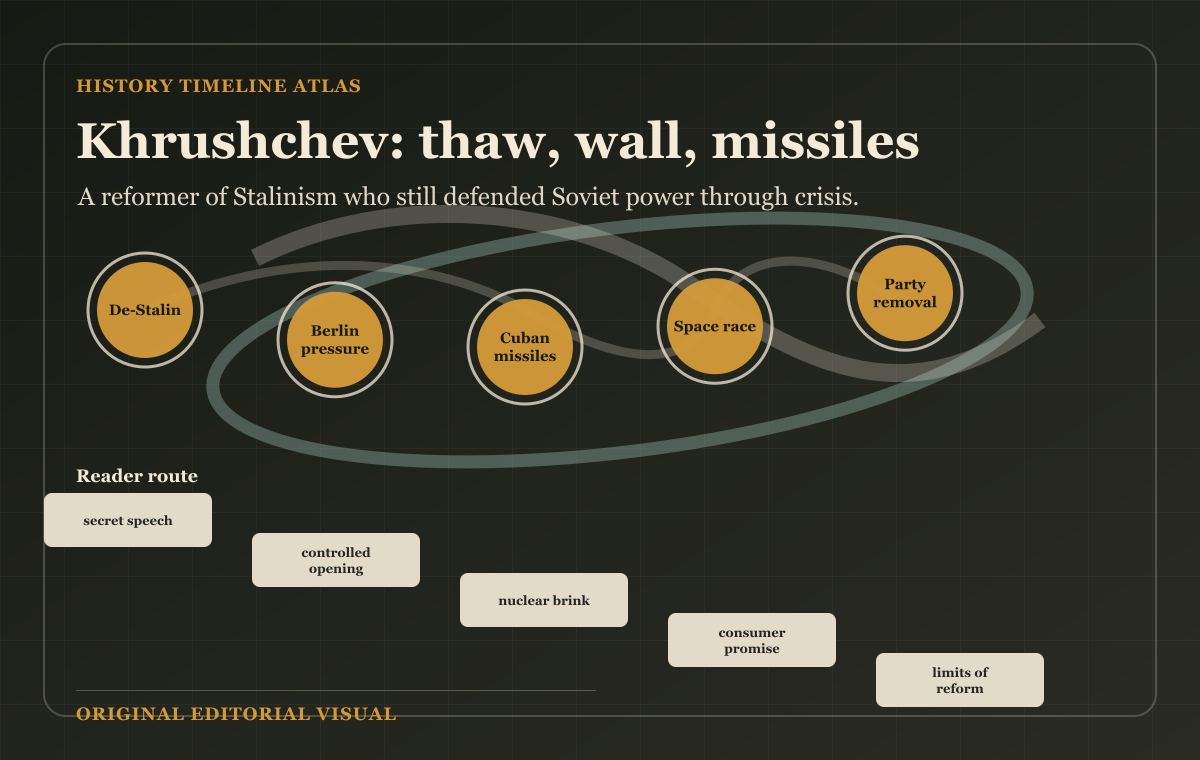
Nikita Khrushchev's biography sits between Stalin's terror and the later Cold War world of walls, missiles, space competition, and unstable reform. He did not simply inherit Soviet power. He tried to redefine it after Stalin by attacking the cult of personality, releasing some pressure inside the system, and proving that Soviet socialism could compete with the United States without permanent mass terror.
The Secret Speech of 1956 is the key interpretive doorway even when the page's linked events begin later. By denouncing Stalin's crimes to party audiences, Khrushchev opened a controlled critique that could not remain completely controlled. De-Stalinization changed prisons, memory, party legitimacy, cultural life, and the expectations of people who hoped reform might go further.
The same leader who loosened some controls also used force and pressure to defend Soviet power. Hungary in 1956, Berlin crises, pressure on Eastern Europe, and the construction of the Berlin Wall reveal the limits of the thaw. Khrushchev challenged Stalin's model, but he did not abandon the Soviet sphere or the one-party system that held it together.
The Cuban Missile Crisis gives the biography its most dangerous scene. Khrushchev tried to alter the strategic balance by placing nuclear missiles in Cuba, partly in response to U.S. pressure, NATO missiles, and the defense of a revolutionary ally. The crisis showed how secrecy, prestige, fear, and nuclear weapons could bring leaders close to catastrophe before compromise became possible.
Domestic reform keeps the page from becoming only Cold War theater. Housing campaigns, agricultural experiments, Virgin Lands, consumer promises, education, party reorganization, and uneven economic results shaped Soviet daily life. Khrushchev wanted communism to feel modern and materially credible, but improvisation and overpromising often weakened his authority.
The space race made that promise visible. Sputnik, Yuri Gagarin, missile boasts, industrial exhibitions, and kitchen-debate consumer comparisons all helped Khrushchev present socialism as a future-facing system. Yet spectacle also created pressure. If Soviet modernity was supposed to feed people, house families, master technology, and deter the United States, then shortages, crop failures, and bureaucratic confusion became political evidence against his style of rule.
Khrushchev also belongs in a wider communist world, not only a U.S.-Soviet rivalry. The Sino-Soviet split, arguments with Mao, debates over peaceful coexistence, and competition for revolutionary leadership showed that communism was not a single obedient bloc. His criticism of Stalin and search for coexistence could look necessary in Moscow, dangerous in Beijing, and uncertain to movements watching both powers.
The U-2 crisis adds another useful scene because it shows how quickly diplomacy could be wrecked by secrecy and surveillance. A hoped-for summit collapsed after the American spy plane was shot down over Soviet territory. For readers, the episode connects Khrushchev's public bluster with the quieter machinery of reconnaissance, mistrust, and prestige that made Cold War negotiation so brittle.
That brittle diplomacy is why Khrushchev works well as a reader bridge between Stalin and later detente. The world after him still had nuclear danger, censorship, and imperial pressure, but it also had habits of summitry, hotline management, and crisis bargaining that made superpower conflict more procedural than the terror politics he had helped expose.
His removal in 1964 closes the biography with a lesson about party power. Khrushchev had survived the post-Stalin struggle, but he did not create secure personal rule. Colleagues could present him as erratic, risky, and administratively disruptive. The end of his career shows that Soviet leadership after Stalin was less murderous than before, but still deeply controlled by party hierarchy.
Nikita Khrushchev helps connect individual action with wider historical change in Soviet Union. The biography works best when it keeps the surrounding world visible: authority, conflict, belief, reform, or discovery moved through decisions made under pressure.
The related events show how roles such as Soviet leader can be read through dates, places, institutions, and consequences rather than through reputation alone. The biography explains why this person matters, while the linked events explain what changed around them.
A richer reading starts with the limits around the person. Some figures acted through offices, armies, courts, laboratories, churches, parties, ships, trade networks, or protest movements; others became important because later communities turned their lives into symbols. The page therefore asks what this person could actually change, what was already moving before them, and which consequences later readers attached to the name.
Read the biography against absence as well. Many lives around Nikita Khrushchev are less visible in the record: opponents, collaborators, family members, workers, soldiers, students, subjects, victims, translators, scribes, or local communities. Keeping those surrounding people in view makes the page less like a name card and more like an entry point into historical systems.
Nikita Khrushchev also works as a navigation point. Open the linked event pages to see where the biography becomes chronology, then use the topic routes to test whether the same pattern appears beyond one life. That extra step matters because historical importance is rarely contained inside a single decision; it usually spreads through institutions, witnesses, opponents, imitators, and later arguments over memory.
Sources and Method
Source trail: the biography uses Khrushchev references, Berlin Wall and Cuban Missile Crisis pages, and Cold War route sources to connect domestic de-Stalinization with international confrontation.
Method note: reform and coercion are held together. Khrushchev's thaw matters, but so do Hungary, Berlin, Cuba, agricultural pressure, and party discipline.
Evidence Notes
How Sensitive Claims Are Sourced
- 1
Thaw, walls, and missiles
Khrushchev is read through de-Stalinization, the Berlin crisis, the Cuban Missile Crisis, domestic reform campaigns, and the limits of Soviet liberalization.
Why This Person Matters
Nikita Khrushchev matters because the connected events make a larger historical pattern easier to follow. The page links biography to consequences so readers can move from a life story into the wider atlas, compare the person with contemporaries, and understand why later memory kept returning to this figure. Khrushchev matters because he makes the Cold War less static. His career links de-Stalinization, Soviet reform limits, Berlin, Cuba, nuclear risk, housing, agriculture, and the problem of proving that a command system could become humane and modern without losing control.
Can a political system criticize its own terror without opening questions that threaten its authority?
How to Read This Life
Nikita Khrushchev is easiest to understand when the biography is read beside Berlin Wall Built, Cuban Missile Crisis. Those events show the historical setting in motion: dates, places, institutions, conflict, and consequences give the life a structure that a short biography alone cannot provide.
The surrounding route crosses Cold War and locations such as Berlin, Cuba. That matters because influence rarely stays inside one person. It moves through offices, armies, movements, laws, texts, speeches, institutions, and later memory.
A useful reading path starts with the role labels, then opens the event pages to see what changed, and finally compares this person with other actors facing similar pressures.
For readers who arrive on a biography first, this page is meant to become a doorway rather than a stop. Read one paragraph for the answer, then use the turning points, topic routes, and event links to test whether the person's reputation matches the wider evidence.
Read Khrushchev beside the Berlin Wall and Cuban Missile Crisis. Those pages show how reform at home could coexist with confrontation abroad.
Then move backward to Stalin and forward to Gorbachev. The route shows three different Soviet problems: terror and mobilization, controlled thaw, and reform that eventually broke control.
Read Nikita Khrushchev through the roles of Soviet leader rather than as reputation alone.
Place the biography inside Soviet Union and the wider events linked below.
Ask which choices were personal and which were constrained by institutions or crisis.
Follow how later memory simplified, contested, or reused this person's role.
Follow de-Stalinization as a controlled opening with unpredictable consequences.
Read Berlin and Cuba through prestige, fear, alliance politics, and nuclear danger.
Ask how housing, food, consumer promises, and reform campaigns shaped Soviet legitimacy.
Legacy, Limits, and Memory
A useful biography keeps scale in view. Nikita Khrushchev mattered because individual choices met a wider structure: institutions, enemies, allies, audiences, technologies, beliefs, and inherited conflicts. The related event pages help separate personal agency from conditions that no single person controlled.
Memory is part of the biography too. Later readers often simplify a figure into a hero, villain, founder, reformer, conqueror, prophet, scientist, or symbol. Those labels can be helpful, but they become misleading when they hide conflict, compromise, exclusion, uncertainty, or the experiences of people outside the main biography.
For the next step, compare this life with a topic route rather than stopping at the name. If the same pattern appears across several figures, the reader has found a historical structure; if this person breaks the pattern, the contrast is usually where the most interesting question begins.
Khrushchev resists a clean reformer label. He exposed parts of Stalinism, reduced some terror, and opened cultural space, yet he defended Soviet power through coercion when he believed the system was threatened.
The missile crisis also needs caution. It was not only a personal duel with Kennedy. Cuba, NATO, Turkey, Soviet prestige, U.S. intelligence, naval quarantine, and back-channel bargaining shaped the outcome.
His domestic record shows how hard it was to make Soviet legitimacy material. Housing blocks, corn campaigns, consumer promises, and agricultural targets mattered because citizens judged socialism through everyday life.
Turning Points to Read Next
Berlin Wall Built
East German authorities built the Berlin Wall to stop movement from East to West Berlin, turning the city's division into concrete and barbed wire.
Cuban Missile Crisis
The United States and Soviet Union confronted each other over Soviet nuclear missiles in Cuba, bringing the Cold War close to nuclear war.
Related Timeline
- August 1961Berlin Wall Built
East German authorities built the Berlin Wall to stop movement from East to West Berlin, turning the city's division into concrete and barbed wire.
- October 1962Cuban Missile Crisis
The United States and Soviet Union confronted each other over Soviet nuclear missiles in Cuba, bringing the Cold War close to nuclear war.
References
Where to Check the Facts
- Encyclopaedia Britannica: Nikita KhrushchevBiographical reference for Nikita Khrushchev's life dates, roles, institutions, and historical setting.
- Encyclopaedia BritannicaBackground reference for chronology, names, and historical context.
- WikidataStructured reference for dates, places, alternate names, and entity links.