Historical Role
Anwar Sadat's biography sits between war, diplomacy, Egyptian state power, and Cold War realignment. He inherited Nasser's Egypt, but he did not simply continue Nasserism. Sadat had to manage military recovery after 1967, domestic legitimacy, Soviet and American pressure, the place of Islam in public politics, economic opening, and Egypt's role in the Arab world.
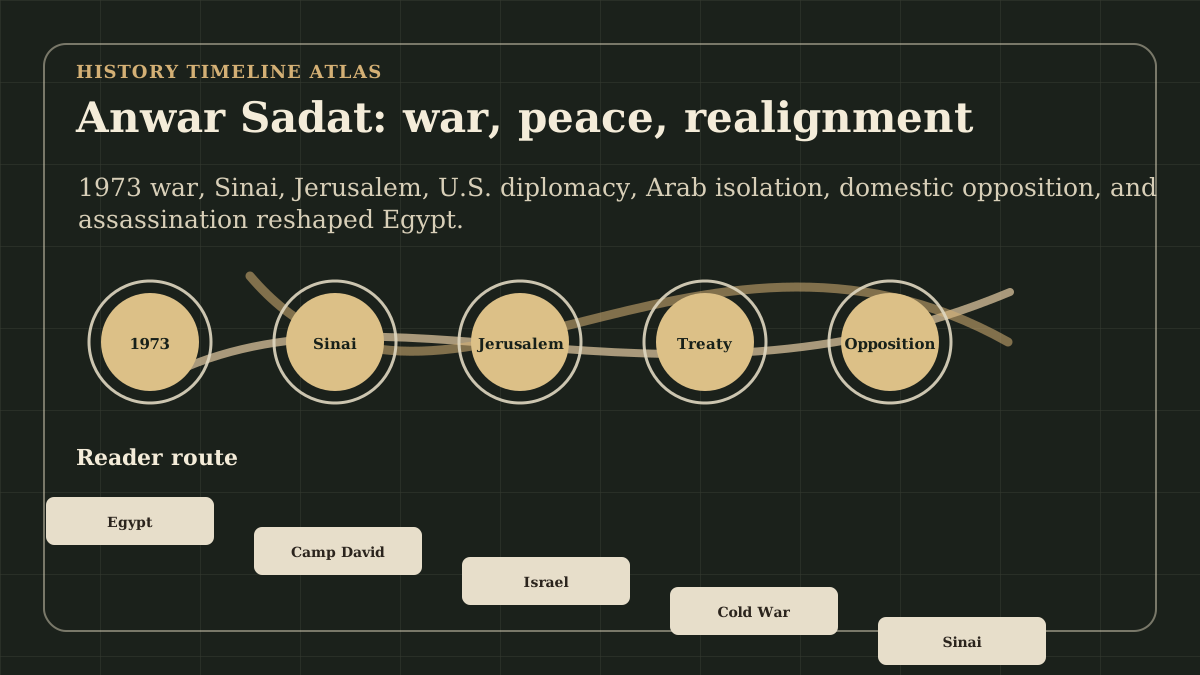
The 1973 war gives the biography a concrete hinge. Egypt's crossing of the Suez Canal restored military confidence and changed diplomatic leverage, even though the war did not end the Arab-Israeli conflict. Sadat used battlefield movement to reopen politics, then moved toward negotiations that many supporters and opponents read in very different ways.
His Jerusalem visit and peace with Israel made him one of the most consequential diplomats of the late twentieth-century Middle East. For supporters, peace recovered Sinai and broke a cycle of war. For critics, it isolated Egypt from parts of the Arab world and left Palestinian sovereignty unresolved.
Sadat's domestic record also matters. Economic infitah, repression of critics, changing relationships with Islamists, and the politics that preceded his assassination complicate any page that treats him only as peacemaker. His life shows how foreign-policy breakthroughs can coexist with domestic fragility.
The crossing of the canal was symbolic as well as military. It allowed Sadat to challenge the humiliation of 1967, speak to Egyptian morale, and create a stronger negotiating position. The point is not that war solved the conflict, but that limited war changed what diplomacy could do.
Camp David and the Egypt-Israel treaty need several audiences at once. Washington saw a diplomatic breakthrough, Israel saw a security transformation, Egypt recovered Sinai, and many Arab and Palestinian critics saw a separate peace that weakened collective pressure. The same agreement therefore produced stability, anger, and new regional alignments.
Sadat's economic opening belongs inside the biography because peace diplomacy was tied to a new idea of Egypt's future. Infitah promised investment and consumer possibility, but it also exposed inequality, price pressure, corruption claims, and disappointment among people who expected the state to provide social guarantees.
The assassination in 1981 gives the page an ending that is political rather than merely dramatic. It connects Islamist opposition, state repression, the costs of realignment, and the volatility of a regime trying to change foreign policy, economic policy, and public legitimacy at the same time.
Anwar Sadat helps connect individual action with wider historical change in Egypt. The biography works best when it keeps the surrounding world visible: authority, conflict, belief, reform, or discovery moved through decisions made under pressure.
The related events show how roles such as Egyptian president, Diplomat can be read through dates, places, institutions, and consequences rather than through reputation alone. The biography explains why this person matters, while the linked events explain what changed around them.
A richer reading starts with the limits around the person. Some figures acted through offices, armies, courts, laboratories, churches, parties, ships, trade networks, or protest movements; others became important because later communities turned their lives into symbols. The page therefore asks what this person could actually change, what was already moving before them, and which consequences later readers attached to the name.
Read the biography against absence as well. Many lives around Anwar Sadat are less visible in the record: opponents, collaborators, family members, workers, soldiers, students, subjects, victims, translators, scribes, or local communities. Keeping those surrounding people in view makes the page less like a name card and more like an entry point into historical systems.
Anwar Sadat also works as a navigation point. Open the linked event pages to see where the biography becomes chronology, then use the topic routes to test whether the same pattern appears beyond one life. That extra step matters because historical importance is rarely contained inside a single decision; it usually spreads through institutions, witnesses, opponents, imitators, and later arguments over memory.
Sources and Method
Source method: this page uses the existing Sadat biography source and modern Middle East source pack. It separates the 1973 war, Egyptian diplomacy, peace with Israel, Arab politics, and domestic governance rather than treating peace diplomacy as the whole biography.
Evidence Notes
How Sensitive Claims Are Sourced
- 1
War as diplomatic leverage
Sadat's biography links the 1973 war to later negotiation, while keeping Sinai recovery, Arab criticism, Palestinian uncertainty, U.S. diplomacy, and domestic opposition visible together.
Why This Person Matters
Anwar Sadat matters because the connected events make a larger historical pattern easier to follow. The page links biography to consequences so readers can move from a life story into the wider atlas, compare the person with contemporaries, and understand why later memory kept returning to this figure. Anwar Sadat matters because he shows how a leader can use war, diplomacy, and realignment to change a region while deepening domestic and ideological conflict at home. His page helps readers understand that peace is not a single outcome; it is also a redistribution of leverage, security, legitimacy, resentment, and unresolved claims.
What becomes clearer when this person's life is read through connected events instead of isolated biography, and where do the consequences outgrow the person?
How to Read This Life
Anwar Sadat is easiest to understand when the biography is read beside Arab Oil Embargo, Oslo Accords. Those events show the historical setting in motion: dates, places, institutions, conflict, and consequences give the life a structure that a short biography alone cannot provide.
The surrounding route crosses Cold War and Globalization, Post-Cold War and locations such as Middle East and global oil markets, Oslo and Washington. That matters because influence rarely stays inside one person. It moves through offices, armies, movements, laws, texts, speeches, institutions, and later memory.
A useful reading path starts with the role labels, then opens the event pages to see what changed, and finally compares this person with other actors facing similar pressures.
For readers who arrive on a biography first, this page is meant to become a doorway rather than a stop. Read one paragraph for the answer, then use the turning points, topic routes, and event links to test whether the person's reputation matches the wider evidence.
Read Sadat beside the Arab Oil Embargo, Suez Crisis, Oslo Accords, and modern Middle East routes. The path shows how Egypt moved from Nasser-era confrontation into a new diplomatic order.
Compare him with Nasser, Khomeini, Arafat, and Begin where available. The comparison asks how leaders used war memory, sovereignty, religion, and diplomacy to remake public legitimacy.
Read Anwar Sadat through the roles of Egyptian president, Diplomat rather than as reputation alone.
Place the biography inside Egypt and the wider events linked below.
Ask which choices were personal and which were constrained by institutions or crisis.
Follow how later memory simplified, contested, or reused this person's role.
Follow how the 1973 war changed leverage before negotiation changed alliances.
Track Egypt's movement between Soviet ties, U.S. diplomacy, Arab politics, and Israeli peace.
Keep economic opening, repression, Islamists, and assassination in view beside diplomacy.
Legacy, Limits, and Memory
A useful biography keeps scale in view. Anwar Sadat mattered because individual choices met a wider structure: institutions, enemies, allies, audiences, technologies, beliefs, and inherited conflicts. The related event pages help separate personal agency from conditions that no single person controlled.
Memory is part of the biography too. Later readers often simplify a figure into a hero, villain, founder, reformer, conqueror, prophet, scientist, or symbol. Those labels can be helpful, but they become misleading when they hide conflict, compromise, exclusion, uncertainty, or the experiences of people outside the main biography.
For the next step, compare this life with a topic route rather than stopping at the name. If the same pattern appears across several figures, the reader has found a historical structure; if this person breaks the pattern, the contrast is usually where the most interesting question begins.
Sadat's memory depends heavily on where the reader stands. Egyptian national recovery, Arab solidarity, Israeli security, Palestinian dispossession, U.S. diplomacy, and domestic opposition all produce different evaluations.
The biography becomes stronger when peace is not treated as a single moral label. Peace was a diplomatic achievement, a strategic realignment, a domestic political gamble, and an unresolved regional argument.
Turning Points to Read Next
Arab Oil Embargo
Arab oil producers restricted shipments during the 1973 Arab-Israeli war, turning energy supply into a global diplomatic and economic crisis.
Oslo Accords
The Oslo Accords created a formal peace process between Israel and the Palestine Liberation Organization after mutual recognition and secret negotiations.
Related Timeline
- 1973-1974 CEArab Oil Embargo
Arab oil producers restricted shipments during the 1973 Arab-Israeli war, turning energy supply into a global diplomatic and economic crisis.
- 1993 CEOslo Accords
The Oslo Accords created a formal peace process between Israel and the Palestine Liberation Organization after mutual recognition and secret negotiations.
References
Where to Check the Facts
- Encyclopaedia Britannica: Anwar SadatBiographical reference for Sadat, war, and diplomacy.
- Encyclopaedia Britannica: Arab oil embargoReference for the 1973-1974 embargo and its energy, diplomatic, and economic consequences.