Practical guide
Why Are VE Day and Victory Day on May 8 and May 9?
V-E Day on 8 May and Soviet Victory Day on 9 May refer to the defeat of Nazi Germany through different parts of the surrender and commemoration sequence. The Reims instrument was signed on 7 May, another signing took place in Berlin on 8 May, and a late-evening Central European reference time falls on 9 May in Moscow. The calendar explains part of the difference; the Soviet objections to Reims and the Berlin ceremony also matter.
The short answer: distinguish four kinds of date
There is no need to choose one date and declare every other label false. A surrender can have a signature date, a specified military deadline, an announcement date and a commemorative anniversary. These may overlap, but they answer different questions. The first Reims signature on 7 May does not cancel V-E Day on 8 May; the Moscow calendar date does not turn the Western Allied observance into a mistake.
The US National Archives’ surrender record gives the Reims text and explains the further Berlin signing. The National WWII Museum’s V-E Day account describes the two signatures, the victory announcement, the Soviet date and the continuing Pacific war. Read those historical explanations together with the worked clock conversion below. A two-hour difference explains a date boundary; it does not replace the explanation of why the Berlin ceremony mattered.
This guide concentrates on Germany’s surrender in Europe and the meaning of the two anniversaries. It also separates them from EU Europe Day, which falls on 9 May but commemorates a 1950 declaration. For a broader account of the war’s ending and consequences, use the end of World War II event page. For the difference between surrender and a peace treaty, continue to the four-term military-ending guide.
Timeline: what happened, what the document says, and what is remembered
| Date | What is being dated | Meaning | Source and limit |
|---|---|---|---|
| 7 May 1945, 02:41 | Reims signing | Jodl signed the surrender instrument on behalf of the German High Command. | D1 transcript: the signature line gives 0241, but does not specify its time zone. |
| 8 May 1945 | Berlin signing | A further surrender instrument was signed in Berlin after Soviet objections to the Reims arrangements. | D1 institutional introduction and D2; no exact Berlin signing hour is asserted here. |
| 8 May 1945, 23:01 | Military deadline in the Reims text | The instrument ordered German-controlled forces to cease active operations at this stated time. | D1, paragraph 2: the document explicitly labels its time Central European time. |
| 8 May 1945 | V-E Day in the Western Allied account | Truman proclaimed victory in Europe; people celebrated in places including London and New York. | D2; an announcement and commemoration date, not a claim that every celebration began simultaneously. |
| 9 May 1945 | Soviet victory commemoration | The Soviet victory date followed the Berlin signing and the later calendar date in Moscow. | D1–D2 for the surrender sequence; D4 for the Moscow offset used in the worked conversion. |
| 9 May 1950 | Schuman Declaration | The declaration proposed deeper European cooperation; the EU commemorates it as Europe Day. | D3; a different event in a different year, not another name for German surrender. |
The table is a selected sequence rather than a minute-by-minute reconstruction of every military order. Its Berlin row deliberately gives a date without supplying a signing hour that the linked accounts do not establish here. Its Reims row preserves the hour printed in the transcript while leaving its unstated time zone unstated. Those gaps are more informative than a neat timeline filled with unsupported precision.
The announcement and celebration row also has a different job from the operative-deadline row. D2 describes people celebrating in some places after news on 7 May, before the formal 8 May announcement. Public knowledge, official announcements and military instructions need not begin at the same instant. When a photograph says “V-E celebrations,” check where it was taken and its own caption date rather than assigning every photograph the time in a surrender clause.
Reims, 7 May: signing is not the same as the military deadline
The Reims instrument records a signature at 0241 on 7 May 1945. Alfred Jodl signed on behalf of the German High Command. The document submitted German-controlled land, sea and air forces to unconditional surrender to the Allied Expeditionary Force and the Soviet High Command. It was a military instrument with instructions for forces, rather than a general declaration that every consequence of war had ended.
Paragraph 2 ordered German-controlled forces to cease active operations at a named future time:
“at 2301 hours Central European time on 8 May”
That short quotation is from D1, paragraph 2 of the transcript. The date in the signature line is 7 May; the operative deadline in the clause is late on 8 May. Keeping both dates allows a reader to explain the document rather than treating its later deadline as evidence that its earlier signature could not have happened.
Other clauses help identify its purpose. The text required further orders to be followed and warned that the Allied commanders could take measures if the High Command failed to act. It also contemplated replacement by a general instrument of surrender imposed by or on behalf of the United Nations. That wording belongs to the text’s wartime Allied setting; it should not be casually turned into a claim that the later UN organisation had negotiated an ordinary peace treaty at Reims.
The signature line does not attach an explicit zone label to 0241. Paragraph 2 does attach Central European time to 2301. When building a timeline, carry a label only as far as the source supports it. The worked conversion in this article therefore converts the expressly labelled deadline, not the unlabelled signature hour.
Berlin, 8 May: why a second signing matters
The National Archives’ introduction explains that Soviet military leaders objected to the Reims arrangements. It describes concerns about the form and authority of the surrender and the possibility of a separate peace. Another signing in Berlin, with additional provisions, followed on 8 May. The museum account identifies Wilhelm Keitel as signing the further instrument there at Soviet request.
This sequence prevents a misleading shortcut: “Germany signed only once, and people in Moscow merely changed the date on their clocks.” The record includes two signing occasions. The further ceremony in the defeated German capital mattered to Soviet recognition of the surrender. The museum connects the Soviet victory date to that Berlin signing, while the Western Allied announcement used 8 May.
The documents and ceremonies nevertheless concern Germany’s surrender within the same final European defeat, not two separate wars ending on consecutive dates. A reader can recognise the relationship without flattening the instruments into identical events or treating one commemoration as a clerical error. In a classroom comparison, ask what each caption dates: the Reims instrument, the Berlin instrument, the military deadline, or the anniversary.
The linked historical accounts do not supply a verified exact Berlin signing hour in the passages used here. This guide does not manufacture one from the date of the ceremony or borrow the Reims clause’s 23:01 deadline as if it were a Berlin signature timestamp. If another source gives an hour, inspect that source’s document, clock label and meaning before combining the figures.
The clock diagram: cross midnight without changing the instant
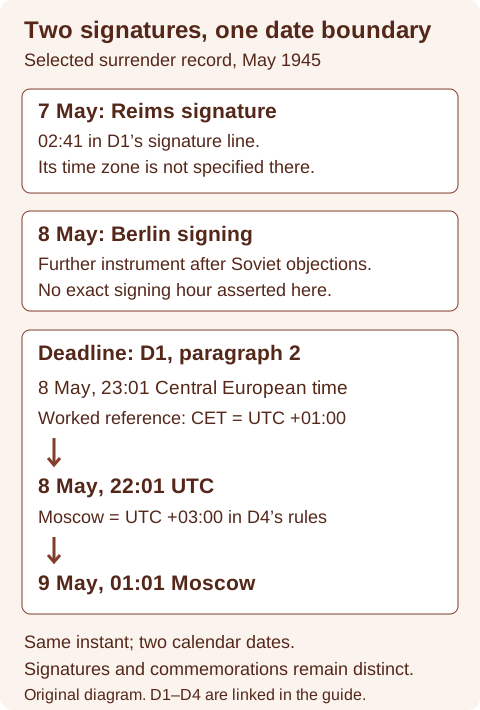
Start with the document’s labelled time: 8 May 1945 at 23:01 Central European time. For this worked conversion, interpret CET as the standard reference UTC +01:00. The Europe/Moscow entry and Russia rules in the IANA Time Zone Database Europe file represent Moscow at UTC +03:00 during this period. The listed Russian daylight-saving rules end in 1921 and do not resume until 1981, so the 1945 Moscow calculation does not add a further summer hour.
8 May, 23:01 at UTC +01:00
minus 1 hour = 8 May, 22:01 UTC
plus 3 hours = 9 May, 01:01 Moscow
Net difference: Moscow is 2 hours ahead.
Midnight is a boundary between calendar dates, not a gap between two instants. The calculated Moscow clock passes that boundary while the CET reference remains on 8 May. That is how the same late-evening reference time can be associated with consecutive dates.
Be careful with place names and abbreviations. CET is not CEST: a +01:00 standard reference is different from a +02:00 summer reference. Wartime civil clocks had their own historical rules. Replacing the document’s label with a present-day “Berlin time” setting, or assuming that every European clock used the same offset, changes the input. This diagram does neither. It converts the specified reference and states both offsets so the arithmetic can be checked.
The database is a technical representation of historical clock rules, not the surrender document and not an account of Soviet commemorative policy. Its use here is narrow: supporting the Moscow offset in an explicit calculation. The historical explanation still needs the Reims objections, Berlin signing and victory announcements. A successful time conversion cannot settle all questions of ceremony, political memory or documentary authority.
What V-E Day marks—and what it does not finish
V-E means Victory in Europe. D2 describes Truman’s 8 May proclamation and celebrations in New York and London, while making clear that the war in the Pacific continued. Fighting at Okinawa was still under way. Germany’s defeat was an enormous military ending, but it was not a worldwide cessation of the war against Japan.
Similarly, a surrender anniversary does not claim that every prisoner had returned home, every displaced person had found safety, or every occupied territory had reached a settled political future. Those are different historical questions. A surrender instrument primarily addresses forces and their compliance; a commemorative label selects an event to remember. Neither label alone supplies a complete account of civilian recovery.
The contrast between celebrations and continuing war helps explain why an anniversary can carry both relief and grief. D2 records mass celebrations, but also notes the losses and the further struggle against Japan. It is reasonable to describe joy at German defeat without implying that all people experienced the same day in the same way. A public celebration photograph captures a particular place and moment; it is not a survey of all wartime experiences.
For orientation, read the World War II timeline and World Wars and Postwar Order topic. Use the date guide for its precise question, then return to those wider routes for the sequence and aftermath. This avoids asking one anniversary to stand in for an entire global history.
Why EU Europe Day also falls on 9 May
EU Europe Day commemorates the Schuman Declaration of 9 May 1950. The European Union’s own Europe Day page explains that Robert Schuman’s speech and proposal for deeper cooperation helped lay the foundations for the later Union. That event occurred five years after the surrender sequence discussed here.
A calendar entry titled only “Europe Day” can therefore confuse a reader looking for victory commemorations. Add the full name and historical year: “EU Europe Day—Schuman Declaration, 9 May 1950” or “Victory Day—defeat of Nazi Germany, May 1945,” depending on the occasion. The identical month and day are not evidence that the two events are interchangeable.
The EU page describes Europe Day programmes at institutions and across member countries. It does not establish one uniform public-holiday rule for every country. For travel, opening hours or an event you plan to attend, consult the organiser’s current programme and the relevant local calendar. A 2026 institutional event time cannot verify a 1945 surrender timestamp; each record answers its own question.
A five-question checklist for anniversary captions
- What action is dated? Name the signature, operative deadline, announcement or anniversary. Avoid the undifferentiated word “ended” when the distinction matters.
- Which document or place? Identify Reims or Berlin, and cite the relevant record rather than merging their details into one imagined signature.
- Does the source specify a clock? Preserve a supplied label. If it is absent, say so; do not transfer a zone label from another clause without evidence.
- What geographical scope? Specify Germany’s defeat and victory in Europe. Check any separate claim about the Pacific war against its own source.
- What occasion is observed today? Include the name and year being remembered. Check a current organiser for practical dates, venues and opening hours.
Try the checklist on a caption such as “Germany surrendered on 9 May, ending all fighting.” It needs several repairs: an identified instrument or commemoration, a distinction between signature and deadline, and a European rather than global claim. A stronger short version is: “Victory Day commemorates Germany’s defeat in May 1945; the surrender sequence included Reims on 7 May and Berlin on 8 May, while the Moscow calendar crossed into 9 May.” Expand the clock explanation only if the caption has room to state its reference.
Six source questions with worked answers
Answer these before opening each explanation. Use D1 for the document’s wording, D2 for the surrender and celebration account, D3 for Europe Day, and D4 for the historical Moscow rule. The exercise is to keep dates attached to their evidence, not to memorise one number and discard the rest.
Case 1
A label says “Germany surrendered on 7 May.” Does that make an 8 May V-E Day label wrong?
Show answer and explanation for case 1
No. The first label can refer to the Reims signature; the second can refer to the victory announcement and commemoration.
D1 distinguishes the instrument signed at Reims on 7 May from its requirement to cease operations at 23:01 Central European time on 8 May. D2 describes the Berlin signing and Western Allied victory announcement on 8 May. A label becomes misleading when it fails to say which action it dates. Improve it to “Reims surrender instrument signed, 7 May 1945” or “V-E Day, 8 May 1945.” Do not change a verified signature date just to make every caption match the anniversary.
Case 2
Can the 02:41 signature time be converted to Moscow by copying the time-zone label from paragraph 2?
Show answer and explanation for case 2
No. The signature line and the military deadline are separate pieces of the document.
The transcript supplies 0241 on 7 May in the signature line. Paragraph 2 supplies 2301 Central European time on 8 May for the cessation of active operations. A time-zone label attached to one clause is not automatically attached to every other number on the page. For the Reims signature, this guide preserves the stated hour and date without claiming a separately verified zone. For the operative deadline, it shows a conversion with explicitly identified offsets. This is an evidence distinction rather than an assertion that the two clocks necessarily differed.
Case 3
Under the worked CET +01:00 and Moscow +03:00 assumptions, what is 8 May at 23:01 in Moscow?
Show answer and explanation for case 3
9 May at 01:01. The destination clock is two hours ahead and crosses midnight.
Subtract one hour from 23:01 to obtain 22:01 UTC on 8 May. Add three hours to obtain 01:01 on 9 May. The instant stays the same; the calendar date changes. D4 supplies the historical Moscow zone entry and Russia rules used for the +03:00 offset. The input is the document’s expressly stated Central European time, interpreted as the standard +01:00 reference. Do not silently replace it with a modern Europe/Berlin setting, call it summer time, or claim that this arithmetic by itself explains the Soviet choice of commemoration.
Case 4
A caption says “The Soviets had a different date only because their clocks were ahead.” What evidence is missing?
Show answer and explanation for case 4
It omits the objections to Reims and the further Berlin signing, which are part of the historical explanation.
D1 describes Soviet dissatisfaction with the Reims arrangements and the requirement for another signing in Berlin. D2 connects the Soviet victory date with that Berlin ceremony. A clock calculation explains how a late-evening reference time can fall on the next Moscow date. It does not explain why another instrument was required, which representatives were present, or why a state selected one anniversary. Repair the caption by mentioning both the surrender sequence and the date boundary. Do not invent an exact Berlin signing hour to make a simplified story look complete.
Case 5
A museum label reads “World War II ended everywhere on 8 May 1945.” How should it change?
Show answer and explanation for case 5
Specify the European victory and Germany’s defeat. The war against Japan was still continuing.
D2 explicitly separates victory in Europe from the continuing Pacific war, including fighting at Okinawa. A regional military ending is not automatically the end of the entire world war, the return of every prisoner, or a completed peace settlement. “Victory in Europe marked Germany’s defeat in May 1945; the war against Japan continued” keeps the distinction visible. If a display also gives a later Japanese surrender date, that additional date needs its own source and event label. This exercise does not infer a worldwide ending from an anniversary name.
Case 6
Both a Victory Day event and an EU Europe Day event are advertised for 9 May. Do they commemorate the same event?
Show answer and explanation for case 6
No. Victory Day concerns the 1945 defeat of Nazi Germany; EU Europe Day commemorates the Schuman Declaration of 9 May 1950.
D3 identifies the declaration, its date, and its role in the development of European cooperation. D1–D2 address German surrender in May 1945. The shared month and day do not erase the five-year difference or the different purpose of the occasions. A calendar or classroom worksheet should include the full event name and year. A modern EU programme can confirm that an institution holds a Europe Day event; it cannot establish the hour of a 1945 military signature or the public-holiday law of every European country.
Download the timeline and source-reading sheet
Download the plain-text timeline, checklist and six questions with answers, or download the original signing and clock diagram. The sheet names its sources and keeps the time-zone assumptions visible, so the calculation can be followed away from the screen. Its examples are reading exercises, not claims about classroom learning results.
Sources and further reading
- D1 — US National Archives: Surrender of Germany (1945)Reims instrument transcript, paragraph 2 military deadline, signature line, and institutional explanation of the further Berlin signing.
- D2 — National WWII Museum: V-E Day, Victory in EuropeReims and Berlin signing sequence, Western Allied proclamation, Soviet victory date, celebrations and the continuing Pacific war.
- D3 — European Union: Europe Day, May 9Schuman Declaration dated 9 May 1950 and its distinction from the 1945 surrender commemorations.
- D4 — IANA Time Zone Database: Europe source fileEurope/Moscow zone entry and Russia rules supporting the historical +03:00 Moscow offset in the explicitly labelled conversion.